



 Chat with AI
Exam 8: Chemical Bonds: What Makes a Gas a Greenhouse Gas

Exam 1: Matter and Energy: The Origin of the Universe103 Questions
Exam 2: Atoms, Ions, and Molecules: Matter Starts Here144 Questions
Exam 3: Stoichiometry: Mass, Formulas, and Reactions141 Questions
Exam 4: Solution Chemistry: The Hydrosphere148 Questions
Exam 5: Thermochemistry: Energy Changes in Reactions139 Questions
Exam 6: Properties of Gases: The Air We Breathe164 Questions
Exam 7: A Quantum Model of Atoms: Waves and Particles166 Questions
Exam 8: Chemical Bonds: What Makes a Gas a Greenhouse Gas156 Questions
Exam 9: Molecular Geometry: Shape Determines Function188 Questions
Exam 10: Intermolecular Forces: The Uniqueness of Water165 Questions
Exam 11: Solutions: Properties and Behavior150 Questions
Exam 12: Solids: Crystals, Alloys, and Polymers130 Questions
Exam 13: Chemical Kinetics: Reactions in the Atmosphere155 Questions
Exam 14: Chemical Equilibrium: How Much Product Does a Reaction Really Make111 Questions
Exam 15: Acidbase Equilibria: Proton Transfer in Biological Systems122 Questions
Exam 16: Additional Aqueous Equilibria: Chemistry and the Oceans127 Questions
Exam 17: Thermodynamics: Spontaneous and Nonspontaneous Reactions and Processes186 Questions
Exam 18: Electrochemistry: The Quest for Clean Energy167 Questions
Exam 19: Nuclear Chemistry: Applications to Energy and Medicine165 Questions
Exam 20: Organic and Biological Molecules: the Compounds of Life168 Questions
Exam 21: The Main Group Elements: Life and the Periodic Table96 Questions
Exam 22: Transition Metals: Biological and Medical Applications142 Questions
Select questions type


The measure of an atom's ability to attract electrons in a chemical bond is called ________
(Multiple Choice)
4.9/5  (89)
(89) How many lone-pair electrons are on the central oxygen atom in the Lewis structure for dinitrogen pentoxide (N2O5)? A skeleton of the molecule is provided below. 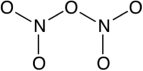
(Multiple Choice)
4.9/5 (76)
(76) Nitrite (NO2) is an important nutrient in the eutrophic zone of the ocean. Which of the following is the correct set of resonance structures for this ion? 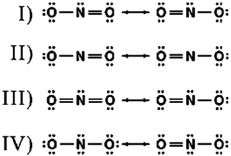
(Multiple Choice)
4.8/5 (86)
(86) When sulfur-containing fuels are burned, sulfur trioxide (SO3) is formed in the atmosphere and contributes to acid rain (sulfur trioxide plus water produces sulfuric acid). How many resonance structures are there for SO3 when each atom satisfies the octet rule?
(Multiple Choice)
4.7/5 (65)
(65) Draw the Lewis structure for the oxalate anion, C2O42. Include all reasonable resonance structures.
(Essay)
4.9/5 (82)
(82) In which bond does the Cl atom have the highest electron density?
(Multiple Choice)
5.0/5 (72)
(72) How many shared electron pairs are there in the Lewis structure of CN?
(Multiple Choice)
4.8/5 (89)
(89) Which statements correctly describe a polar covalent bond?
I. Electrons are shared but not equally by the two atoms.
II. One atom has a small negative charge, and the other atom has a small positive charge.
III. The bond dipole is zero.
IV. One or more electrons are transferred from one atom to a second atom.
(Multiple Choice)
4.8/5 (95)
(95) What is the formal charge of the nitrogen atom in hydrogen cyanide (HCN)?
(Multiple Choice)
4.8/5 (77)
(77) Hydrogen isocyanide (HNC) and hydrogen cyanide (HCN) have the same elemental composition. Is one structure more stable than the other? Support your answer with the Lewis structures and formal charges assigned to each atom for these molecules.
(Essay)
4.7/5 (89)
(89) In which bond does the H atom have the highest electron density?
(Multiple Choice)
4.9/5 (70)
(70) Which of the following properties is typically used to identify whether a bond is polar, nonpolar, or ionic?
(Multiple Choice)
4.8/5 (78)
(78) Which of the following pairs of Lewis structures are not resonance structures of one another? 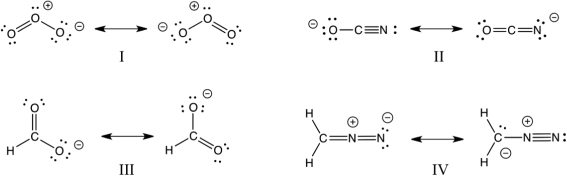
(Multiple Choice)
4.9/5 (75)
(75) 
Filters
- Essay(0)
- Multiple Choice(0)
- Short Answer(0)
- True False(0)
- Matching(0)