



 Chat with AI
Exam 8: Chemical Bonds: What Makes a Gas a Greenhouse Gas

Exam 1: Matter and Energy: The Origin of the Universe103 Questions
Exam 2: Atoms, Ions, and Molecules: Matter Starts Here144 Questions
Exam 3: Stoichiometry: Mass, Formulas, and Reactions141 Questions
Exam 4: Solution Chemistry: The Hydrosphere148 Questions
Exam 5: Thermochemistry: Energy Changes in Reactions139 Questions
Exam 6: Properties of Gases: The Air We Breathe164 Questions
Exam 7: A Quantum Model of Atoms: Waves and Particles166 Questions
Exam 8: Chemical Bonds: What Makes a Gas a Greenhouse Gas156 Questions
Exam 9: Molecular Geometry: Shape Determines Function188 Questions
Exam 10: Intermolecular Forces: The Uniqueness of Water165 Questions
Exam 11: Solutions: Properties and Behavior150 Questions
Exam 12: Solids: Crystals, Alloys, and Polymers130 Questions
Exam 13: Chemical Kinetics: Reactions in the Atmosphere155 Questions
Exam 14: Chemical Equilibrium: How Much Product Does a Reaction Really Make111 Questions
Exam 15: Acidbase Equilibria: Proton Transfer in Biological Systems122 Questions
Exam 16: Additional Aqueous Equilibria: Chemistry and the Oceans127 Questions
Exam 17: Thermodynamics: Spontaneous and Nonspontaneous Reactions and Processes186 Questions
Exam 18: Electrochemistry: The Quest for Clean Energy167 Questions
Exam 19: Nuclear Chemistry: Applications to Energy and Medicine165 Questions
Exam 20: Organic and Biological Molecules: the Compounds of Life168 Questions
Exam 21: The Main Group Elements: Life and the Periodic Table96 Questions
Exam 22: Transition Metals: Biological and Medical Applications142 Questions
Select questions type


Which of these statements correctly describes the use of formal charge in choosing between possible Lewis structures to describe a molecule?
I. Formal charge on all the atoms should be zero, or at least the smallest possible value.
II. The sum of the formal charges on all the atoms should equal the charge on the molecule
Or ion.
III. The formal charge on an atom is not affected by the electronegativity of the atom.
IV. In an anion containing nitrogen and oxygen, the Lewis structures with a negative charge
On the nitrogen will contribute the most to the description of the bonding.
(Multiple Choice)
4.9/5  (76)
(76) Describe the relationship between bond order, bond energy, and bond length.
(Essay)
5.0/5 (78)
(78) In comparing the length and strength of single, double, and triple bonds between the same pair of atoms, the ________
(Multiple Choice)
4.7/5 (89)
(89) Using the positions of the atoms in the periodic table, identify which of the following bonds is expected to be most polar: CF, ClF, SiF, SF, OF.
(Short Answer)
4.8/5 (96)
(96) Trends in electronegativity are primarily a result of ________
(Multiple Choice)
5.0/5 (74)
(74) Which of the following elements contains the fewest number of valence electrons?
(Multiple Choice)
4.9/5 (80)
(80) How many total equivalent Lewis structures are needed to describe the cyclic compound benzene, C6H6? 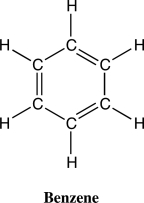
(Multiple Choice)
4.9/5 (81)
(81) Draw three reasonable Lewis structures for the thiocarbonate ion (SCO22). Identify the most stable form by using the concept of formal charges. Explain the reason for your choice.
(Essay)
4.9/5 (79)
(79) An Si-Si linkage would be classified as what type of bonding interaction?
(Multiple Choice)
4.8/5 (90)
(90) How many total shared electrons are there in the Lewis structure of CS2?
(Multiple Choice)
4.7/5 (78)
(78) Draw the Lewis structure for the carbonate anion, CO32. Include resonance structures if necessary.
(Essay)
4.9/5 (67)
(67) Which statement A-D regarding formal charge is not correct?
(Multiple Choice)
4.9/5 (82)
(82) Which statement provides the best description of an ionic bond?
(Multiple Choice)
4.8/5 (76)
(76) How many valence electrons are there in a correctly drawn Lewis structure for formamide, HCONH2?
(Multiple Choice)
4.9/5 (89)
(89) Identify which of the molecules below violates the octet rule.
I.ClF3
II. SF4
III.PCl3
IV. SOCl2
(Multiple Choice)
4.8/5 (73)
(73) In a chemical reaction, bonds are broken and new bonds are formed. Which one of the following statements regarding bond energies is correct?
(Multiple Choice)
4.8/5 (79)
(79) In the following molecule, identify a) the strongest bond in the molecule and b) the longest bond in the molecule. 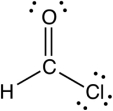
(Essay)
4.8/5 (78)
(78) 
Filters
- Essay(0)
- Multiple Choice(0)
- Short Answer(0)
- True False(0)
- Matching(0)