



 Chat with AI
Exam 8: Chemical Bonds: What Makes a Gas a Greenhouse Gas

Exam 1: Matter and Energy: The Origin of the Universe103 Questions
Exam 2: Atoms, Ions, and Molecules: Matter Starts Here144 Questions
Exam 3: Stoichiometry: Mass, Formulas, and Reactions141 Questions
Exam 4: Solution Chemistry: The Hydrosphere148 Questions
Exam 5: Thermochemistry: Energy Changes in Reactions139 Questions
Exam 6: Properties of Gases: The Air We Breathe164 Questions
Exam 7: A Quantum Model of Atoms: Waves and Particles166 Questions
Exam 8: Chemical Bonds: What Makes a Gas a Greenhouse Gas156 Questions
Exam 9: Molecular Geometry: Shape Determines Function188 Questions
Exam 10: Intermolecular Forces: The Uniqueness of Water165 Questions
Exam 11: Solutions: Properties and Behavior150 Questions
Exam 12: Solids: Crystals, Alloys, and Polymers130 Questions
Exam 13: Chemical Kinetics: Reactions in the Atmosphere155 Questions
Exam 14: Chemical Equilibrium: How Much Product Does a Reaction Really Make111 Questions
Exam 15: Acidbase Equilibria: Proton Transfer in Biological Systems122 Questions
Exam 16: Additional Aqueous Equilibria: Chemistry and the Oceans127 Questions
Exam 17: Thermodynamics: Spontaneous and Nonspontaneous Reactions and Processes186 Questions
Exam 18: Electrochemistry: The Quest for Clean Energy167 Questions
Exam 19: Nuclear Chemistry: Applications to Energy and Medicine165 Questions
Exam 20: Organic and Biological Molecules: the Compounds of Life168 Questions
Exam 21: The Main Group Elements: Life and the Periodic Table96 Questions
Exam 22: Transition Metals: Biological and Medical Applications142 Questions
Select questions type


Which statement provides the best description of a covalent bond?
(Multiple Choice)
4.9/5  (78)
(78) Which of the following is a correct Lewis structure for HCO3?
(Multiple Choice)
4.9/5 (90)
(90) Which of the following single bonds would you predict to be the longest, based on atom position in the periodic table?
(Multiple Choice)
4.8/5 (77)
(77) Indicate which of the following molecules has four shared electrons.
(Multiple Choice)
4.9/5 (88)
(88) In general, resonance ________ electrons and ________ molecules.
(Multiple Choice)
5.0/5 (77)
(77) Which group of elements is listed in order of increasing electronegativity?
(Multiple Choice)
4.9/5 (89)
(89) Which of the following molecules does not contain a triple bond?
(Multiple Choice)
4.8/5 (76)
(76) Rank the following species in order of increasing nitrogen-oxygen bond energy: NO, NO2, NO3.
(Essay)
4.9/5 (81)
(81) In addition to CO2, which of the gases in the atmosphere listed below can contribute to the greenhouse effect?
(Multiple Choice)
4.7/5 (88)
(88) Which of the following gases in the atmosphere does not contribute to the greenhouse effect?
(Multiple Choice)
4.8/5 (74)
(74) How many total bonding pairs of electrons exist in a single resonance structure for NO3?
(Multiple Choice)
4.8/5 (98)
(98) Explain why multiple Lewis structures are needed to describe some molecules.
(Essay)
4.9/5 (89)
(89) Do the vibrations of N2 and O2 molecules in the atmosphere absorb infrared radiation and contribute to the greenhouse effect? Explain why or why not.
(Essay)
4.8/5 (84)
(84) Which of the following is an example of a nonpolar covalent bond?
(Multiple Choice)
4.7/5 (71)
(71) Which structure for dinitrogen sulfide (NNS or NSN) is the more stable?
(Multiple Choice)
4.7/5 (66)
(66) What is the formal charge of each atom (from left to right) in the following resonance structure of SN2? 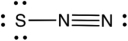
(Multiple Choice)
4.7/5 (76)
(76) 
Filters
- Essay(0)
- Multiple Choice(0)
- Short Answer(0)
- True False(0)
- Matching(0)