



 Chat with AI
Exam 8: Chemical Bonds: What Makes a Gas a Greenhouse Gas

Exam 1: Matter and Energy: The Origin of the Universe103 Questions
Exam 2: Atoms, Ions, and Molecules: Matter Starts Here144 Questions
Exam 3: Stoichiometry: Mass, Formulas, and Reactions141 Questions
Exam 4: Solution Chemistry: The Hydrosphere148 Questions
Exam 5: Thermochemistry: Energy Changes in Reactions139 Questions
Exam 6: Properties of Gases: The Air We Breathe164 Questions
Exam 7: A Quantum Model of Atoms: Waves and Particles166 Questions
Exam 8: Chemical Bonds: What Makes a Gas a Greenhouse Gas156 Questions
Exam 9: Molecular Geometry: Shape Determines Function188 Questions
Exam 10: Intermolecular Forces: The Uniqueness of Water165 Questions
Exam 11: Solutions: Properties and Behavior150 Questions
Exam 12: Solids: Crystals, Alloys, and Polymers130 Questions
Exam 13: Chemical Kinetics: Reactions in the Atmosphere155 Questions
Exam 14: Chemical Equilibrium: How Much Product Does a Reaction Really Make111 Questions
Exam 15: Acidbase Equilibria: Proton Transfer in Biological Systems122 Questions
Exam 16: Additional Aqueous Equilibria: Chemistry and the Oceans127 Questions
Exam 17: Thermodynamics: Spontaneous and Nonspontaneous Reactions and Processes186 Questions
Exam 18: Electrochemistry: The Quest for Clean Energy167 Questions
Exam 19: Nuclear Chemistry: Applications to Energy and Medicine165 Questions
Exam 20: Organic and Biological Molecules: the Compounds of Life168 Questions
Exam 21: The Main Group Elements: Life and the Periodic Table96 Questions
Exam 22: Transition Metals: Biological and Medical Applications142 Questions
Select questions type


Draw the Lewis structure for the nitrate anion, NO3. Include resonance structures if necessary.
(Essay)
4.9/5  (80)
(80) Sodium nitrite (NaNO2) is often used in meat curing because it prevents bacterial growth. How many major resonance contributing Lewis structures can be drawn for the nitrite anion (NO2) ?
(Multiple Choice)
4.8/5 (67)
(67) Which of the following bonds is primarily ionic? Element
Electronegativity
C
2)5
O
3)5
H
2)1
Li
1)0
(Multiple Choice)
4.8/5 (75)
(75) Identify which of the following bonds is considered to be ionic: CO, CaCl, SN, and SiO.
Explain why.
(Essay)
4.8/5 (89)
(89) Which of the following molecules cannot absorb infrared radiation?
(Multiple Choice)
4.8/5 (79)
(79) What types of bonds form between the chlorine and oxygen atoms of the chlorite ion (ClO2) to minimize the formal charge?
(Multiple Choice)
4.8/5 (80)
(80) Which of the following represents the best Lewis structure for dinitrogen oxide? Support your answer with the Lewis structures and formal charges assigned to each atom for these molecules. 
(Essay)
4.8/5 (79)
(79) Two reasonable Lewis structures for sulfurous acid (H2SO3) are given below. Add the formal charges to each atom. 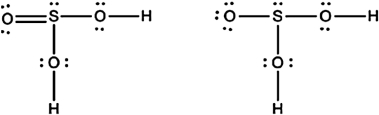
(Essay)
4.9/5 (68)
(68) Based on consideration of formal charges, which of the following is the most stable Lewis structure for the azide ion (N3)?
(Multiple Choice)
4.9/5 (78)
(78) In going down a column in the periodic table, the electronegativity ________
(Multiple Choice)
4.9/5 (78)
(78) Which type of bonding involves the sharing of valence electrons by two atoms?
(Multiple Choice)
4.8/5 (72)
(72) Which of the following ions does not have a complete valence-shell octet?
(Multiple Choice)
4.8/5 (83)
(83) Which diatomic molecule has the least number of valence electrons?
(Multiple Choice)
4.8/5 (85)
(85) What is the formal charge on the central nitrogen atom in dinitrogen sulfide (N2S)?
(Multiple Choice)
4.8/5 (95)
(95) Not all the vibrations of carbon dioxide can absorb infrared radiation because ________
(Multiple Choice)
4.9/5 (88)
(88) Which one of the following molecules or ions contains an exception to the octet rule?
(Multiple Choice)
5.0/5 (83)
(83) Which of the following molecules contains an exception to the octet rule?
(Multiple Choice)
4.8/5 (81)
(81) How many lone-pair electrons are on the central atom of xenon tetrachloride (XeCl4)?
(Multiple Choice)
4.9/5 (82)
(82) 
Filters
- Essay(0)
- Multiple Choice(0)
- Short Answer(0)
- True False(0)
- Matching(0)