



 Chat with AI
Exam 11: Costs and Profit Maximization Under Competition

Exam 1: The Big Ideas253 Questions
Exam 2: The Power of Trade and Comparative239 Questions
Exam 3: Supply and Demand249 Questions
Exam 4: Equilibrium256 Questions
Exam 5: Elasticity and Its Applications271 Questions
Exam 6: Taxes and Subsidies225 Questions
Exam 7: The Price System275 Questions
Exam 8: Price Ceilings and Floors327 Questions
Exam 9: International Trade195 Questions
Exam 10: Externalities- When the Price Is Not Right273 Questions
Exam 11: Costs and Profit Maximization Under Competition217 Questions
Exam 12: Competition and the Invisible Hand144 Questions
Exam 13: Monopoly233 Questions
Exam 14: Price Discrimination262 Questions
Exam 15: Oligopoly and Game Theory218 Questions
Exam 16: Competing for Monopoly160 Questions
Exam 17: Monopolistic Competition and Advertising113 Questions
Exam 18: Labor Markets262 Questions
Exam 19: Public Goods and the Tragedy of the Commons244 Questions
Exam 20: Political Economy and Public Choice306 Questions
Exam 21: Economics, Ethics, and Public Policy241 Questions
Exam 22: Managing Incentives263 Questions
Exam 23: Stock Markets and Personal Finance271 Questions
Exam 24: Price Discrimination151 Questions
Exam 25: Consumer Choice145 Questions
Select questions type


Use the following to answer questions:
Figure: Profits and Competitive Firms 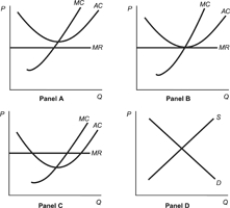 -(Figure: Profits and Competitive Firms) Refer to the four panels in the figure. Which panel shows a competitive firm making positive economic profits?
 (Multiple Choice)
4.7/5  (85)
(85) Firms in competitive industries should adhere to: 1) expanding output if MR > MC, and 2) reducing output if MC > MR.
(True/False)
4.8/5 (79)
(79) Table: Constant Cost Industries 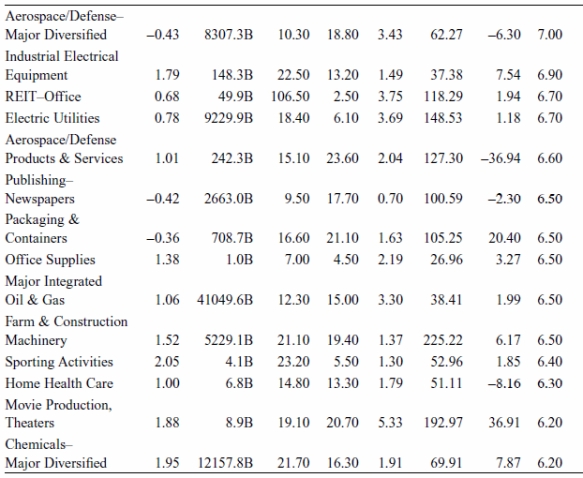 As of July 2011, oil companies had a 6.5 percent profit margin (for each dollar of sales, 6.5 cents was profit), ranking 131 (profit margin is the far right column). Other industries making the same profit margin include packaging and containers, office supplies, farm and construction, and newspapers. If these profits are typical, what does this similar profit margin across very different industries suggest about oil companies' profits?
 (Multiple Choice)
4.9/5 (82)
(82) Graphically illustrate how a constant cost industry responds to an increase in demand in the short run and in the long run.
(Essay)
4.8/5 (81)
(81) Figure: Calculating Profits 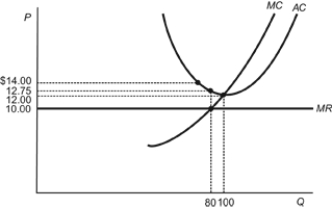 Refer to the figure that shows a representative firm in a perfectly competitive industry. Using the information provided in the figure answer the following questions.
a.
What is the total profit or loss that this firm is making? Show all your calculations.
b.
Will firms enter or exit the industry?
Refer to the figure that shows a representative firm in a perfectly competitive industry. Using the information provided in the figure answer the following questions.
a.
What is the total profit or loss that this firm is making? Show all your calculations.
b.
Will firms enter or exit the industry? (Essay)
4.8/5 (87)
(87) Figure: Profit Maximization 4 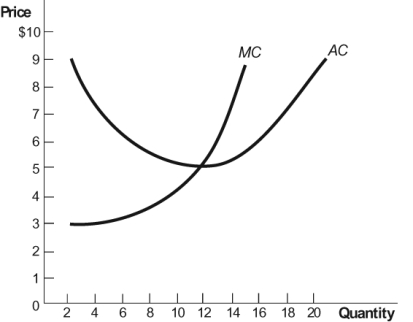 At the profit-maximizing level of output in this diagram, the firm's total revenue and total cost are ______ and ______, respectively.
 (Multiple Choice)
4.8/5 (54)
(54) Based on the premise that dogs are carnivores and thus should not eat grains, Natura Pet Products introduced the first brand of grain-free dog food called EVO in 2005. There were over 12 different manufacturers of grain-free dog food by 2009. Was Natura's EVO a profitable line of dog food in 2005? Since 2005, what has happened to the profitability of producing grain-free dog food?
(Essay)
4.7/5 (90)
(90) Suppose that Jennifer and Megan are both buying a beach vacation home, each with the same selling price. Megan is paying for the home by taking out a 30-year mortgage at an annual interest rate of 5%. Over the course of her mortgage, Megan will have paid $300,000 in interest alone. Jennifer is considering using an inheritance received and paying cash for the home. If the current annual market interest rate paid on investments is 6% (i.e., market annual rate of return is equal to 6%), then is Jennifer better off paying cash for her vacation home or taking out the same mortgage as Megan? Explain.
(Essay)
5.0/5 (83)
(83) Explicit costs incurred by firms include the firm's opportunity costs.
(True/False)
4.8/5 (82)
(82) Total profit for a given quantity of output can be calculated as:
(Multiple Choice)
4.8/5 (77)
(77) The competitive firm's demand curve is horizontal at the market price.
(True/False)
4.8/5 (77)
(77) Firms should exit the industry if average costs are greater than marginal costs.
(True/False)
4.9/5 (86)
(86) Draw a competitive firm in each of the following situations.
a. earning abnormal profits
b. making losses
c. Are either of the situations in (a) and (b) sustainable into the long run? If not, explain why and graphically demonstrate how the competitive firm is expected to behave in the long run.
(Essay)
4.8/5 (86)
(86) In their calculation of profit, accountants typically do not take into account:
(Multiple Choice)
5.0/5 (73)
(73) 
Filters
- Essay(0)
- Multiple Choice(0)
- Short Answer(0)
- True False(0)
- Matching(0)