



 Chat with AI
Exam 11: Costs and Profit Maximization Under Competition

Exam 1: The Big Ideas253 Questions
Exam 2: The Power of Trade and Comparative239 Questions
Exam 3: Supply and Demand249 Questions
Exam 4: Equilibrium256 Questions
Exam 5: Elasticity and Its Applications271 Questions
Exam 6: Taxes and Subsidies225 Questions
Exam 7: The Price System275 Questions
Exam 8: Price Ceilings and Floors327 Questions
Exam 9: International Trade195 Questions
Exam 10: Externalities- When the Price Is Not Right273 Questions
Exam 11: Costs and Profit Maximization Under Competition217 Questions
Exam 12: Competition and the Invisible Hand144 Questions
Exam 13: Monopoly233 Questions
Exam 14: Price Discrimination262 Questions
Exam 15: Oligopoly and Game Theory218 Questions
Exam 16: Competing for Monopoly160 Questions
Exam 17: Monopolistic Competition and Advertising113 Questions
Exam 18: Labor Markets262 Questions
Exam 19: Public Goods and the Tragedy of the Commons244 Questions
Exam 20: Political Economy and Public Choice306 Questions
Exam 21: Economics, Ethics, and Public Policy241 Questions
Exam 22: Managing Incentives263 Questions
Exam 23: Stock Markets and Personal Finance271 Questions
Exam 24: Price Discrimination151 Questions
Exam 25: Consumer Choice145 Questions
Select questions type


The long run is the period after all exit and entry has occurred.
(True/False)
4.9/5  (77)
(77) A firm should exit the industry if which of the following conditions apply?
(Multiple Choice)
4.8/5 (78)
(78) Industry clusters always cause part of the supply curve to be downward sloping.
(True/False)
4.7/5 (70)
(70) When there are many buyers and sellers of a good and the product sold is identical across firms,:
(Multiple Choice)
4.8/5 (87)
(87) The marginal cost curve may intersect the average cost curve anywhere on the curve that is less than the minimum point.
(True/False)
4.8/5 (86)
(86) Mike takes $100,000 out of his bank account, which pays a 5% annual interest rate, to build an oil well. An implicit cost of producing the oil well is $5,000, the foregone interest income.
(True/False)
4.9/5 (92)
(92) Stock market investors should ultimately focus on a company's:
(Multiple Choice)
4.8/5 (86)
(86) Firms should enter the industry if marginal revenue is greater than the total costs.
(True/False)
4.7/5 (86)
(86) A market becomes more competitive as there are ______ buyers and ______ sellers.
(Multiple Choice)
4.9/5 (91)
(91) Figure: Supply and Demand  The figure depicts a constant cost industry. What happens if there is an increase in demand?
 (Multiple Choice)
4.8/5 (71)
(71) A firm should always shut down if it is earning negative profits.
(True/False)
4.7/5 (57)
(57) In late November of 2010, a share of Microsoft sold for about $25 and a share of McDonald's sold for about $80. In late June of 2011, Microsoft shares were about $26 and McDonald's shares were about $85. If these two companies were the only choices available, what is your economic profit if you invest $400 in Microsoft?
(Multiple Choice)
5.0/5 (78)
(78) Figure: Representative Firm 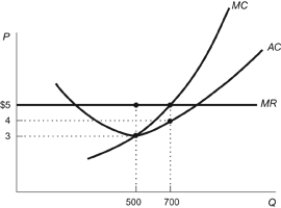 Refer to the figure that shows a representative firm in a perfectly competitive industry. Using the information provided in the figure answer the following questions.
a.
What is the total profit or loss that this firm is making? Show all your calculations.
b.
Will firms enter or exit the industry?
Refer to the figure that shows a representative firm in a perfectly competitive industry. Using the information provided in the figure answer the following questions.
a.
What is the total profit or loss that this firm is making? Show all your calculations.
b.
Will firms enter or exit the industry? (Essay)
4.7/5 (73)
(73) If your opportunity cost is a positive profit, accounting profit is always greater than economic profit.
(True/False)
5.0/5 (84)
(84) A firm's total profit is equal to the marginal cost of production multiplied by the quantity produced.
(True/False)
4.7/5 (103)
(103) Tom opens a sandwich shop; which of the following is NOT an economic cost (total cost) of running his business?
(Multiple Choice)
4.7/5 (70)
(70) 
Filters
- Essay(0)
- Multiple Choice(0)
- Short Answer(0)
- True False(0)
- Matching(0)