



 Chat with AI
Exam 12: Firms in Perfectly Competitive Markets

Exam 1: Economics: Foundations and Models142 Questions
Exam 2: Trade-Offs, comparative Advantage, and the Market System152 Questions
Exam 3: Where Prices Come From: the Interaction of Demand and Supply149 Questions
Exam 4: Economic Efficiency, government Price Setting, and Taxes137 Questions
Exam 5: Externalities, environmental Policy, and Public Goods139 Questions
Exam 6: Elasticity: The Responsiveness of Demand and Supply149 Questions
Exam 7: The Economics of Health Care117 Questions
Exam 8: Firms, the Stock Market, and Corporate Governance140 Questions
Exam 9: Comparative Advantage and the Gains From International Trade124 Questions
Exam 10: Consumer Choice and Behavioral Economics154 Questions
Exam 11: Technology, production, and Costs174 Questions
Exam 12: Firms in Perfectly Competitive Markets153 Questions
Exam 13: Monopolistic Competition: The Competitive Model in a More Realistic Setting137 Questions
Exam 14: Oligopoly: Firms in Less Competitive Markets129 Questions
Exam 15: Monopoly and Antitrust Policy148 Questions
Exam 16: Pricing Strategy134 Questions
Exam 17: The Markets for Labor and Other Factors of Production149 Questions
Exam 18: Public Choice, taxes, and the Distribution of Income134 Questions
Exam 19: GDP: Measuring Total Production and Income135 Questions
Exam 20: Unemployment and Inflation148 Questions
Exam 21: Economic Growth, the Financial System, and Business Cycles130 Questions
Exam 22: Long-Run Economic Growth: Sources and Policies134 Questions
Exam 23: Aggregate Expenditure and Output in the Short Run157 Questions
Exam 24: Aggregate Demand and Aggregate Supply Analysis145 Questions
Exam 25: Money, banks, and the Federal Reserve System144 Questions
Exam 26: Monetary Policy145 Questions
Exam 27: Fiscal Policy155 Questions
Exam 28: Inflation, unemployment, and Federal Reserve Policy135 Questions
Exam 29: Macroeconomics in an Open Economy145 Questions
Exam 30: The International Financial System139 Questions
Select questions type


Use a graph to show the demand,AVC,ATC,MC,and MR curves of a firm that should temporarily shut down in the short run.Identify the shutdown point on the graph.
(Essay)
4.8/5  (60)
(60) Max Shreck,an accountant,quit his $80,000-a-year job and bought an existing tattoo parlor from its previous owner,Sylvia Sidney.The lease has five years remaining and requires a monthly payment of $4,000.The lease
(Multiple Choice)
4.9/5 (75)
(75) Suppose there are economies of scale in the production of a specialized memory chip that is used in manufacturing microwaves.This suggests that the microwave industry is a decreasing-cost industry.
(True/False)
4.9/5 (75)
(75) In long-run perfectly competitive equilibrium,which of the following is false?
(Multiple Choice)
4.9/5 (91)
(91) In the short run,if price falls below a firm's minimum average total cost,the firm should shut down.
(True/False)
4.8/5 (73)
(73) How are market price,average revenue,and marginal revenue related for a perfectly competitive firm and why?
(Essay)
4.9/5 (79)
(79) Figure 12-6  Figure 12-6 shows cost and demand curves facing a profit-maximizing, perfectly competitive firm.
-Refer to Figure 12-6.At price P1,the firm would produce
Figure 12-6 shows cost and demand curves facing a profit-maximizing, perfectly competitive firm.
-Refer to Figure 12-6.At price P1,the firm would produce (Multiple Choice)
4.8/5 (82)
(82) Assume that after a banner year in U.S.farm exports in 2011,farmers are expected to break even in 2012.This means that at the quantity being produced in 2012,
(Multiple Choice)
4.7/5 (71)
(71) Figure 12-9 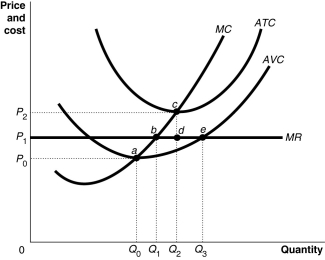 -Refer to Figure 12-9.Suppose the prevailing price is P1 and the firm is currently producing its loss-minimizing quantity.If the firm represented in the diagram continues to stay in business,in the long-run equilibrium,
 (Multiple Choice)
4.7/5 (95)
(95) Figure 12-5  Figure 12-5 shows cost and demand curves facing a typical firm in a constant-cost, perfectly competitive industry.
-Refer to Figure 12-5.If the market price is $20,what is the average profit at the profit-maximizing quantity?
Figure 12-5 shows cost and demand curves facing a typical firm in a constant-cost, perfectly competitive industry.
-Refer to Figure 12-5.If the market price is $20,what is the average profit at the profit-maximizing quantity? (Multiple Choice)
4.9/5 (85)
(85) Table 12-1
 Table 12-1 shows the short-run cost data of a perfectly competitive firm that produces plastic camera cases. Assume that output can only be increased in batches of 100 units.
-Refer to Table 12-1.What is the fixed cost of production?
Table 12-1 shows the short-run cost data of a perfectly competitive firm that produces plastic camera cases. Assume that output can only be increased in batches of 100 units.
-Refer to Table 12-1.What is the fixed cost of production? (Multiple Choice)
4.8/5 (77)
(77) Figure 12-4  Figure 12-4 shows the cost and demand curves for a profit-maximizing firm in a perfectly competitive market.
-Refer to Figure 12-4.If the market price is $30 and the firm is producing output,what is the amount of the firm's profit or loss?
Figure 12-4 shows the cost and demand curves for a profit-maximizing firm in a perfectly competitive market.
-Refer to Figure 12-4.If the market price is $30 and the firm is producing output,what is the amount of the firm's profit or loss? (Multiple Choice)
4.8/5 (74)
(74) What is a long-run supply curve? What does a long-run supply curve look like on a perfectly competitive market graph?
(Essay)
4.8/5 (82)
(82) Figure 12-7  -Refer to Figure 12-7.Suppose the prevailing price is $20 and the firm is currently producing 1,350 units.In the long-run equilibrium,the firm represented in the diagram
 (Multiple Choice)
4.9/5 (70)
(70) If the market price is $25 in a perfectly competitive market,the marginal revenue from selling the fifth unit is
(Multiple Choice)
4.8/5 (92)
(92) Without government subsidization,the conversion of farmland in the United Kingdom from conventional to organic production will generally cause a farmer's
(Multiple Choice)
4.7/5 (72)
(72) Figure 12-2  -Refer to Figure 12-2.What is the amount of profit if the firm produces Q2 units?
 (Multiple Choice)
4.9/5 (89)
(89) Max Shreck,an accountant,quit his $80,000-a-year job and bought an existing tattoo parlor from its previous owner,Sylvia Sidney.The lease has five years remaining and requires a monthly payment of $4,000.Max's explicit cost amounts to $3,000 per month more than his revenue.Should Max continue operating his business?
(Multiple Choice)
4.8/5 (80)
(80) Assume that price is greater than average variable cost.If a perfectly competitive firm is producing at an output where price is $114 and the marginal cost is $102,then the firm is probably producing more than its profit-maximizing quantity.
(True/False)
4.9/5 (84)
(84) 
Filters
- Essay(0)
- Multiple Choice(0)
- Short Answer(0)
- True False(0)
- Matching(0)