



 Chat with AI
Exam 12: Firms in Perfectly Competitive Markets

Exam 1: Economics: Foundations and Models142 Questions
Exam 2: Trade-Offs, comparative Advantage, and the Market System152 Questions
Exam 3: Where Prices Come From: the Interaction of Demand and Supply149 Questions
Exam 4: Economic Efficiency, government Price Setting, and Taxes137 Questions
Exam 5: Externalities, environmental Policy, and Public Goods139 Questions
Exam 6: Elasticity: The Responsiveness of Demand and Supply149 Questions
Exam 7: The Economics of Health Care117 Questions
Exam 8: Firms, the Stock Market, and Corporate Governance140 Questions
Exam 9: Comparative Advantage and the Gains From International Trade124 Questions
Exam 10: Consumer Choice and Behavioral Economics154 Questions
Exam 11: Technology, production, and Costs174 Questions
Exam 12: Firms in Perfectly Competitive Markets153 Questions
Exam 13: Monopolistic Competition: The Competitive Model in a More Realistic Setting137 Questions
Exam 14: Oligopoly: Firms in Less Competitive Markets129 Questions
Exam 15: Monopoly and Antitrust Policy148 Questions
Exam 16: Pricing Strategy134 Questions
Exam 17: The Markets for Labor and Other Factors of Production149 Questions
Exam 18: Public Choice, taxes, and the Distribution of Income134 Questions
Exam 19: GDP: Measuring Total Production and Income135 Questions
Exam 20: Unemployment and Inflation148 Questions
Exam 21: Economic Growth, the Financial System, and Business Cycles130 Questions
Exam 22: Long-Run Economic Growth: Sources and Policies134 Questions
Exam 23: Aggregate Expenditure and Output in the Short Run157 Questions
Exam 24: Aggregate Demand and Aggregate Supply Analysis145 Questions
Exam 25: Money, banks, and the Federal Reserve System144 Questions
Exam 26: Monetary Policy145 Questions
Exam 27: Fiscal Policy155 Questions
Exam 28: Inflation, unemployment, and Federal Reserve Policy135 Questions
Exam 29: Macroeconomics in an Open Economy145 Questions
Exam 30: The International Financial System139 Questions
Select questions type


Table 12-1
 Table 12-1 shows the short-run cost data of a perfectly competitive firm that produces plastic camera cases. Assume that output can only be increased in batches of 100 units.
-Refer to Table 12-1.The firm will not produce in the short run if the output price falls below
Table 12-1 shows the short-run cost data of a perfectly competitive firm that produces plastic camera cases. Assume that output can only be increased in batches of 100 units.
-Refer to Table 12-1.The firm will not produce in the short run if the output price falls below (Multiple Choice)
4.8/5  (76)
(76) Figure 12-12 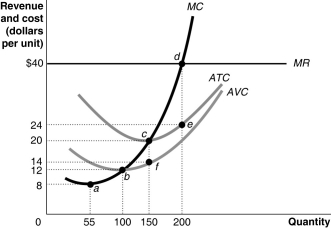 -Use the figure above to answer the following questions.
a.How can you determine that the figure represents a graph of a perfectly competitive firm? Be specific; indicate which curve gives you the information and how you use this information to arrive at your conclusion.
b.What is the market price?
c.What is the profit-maximizing output?
d.What is total revenue at the profit-maximizing output?
e.What is the total cost at the profit-maximizing output?
f.What is the profit or loss at the profit-maximizing output?
g.What is the firm's total fixed cost?
h.What is the total variable cost?
i.Identify the firm's short-run supply curve.
j.Is the industry in a long-run equilibrium?
k.If it is not in long-run equilibrium,what will happen in this industry to restore long-run equilibrium?
l.In long-run equilibrium,what is the firm's profit maximizing quantity?
-Use the figure above to answer the following questions.
a.How can you determine that the figure represents a graph of a perfectly competitive firm? Be specific; indicate which curve gives you the information and how you use this information to arrive at your conclusion.
b.What is the market price?
c.What is the profit-maximizing output?
d.What is total revenue at the profit-maximizing output?
e.What is the total cost at the profit-maximizing output?
f.What is the profit or loss at the profit-maximizing output?
g.What is the firm's total fixed cost?
h.What is the total variable cost?
i.Identify the firm's short-run supply curve.
j.Is the industry in a long-run equilibrium?
k.If it is not in long-run equilibrium,what will happen in this industry to restore long-run equilibrium?
l.In long-run equilibrium,what is the firm's profit maximizing quantity? (Essay)
4.8/5 (75)
(75) Figure 12-5  Figure 12-5 shows cost and demand curves facing a typical firm in a constant-cost, perfectly competitive industry.
-Refer to Figure 12-5.If the market price is $20,what is the firm's profit-maximizing output?
Figure 12-5 shows cost and demand curves facing a typical firm in a constant-cost, perfectly competitive industry.
-Refer to Figure 12-5.If the market price is $20,what is the firm's profit-maximizing output? (Multiple Choice)
4.8/5 (70)
(70) A perfectly competitive firm produces 3,000 units of a good at a total cost of $36,000.The fixed cost of production is $20,000.The price of each good is $10.Should the firm continue to produce in the short run?
(Multiple Choice)
4.8/5 (86)
(86) Both buyers and sellers are price takers in a perfectly competitive market because
(Multiple Choice)
4.8/5 (71)
(71) Suppose the equilibrium price in a perfectly competitive industry is $15 and a firm in the industry charges $21.Which of the following will happen?
(Multiple Choice)
4.9/5 (93)
(93) Writing in the New York Times on the technology boom of the late 1990s,Michael Lewis argues,"The sad truth,for investors,seems to be that most of the benefits of new technologies are passed right through to consumers free of charge." What does Lewis means by the benefits of new technology being "passed right through to consumers free of charge"?
(Multiple Choice)
4.9/5 (75)
(75) Figure 12-5
Figure 12-5 shows cost and demand curves facing a typical firm in a constant-cost, perfectly competitive industry.
-Refer to Figure 12-5.What is the amount of the firm's fixed cost of production?
Figure 12-5 shows cost and demand curves facing a typical firm in a constant-cost, perfectly competitive industry.
-Refer to Figure 12-5.What is the amount of the firm's fixed cost of production? (Multiple Choice)
4.8/5 (85)
(85) Table 12-1
Table 12-1 shows the short-run cost data of a perfectly competitive firm that produces plastic camera cases. Assume that output can only be increased in batches of 100 units.
-Refer to Table 12-1.If the market price of each camera case is $8 and the firm maximizes profit,what is the amount of the firm's profit or loss?
Table 12-1 shows the short-run cost data of a perfectly competitive firm that produces plastic camera cases. Assume that output can only be increased in batches of 100 units.
-Refer to Table 12-1.If the market price of each camera case is $8 and the firm maximizes profit,what is the amount of the firm's profit or loss? (Multiple Choice)
4.8/5 (70)
(70) Assume that the tuna fishing industry is perfectly competitive.Which of the following best characterizes the industry if,as demand for tuna increases,fishing boats have to go farther into the ocean to harvest tuna?
(Multiple Choice)
4.9/5 (81)
(81) An increase in a firm's fixed cost will not change the firm's profit-maximizing output in the short run.
(True/False)
4.9/5 (67)
(67) Figure 12-3 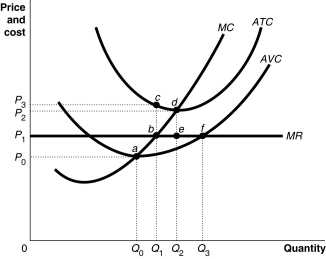 -Refer to Figure 12-3.Suppose the prevailing price is P1 and the firm is currently producing its loss-minimizing quantity.Identify the area that represents the loss.
 (Multiple Choice)
4.9/5 (70)
(70) Figure 12-11 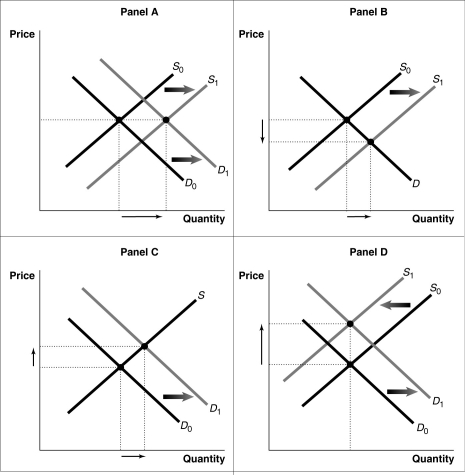 -Refer to Figure 12-11.Suppose a typical firm in a perfectly competitive market is earning economic profits in the short run.Which of the diagrams in the figure depicts what happens to in the industry as it transitions to along run equilibrium?
 (Multiple Choice)
4.9/5 (70)
(70) Consider the market for wheat which is a perfectly competitive market.Is the market demand curve the same as the demand curve facing an individual producer? If not,explain how and why they are different? Illustrate your answer graphically.
(Essay)
4.8/5 (81)
(81) If,for a given output level,a perfectly competitive firm's price is less than its average variable cost,the firm
(Multiple Choice)
4.7/5 (67)
(67) Figure 12-2  -Refer to Figure 12-2.Suppose the firm is currently producing Q2 units.What happens if it expands output to Q3 units?
 (Multiple Choice)
4.8/5 (90)
(90) 
Filters
- Essay(0)
- Multiple Choice(0)
- Short Answer(0)
- True False(0)
- Matching(0)