



 Chat with AI
Exam 15: Monopoly and Antitrust Policy

Exam 1: Economics: Foundations and Models142 Questions
Exam 2: Trade-Offs, comparative Advantage, and the Market System152 Questions
Exam 3: Where Prices Come From: the Interaction of Demand and Supply149 Questions
Exam 4: Economic Efficiency, government Price Setting, and Taxes137 Questions
Exam 5: Externalities, environmental Policy, and Public Goods139 Questions
Exam 6: Elasticity: The Responsiveness of Demand and Supply149 Questions
Exam 7: The Economics of Health Care117 Questions
Exam 8: Firms, the Stock Market, and Corporate Governance140 Questions
Exam 9: Comparative Advantage and the Gains From International Trade124 Questions
Exam 10: Consumer Choice and Behavioral Economics154 Questions
Exam 11: Technology, production, and Costs174 Questions
Exam 12: Firms in Perfectly Competitive Markets153 Questions
Exam 13: Monopolistic Competition: The Competitive Model in a More Realistic Setting137 Questions
Exam 14: Oligopoly: Firms in Less Competitive Markets129 Questions
Exam 15: Monopoly and Antitrust Policy148 Questions
Exam 16: Pricing Strategy134 Questions
Exam 17: The Markets for Labor and Other Factors of Production149 Questions
Exam 18: Public Choice, taxes, and the Distribution of Income134 Questions
Exam 19: GDP: Measuring Total Production and Income135 Questions
Exam 20: Unemployment and Inflation148 Questions
Exam 21: Economic Growth, the Financial System, and Business Cycles130 Questions
Exam 22: Long-Run Economic Growth: Sources and Policies134 Questions
Exam 23: Aggregate Expenditure and Output in the Short Run157 Questions
Exam 24: Aggregate Demand and Aggregate Supply Analysis145 Questions
Exam 25: Money, banks, and the Federal Reserve System144 Questions
Exam 26: Monetary Policy145 Questions
Exam 27: Fiscal Policy155 Questions
Exam 28: Inflation, unemployment, and Federal Reserve Policy135 Questions
Exam 29: Macroeconomics in an Open Economy145 Questions
Exam 30: The International Financial System139 Questions
Select questions type


Table 15-2
 Shakti Inc. has been granted a patent for its Arnica toothache balm. Table 15-2 shows the demand and the total cost schedule for the firm.
-Refer to Table 15-2.What is Shakti's profit-maximizing output?
Shakti Inc. has been granted a patent for its Arnica toothache balm. Table 15-2 shows the demand and the total cost schedule for the firm.
-Refer to Table 15-2.What is Shakti's profit-maximizing output? (Multiple Choice)
5.0/5  (86)
(86) A monopoly is defined as a firm that has the largest market share in an industry.
(True/False)
4.9/5 (82)
(82) For which of the following firms is patent protection of vital importance?
(Multiple Choice)
4.9/5 (75)
(75) Figure 15-6  -Refer to Figure 15-6.What is the area that represents producer surplus under a monopoly?
 (Multiple Choice)
4.7/5 (78)
(78) Figure 15-5  Figure 15-5 shows the demand and cost curves for a monopolist.
-Refer to Figure 15-5.At the profit-maximizing quantity,what is the difference between the monopoly's price and the marginal cost of production?
Figure 15-5 shows the demand and cost curves for a monopolist.
-Refer to Figure 15-5.At the profit-maximizing quantity,what is the difference between the monopoly's price and the marginal cost of production? (Multiple Choice)
4.9/5 (85)
(85) Most pharmaceutical firms selling prescription drugs continue to earn economic profits long after the patents on the prescription drugs expire because they have established a strong foothold in the market.
(True/False)
4.9/5 (68)
(68) What gives rise to a natural monopoly? How do consumers benefit from a natural monopoly?
(Essay)
4.8/5 (74)
(74) Figure 15-9  Figure 15-9 shows the cost and demand curves for the Erickson Power Company.
-Refer to Figure 15-9.Why won't regulators require that Erickson Power produce the economically efficient output level?
Figure 15-9 shows the cost and demand curves for the Erickson Power Company.
-Refer to Figure 15-9.Why won't regulators require that Erickson Power produce the economically efficient output level? (Multiple Choice)
4.9/5 (91)
(91) Holding everything else constant,government approval of horizontal mergers is more likely to be granted if the "market" that firms are in are broadly defined rather than narrowly defined.
(True/False)
4.9/5 (80)
(80) Figure 15-7 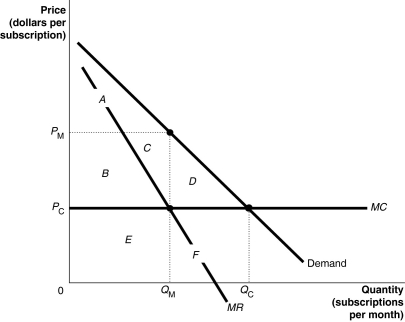 In 2011, Verizon was granted permission to enter the market for cable TV in Upstate New York, ending the virtual monopoly that Time Warner Cable had in most local communities in the region. Figure 15-7 shows the cable television market in Upstate New York.
-Refer to Figure 15-7.What is the size of the deadweight loss prior to Verizon entering the market and what happens to this deadweight loss after Verizon does enter the market?
In 2011, Verizon was granted permission to enter the market for cable TV in Upstate New York, ending the virtual monopoly that Time Warner Cable had in most local communities in the region. Figure 15-7 shows the cable television market in Upstate New York.
-Refer to Figure 15-7.What is the size of the deadweight loss prior to Verizon entering the market and what happens to this deadweight loss after Verizon does enter the market? (Multiple Choice)
4.7/5 (84)
(84) a.What is the difference between a horizontal merger and a vertical merger?
b.Give an example of each type of merger.
c.Could a horizontal merger be welfare improving?
(Essay)
4.7/5 (80)
(80) Table 15-1
 A monopoly producer of foreign language translation software faces a demand and cost structure as given in Table 15-1.
-Refer to Table 15-1.What is the marginal revenue from the sale of the 12th unit?
A monopoly producer of foreign language translation software faces a demand and cost structure as given in Table 15-1.
-Refer to Table 15-1.What is the marginal revenue from the sale of the 12th unit? (Multiple Choice)
4.8/5 (82)
(82) Figure 15-5
Figure 15-5 shows the demand and cost curves for a monopolist.
-Refer to Figure 15-5.What is the economically efficient output level?
Figure 15-5 shows the demand and cost curves for a monopolist.
-Refer to Figure 15-5.What is the economically efficient output level? (Multiple Choice)
4.8/5 (82)
(82) In 2011,Microsoft filed a complaint with the European Commission accusing Google of taking steps to monopolize the Internet search engine business.Microsoft's primary complaint was that
(Multiple Choice)
4.7/5 (79)
(79) 
Filters
- Essay(0)
- Multiple Choice(0)
- Short Answer(0)
- True False(0)
- Matching(0)