



 Chat with AI
Exam 15: Monopoly and Antitrust Policy

Exam 1: Economics: Foundations and Models142 Questions
Exam 2: Trade-Offs, comparative Advantage, and the Market System152 Questions
Exam 3: Where Prices Come From: the Interaction of Demand and Supply149 Questions
Exam 4: Economic Efficiency, government Price Setting, and Taxes137 Questions
Exam 5: Externalities, environmental Policy, and Public Goods139 Questions
Exam 6: Elasticity: The Responsiveness of Demand and Supply149 Questions
Exam 7: The Economics of Health Care117 Questions
Exam 8: Firms, the Stock Market, and Corporate Governance140 Questions
Exam 9: Comparative Advantage and the Gains From International Trade124 Questions
Exam 10: Consumer Choice and Behavioral Economics154 Questions
Exam 11: Technology, production, and Costs174 Questions
Exam 12: Firms in Perfectly Competitive Markets153 Questions
Exam 13: Monopolistic Competition: The Competitive Model in a More Realistic Setting137 Questions
Exam 14: Oligopoly: Firms in Less Competitive Markets129 Questions
Exam 15: Monopoly and Antitrust Policy148 Questions
Exam 16: Pricing Strategy134 Questions
Exam 17: The Markets for Labor and Other Factors of Production149 Questions
Exam 18: Public Choice, taxes, and the Distribution of Income134 Questions
Exam 19: GDP: Measuring Total Production and Income135 Questions
Exam 20: Unemployment and Inflation148 Questions
Exam 21: Economic Growth, the Financial System, and Business Cycles130 Questions
Exam 22: Long-Run Economic Growth: Sources and Policies134 Questions
Exam 23: Aggregate Expenditure and Output in the Short Run157 Questions
Exam 24: Aggregate Demand and Aggregate Supply Analysis145 Questions
Exam 25: Money, banks, and the Federal Reserve System144 Questions
Exam 26: Monetary Policy145 Questions
Exam 27: Fiscal Policy155 Questions
Exam 28: Inflation, unemployment, and Federal Reserve Policy135 Questions
Exam 29: Macroeconomics in an Open Economy145 Questions
Exam 30: The International Financial System139 Questions
Select questions type


Figure 15-7 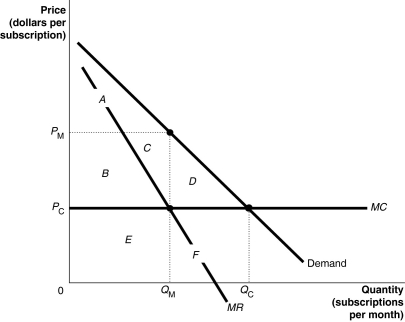 In 2011, Verizon was granted permission to enter the market for cable TV in Upstate New York, ending the virtual monopoly that Time Warner Cable had in most local communities in the region. Figure 15-7 shows the cable television market in Upstate New York.
-Refer to Figure 15-7.Following the entry of Verizon,the subscription price falls from PM to PC.What is the increase in consumer surplus as a result of this change?
In 2011, Verizon was granted permission to enter the market for cable TV in Upstate New York, ending the virtual monopoly that Time Warner Cable had in most local communities in the region. Figure 15-7 shows the cable television market in Upstate New York.
-Refer to Figure 15-7.Following the entry of Verizon,the subscription price falls from PM to PC.What is the increase in consumer surplus as a result of this change? (Multiple Choice)
4.8/5  (75)
(75) Which of the following statements is consistent with the views of Joseph Schumpeter?
(Multiple Choice)
4.8/5 (77)
(77) The De Beers Company,one of the longest-lived monopolies,is facing increasing competition.One source of competition comes from people who might resell their previously owned diamonds.Why is De Beers worried that people might resell their previously owned diamonds?
(Multiple Choice)
4.9/5 (70)
(70) Joe Santos owns the only pizza parlor in a small town that is also home to a McDonald's,a Taco Bell and a Kentucky Fried Chicken.Using a broad definition of a monopoly,Joe has a monopoly.
(True/False)
4.9/5 (82)
(82) How do the price and quantity of a monopoly compare to that of a perfectly competitive industry?
(Essay)
4.9/5 (74)
(74) Long-run economic profits would most likely exist in which market structure?
(Multiple Choice)
4.8/5 (75)
(75) Figure 15-3  Figure 15-3 shows the demand and cost curves for a monopolist.
-Refer to Figure 15-3.What is the amount of the monopoly's profit?
Figure 15-3 shows the demand and cost curves for a monopolist.
-Refer to Figure 15-3.What is the amount of the monopoly's profit? (Multiple Choice)
4.7/5 (76)
(76) Table 15-1
 A monopoly producer of foreign language translation software faces a demand and cost structure as given in Table 15-1.
-Refer to Table 15-1.What is the firm's profit-maximizing output and what is the price charged to sell this output?
A monopoly producer of foreign language translation software faces a demand and cost structure as given in Table 15-1.
-Refer to Table 15-1.What is the firm's profit-maximizing output and what is the price charged to sell this output? (Multiple Choice)
4.9/5 (87)
(87) Table 15-1
A monopoly producer of foreign language translation software faces a demand and cost structure as given in Table 15-1.
-Refer to Table 15-1.What is the amount of the firm's profit?
A monopoly producer of foreign language translation software faces a demand and cost structure as given in Table 15-1.
-Refer to Table 15-1.What is the amount of the firm's profit? (Multiple Choice)
4.8/5 (76)
(76) What happens to a monopoly's revenue when it sells more units of its product?
(Essay)
4.8/5 (74)
(74) The Ecke's family virtual monopoly on commercial poinsettia production by grafting together two varieties of the plant ended around 1996 when university researchers were able to independently make the same discovery.The Ecke family did not patent their grafting process.Would the Ecke's have been better off if they had patented their process of growing poinsettias?
(Multiple Choice)
4.8/5 (82)
(82) Compared to perfect competition,the consumer surplus in a monopoly
(Multiple Choice)
4.7/5 (93)
(93) Suppose that a perfectly competitive industry becomes a monopoly.What effect will this have on consumer surplus,producer surplus,and deadweight loss?
(Essay)
4.9/5 (83)
(83) Market power in the United States causes a huge loss of economic efficiency.
(True/False)
5.0/5 (77)
(77) Figure 15-3 Figure 15-3 shows the demand and cost curves for a monopolist.
-Refer to Figure 15-3.What is likely to happen to this monopoly in the long run?
Figure 15-3 shows the demand and cost curves for a monopolist.
-Refer to Figure 15-3.What is likely to happen to this monopoly in the long run? (Multiple Choice)
4.8/5 (69)
(69) Figure 15-6  -Refer to Figure 15-6.Compared to a perfectly competitive market,consumer surplus is lower in a monopoly by an amount equal to the
 (Multiple Choice)
4.8/5 (70)
(70) 
Filters
- Essay(0)
- Multiple Choice(0)
- Short Answer(0)
- True False(0)
- Matching(0)