



 Chat with AI
Exam 15: Monopoly and Antitrust Policy

Exam 1: Economics: Foundations and Models142 Questions
Exam 2: Trade-Offs, comparative Advantage, and the Market System152 Questions
Exam 3: Where Prices Come From: the Interaction of Demand and Supply149 Questions
Exam 4: Economic Efficiency, government Price Setting, and Taxes137 Questions
Exam 5: Externalities, environmental Policy, and Public Goods139 Questions
Exam 6: Elasticity: The Responsiveness of Demand and Supply149 Questions
Exam 7: The Economics of Health Care117 Questions
Exam 8: Firms, the Stock Market, and Corporate Governance140 Questions
Exam 9: Comparative Advantage and the Gains From International Trade124 Questions
Exam 10: Consumer Choice and Behavioral Economics154 Questions
Exam 11: Technology, production, and Costs174 Questions
Exam 12: Firms in Perfectly Competitive Markets153 Questions
Exam 13: Monopolistic Competition: The Competitive Model in a More Realistic Setting137 Questions
Exam 14: Oligopoly: Firms in Less Competitive Markets129 Questions
Exam 15: Monopoly and Antitrust Policy148 Questions
Exam 16: Pricing Strategy134 Questions
Exam 17: The Markets for Labor and Other Factors of Production149 Questions
Exam 18: Public Choice, taxes, and the Distribution of Income134 Questions
Exam 19: GDP: Measuring Total Production and Income135 Questions
Exam 20: Unemployment and Inflation148 Questions
Exam 21: Economic Growth, the Financial System, and Business Cycles130 Questions
Exam 22: Long-Run Economic Growth: Sources and Policies134 Questions
Exam 23: Aggregate Expenditure and Output in the Short Run157 Questions
Exam 24: Aggregate Demand and Aggregate Supply Analysis145 Questions
Exam 25: Money, banks, and the Federal Reserve System144 Questions
Exam 26: Monetary Policy145 Questions
Exam 27: Fiscal Policy155 Questions
Exam 28: Inflation, unemployment, and Federal Reserve Policy135 Questions
Exam 29: Macroeconomics in an Open Economy145 Questions
Exam 30: The International Financial System139 Questions
Select questions type


Figure 15-6  -Refer to Figure 15-6.What is the area that represents consumer surplus under a monopoly?
 (Multiple Choice)
4.8/5  (86)
(86) Figure 15-9  Figure 15-9 shows the cost and demand curves for the Erickson Power Company.
-Refer to Figure 15-9.What is the economically efficient output level and what is the price at that level?
Figure 15-9 shows the cost and demand curves for the Erickson Power Company.
-Refer to Figure 15-9.What is the economically efficient output level and what is the price at that level? (Multiple Choice)
4.9/5 (88)
(88) Figure 15-10 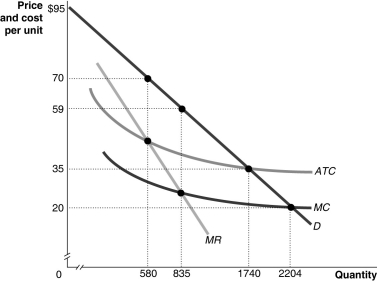 -Refer to Figure 15-10 to answer the following questions.
a.What quantity will this monopoly produce and what price will it charge?
b.Suppose the monopoly is regulated.If the regulatory agency wants to achieve economic efficiency,what price should it require the monopoly to charge?
c.To achieve economic efficiency,what quantity will the regulated monopoly produce?
d.Will the regulated monopoly make a profit if it charges the price that will achieve economic efficiency?
e.Suppose the government decides to regulate the monopoly by imposing a price ceiling of $35.What quantity will the monopoly produce and what price will the monopoly charge?
f.With the price ceiling of $35,what profit will the monopoly earn?
-Refer to Figure 15-10 to answer the following questions.
a.What quantity will this monopoly produce and what price will it charge?
b.Suppose the monopoly is regulated.If the regulatory agency wants to achieve economic efficiency,what price should it require the monopoly to charge?
c.To achieve economic efficiency,what quantity will the regulated monopoly produce?
d.Will the regulated monopoly make a profit if it charges the price that will achieve economic efficiency?
e.Suppose the government decides to regulate the monopoly by imposing a price ceiling of $35.What quantity will the monopoly produce and what price will the monopoly charge?
f.With the price ceiling of $35,what profit will the monopoly earn? (Essay)
4.7/5 (81)
(81) Figure 15-1  Figure 15-1 above shows the demand and cost curves facing a monopolist.
-Refer to Figure 15-1.The firm's profit-maximizing price is
Figure 15-1 above shows the demand and cost curves facing a monopolist.
-Refer to Figure 15-1.The firm's profit-maximizing price is (Multiple Choice)
4.9/5 (72)
(72) How does a network externality serve as a barrier to entry? Is this barrier surmountable? Explain.
(Essay)
4.8/5 (91)
(91) Table 15-2
 Shakti Inc. has been granted a patent for its Arnica toothache balm. Table 15-2 shows the demand and the total cost schedule for the firm.
-Refer to Table 15-2.What is the amount of Shakti's profit?
Shakti Inc. has been granted a patent for its Arnica toothache balm. Table 15-2 shows the demand and the total cost schedule for the firm.
-Refer to Table 15-2.What is the amount of Shakti's profit? (Multiple Choice)
4.9/5 (76)
(76) The government estimated that by allowing the merger between AT&T and T-Mobile to go through,the Herfindahl Hirschman Index for the national market would increase from about 2,400 to about 3,100.According to the merger standards of the Department of Justice and the FTC,these index numbers indicate that the market is ________ concentrated,and the merger ________ be challenged.
(Multiple Choice)
4.8/5 (82)
(82) A merger between two competitors may be approved by the Department of Justice and the FTC if the two companies can substantiate ________ as a result of the merger.
(Multiple Choice)
5.0/5 (76)
(76) Suppose a monopoly is producing its profit-maximizing output level.Now suppose the government imposes a lump-sum tax on the monopoly,independent of its output.As a result the monopoly's profit will fall.
(True/False)
4.8/5 (77)
(77) Figure 15-3  Figure 15-3 shows the demand and cost curves for a monopolist.
-Refer to Figure 15-3.What is the amount of the monopoly's total revenue?
Figure 15-3 shows the demand and cost curves for a monopolist.
-Refer to Figure 15-3.What is the amount of the monopoly's total revenue? (Multiple Choice)
4.9/5 (74)
(74) The Aluminum Company of America (Alcoa)had a monopoly until the 1940s because
(Multiple Choice)
4.8/5 (79)
(79) Which of the following is a characteristic shared by a perfectly competitive firm and a monopoly?
(Multiple Choice)
4.7/5 (69)
(69) One reason patent protection is vitally important to pharmaceutical firms is
(Multiple Choice)
4.9/5 (68)
(68) Figure 15-1 Figure 15-1 above shows the demand and cost curves facing a monopolist.
-Refer to Figure 15-1.To maximize profit,the firm will produce
Figure 15-1 above shows the demand and cost curves facing a monopolist.
-Refer to Figure 15-1.To maximize profit,the firm will produce (Multiple Choice)
4.8/5 (76)
(76) If a theatre company expects $250,000 in ticket revenue from five performances and $288,000 in ticket revenue if it adds a sixth performance,the
(Multiple Choice)
4.8/5 (73)
(73) If we use a narrow definition of monopoly,then a monopoly is defined as a firm
(Multiple Choice)
4.8/5 (82)
(82) 
Filters
- Essay(0)
- Multiple Choice(0)
- Short Answer(0)
- True False(0)
- Matching(0)