



 Chat with AI
Exam 15: Monopoly and Antitrust Policy

Exam 1: Economics: Foundations and Models142 Questions
Exam 2: Trade-Offs, comparative Advantage, and the Market System152 Questions
Exam 3: Where Prices Come From: the Interaction of Demand and Supply149 Questions
Exam 4: Economic Efficiency, government Price Setting, and Taxes137 Questions
Exam 5: Externalities, environmental Policy, and Public Goods139 Questions
Exam 6: Elasticity: The Responsiveness of Demand and Supply149 Questions
Exam 7: The Economics of Health Care117 Questions
Exam 8: Firms, the Stock Market, and Corporate Governance140 Questions
Exam 9: Comparative Advantage and the Gains From International Trade124 Questions
Exam 10: Consumer Choice and Behavioral Economics154 Questions
Exam 11: Technology, production, and Costs174 Questions
Exam 12: Firms in Perfectly Competitive Markets153 Questions
Exam 13: Monopolistic Competition: The Competitive Model in a More Realistic Setting137 Questions
Exam 14: Oligopoly: Firms in Less Competitive Markets129 Questions
Exam 15: Monopoly and Antitrust Policy148 Questions
Exam 16: Pricing Strategy134 Questions
Exam 17: The Markets for Labor and Other Factors of Production149 Questions
Exam 18: Public Choice, taxes, and the Distribution of Income134 Questions
Exam 19: GDP: Measuring Total Production and Income135 Questions
Exam 20: Unemployment and Inflation148 Questions
Exam 21: Economic Growth, the Financial System, and Business Cycles130 Questions
Exam 22: Long-Run Economic Growth: Sources and Policies134 Questions
Exam 23: Aggregate Expenditure and Output in the Short Run157 Questions
Exam 24: Aggregate Demand and Aggregate Supply Analysis145 Questions
Exam 25: Money, banks, and the Federal Reserve System144 Questions
Exam 26: Monetary Policy145 Questions
Exam 27: Fiscal Policy155 Questions
Exam 28: Inflation, unemployment, and Federal Reserve Policy135 Questions
Exam 29: Macroeconomics in an Open Economy145 Questions
Exam 30: The International Financial System139 Questions
Select questions type


Figure 15-3 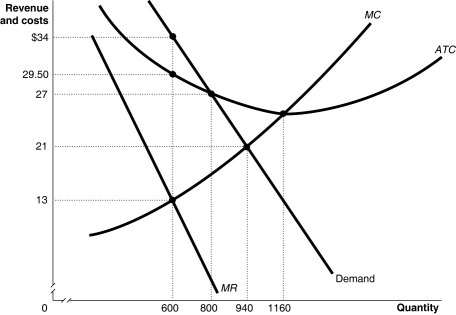 Figure 15-3 shows the demand and cost curves for a monopolist.
-Refer to Figure 15-3.What is the price charged for the profit-maximizing output level?
Figure 15-3 shows the demand and cost curves for a monopolist.
-Refer to Figure 15-3.What is the price charged for the profit-maximizing output level? (Multiple Choice)
4.9/5  (78)
(78) Consider an industry that is made up of nine firms each with a market share (percent of sales)as follows: a.Firm A: 30%
B)Firm B: 20%
C)Firms C,D and E: 10% each
D)Firms F,G,H and J: 5% each
What is the value of the four-firm concentration ratio and how is the industry categorized?
A) 50%; monopolistic competition
B) 70%; oligopoly
C) 75%; oligopoly
D) 80%; strongly oligopolistic
(Not Answered)
This question doesn't have any answer yet
To enter a local cable television market,a firm needs a license from the city government.This is an example of
(Multiple Choice)
4.9/5 (78)
(78) Peet's Coffee and Teas produces some flavorful varieties of Peet's brand coffee.Is Peet's a monopoly?
(Multiple Choice)
4.9/5 (85)
(85) If a monopolist's price is $50 at the output where marginal revenue equals marginal cost and average total cost is $43,then the average profit is $7.
(True/False)
4.7/5 (73)
(73) To maximize profit,a monopolist will produce and sell a quantity such that for the last unit sold,marginal revenue equals marginal cost,and charges a price given by the demand curve at that output level.
(True/False)
4.9/5 (86)
(86) Figure 15-2 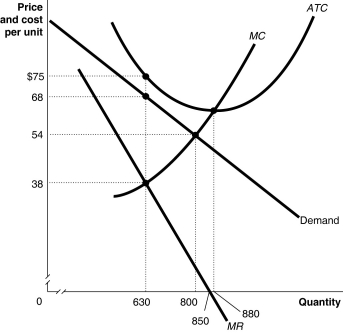 Figure 15-2 above shows the demand and cost curves facing a monopolist.
-Refer to Figure 15-2.Suppose the monopolist represented in the diagram above produces positive output.What is the price charged at the profit-maximizing/loss-minimizing output level?
Figure 15-2 above shows the demand and cost curves facing a monopolist.
-Refer to Figure 15-2.Suppose the monopolist represented in the diagram above produces positive output.What is the price charged at the profit-maximizing/loss-minimizing output level? (Multiple Choice)
4.8/5 (70)
(70) In Walnut Creek,California,there are three very popular supermarkets: Safeway,Whole Foods and Lunardi's.While Safeway remains open twenty-four hours a day,Whole Foods and Lunardi's close at 9 pm.Which of the following statements is true?
(Multiple Choice)
4.9/5 (75)
(75) Because a monopoly's demand curve is the same as the market demand curve for its product,
(Multiple Choice)
4.8/5 (76)
(76) A vertical merger is one that takes place between two companies producing different goods or services for one specific finished product.
(True/False)
4.9/5 (80)
(80) When a proposed merger between two companies is reviewed by the government,the relevant market is defined by
(Multiple Choice)
4.8/5 (83)
(83) Firms do not have market power in which of the following market structures?
(Multiple Choice)
4.8/5 (68)
(68) In regulating a natural monopoly,the price strategy that ensures the highest possible output and zero profit is one that sets price
(Multiple Choice)
4.9/5 (99)
(99) If a monopolist's marginal revenue is $15 per unit and its marginal cost is $25,then to maximize profit the firm should decrease output.
(True/False)
4.8/5 (85)
(85) A firm that has the ability to control to some degree the price of the product it sells
(Multiple Choice)
4.9/5 (83)
(83) 
Filters
- Essay(0)
- Multiple Choice(0)
- Short Answer(0)
- True False(0)
- Matching(0)