



 Chat with AI
Exam 26: Monetary Policy

Exam 1: Economics: Foundations and Models142 Questions
Exam 2: Trade-Offs, comparative Advantage, and the Market System152 Questions
Exam 3: Where Prices Come From: the Interaction of Demand and Supply149 Questions
Exam 4: Economic Efficiency, government Price Setting, and Taxes137 Questions
Exam 5: Externalities, environmental Policy, and Public Goods139 Questions
Exam 6: Elasticity: The Responsiveness of Demand and Supply149 Questions
Exam 7: The Economics of Health Care117 Questions
Exam 8: Firms, the Stock Market, and Corporate Governance140 Questions
Exam 9: Comparative Advantage and the Gains From International Trade124 Questions
Exam 10: Consumer Choice and Behavioral Economics154 Questions
Exam 11: Technology, production, and Costs174 Questions
Exam 12: Firms in Perfectly Competitive Markets153 Questions
Exam 13: Monopolistic Competition: The Competitive Model in a More Realistic Setting137 Questions
Exam 14: Oligopoly: Firms in Less Competitive Markets129 Questions
Exam 15: Monopoly and Antitrust Policy148 Questions
Exam 16: Pricing Strategy134 Questions
Exam 17: The Markets for Labor and Other Factors of Production149 Questions
Exam 18: Public Choice, taxes, and the Distribution of Income134 Questions
Exam 19: GDP: Measuring Total Production and Income135 Questions
Exam 20: Unemployment and Inflation148 Questions
Exam 21: Economic Growth, the Financial System, and Business Cycles130 Questions
Exam 22: Long-Run Economic Growth: Sources and Policies134 Questions
Exam 23: Aggregate Expenditure and Output in the Short Run157 Questions
Exam 24: Aggregate Demand and Aggregate Supply Analysis145 Questions
Exam 25: Money, banks, and the Federal Reserve System144 Questions
Exam 26: Monetary Policy145 Questions
Exam 27: Fiscal Policy155 Questions
Exam 28: Inflation, unemployment, and Federal Reserve Policy135 Questions
Exam 29: Macroeconomics in an Open Economy145 Questions
Exam 30: The International Financial System139 Questions
Select questions type


In reality,the Fed is unable to use monetary policy to keep real GDP exactly at its potential level.
(True/False)
4.8/5  (92)
(92) If the Federal Reserve raises or lowers interest rates too late,it could result in a ________ policy that destabilizes the economy.
(Multiple Choice)
4.9/5 (64)
(64) Using the money demand and money supply model,show and explain why the Federal Reserve cannot achieve a target for both the money supply and an interest rate.
(Essay)
4.9/5 (83)
(83) Expansionary monetary policy enacted during a recession will cause the inflation rate to increase.
(True/False)
4.8/5 (88)
(88) Most economists believe that the best monetary policy target is
(Multiple Choice)
4.9/5 (88)
(88) Which of the following describes what the Fed would do to pursue an expansionary monetary policy?
(Multiple Choice)
4.7/5 (75)
(75) Monetarists think that the Fed should use ________ as a target when conducting monetary policy.
(Multiple Choice)
4.8/5 (93)
(93) Figure 26-5 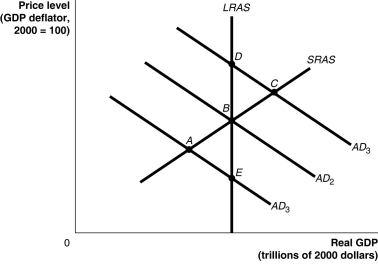 -Refer to Figure 26-5.Suppose the Fed sells Treasury Bills in pursuit of contractionary monetary policy.Using the static AD-AS model in the figure above,this situation would be depicted as a movement from
A) A to B.
B) B to D.
C) C to B.
D) B to C.
E) C to D.
-Refer to Figure 26-5.Suppose the Fed sells Treasury Bills in pursuit of contractionary monetary policy.Using the static AD-AS model in the figure above,this situation would be depicted as a movement from
A) A to B.
B) B to D.
C) C to B.
D) B to C.
E) C to D. (Not Answered)
This question doesn't have any answer yet
From an initial long-run macroeconomic equilibrium,if the Federal Reserve anticipated that next year aggregate demand would grow significantly faster than long-run aggregate supply,then the Federal Reserve would most likely
(Multiple Choice)
4.8/5 (80)
(80) When housing prices fell as they did beginning in 2006 following the housing market bubble,most banks and other lenders ________ the requirement for borrowers,making it ________ for potential home buyers to obtain mortgages.
(Multiple Choice)
4.9/5 (77)
(77) The Federal Reserve cannot target both the money supply and the interest rate because it does not control
(Multiple Choice)
4.8/5 (82)
(82) Contractionary monetary policy to prevent real GDP from rising above potential real GDP would cause the inflation rate to be ________ and real GDP to be ________.
(Multiple Choice)
4.9/5 (86)
(86) Using the money demand and money supply model,an open market sale of Treasury securities by the Federal Reserve would cause the equilibrium interest rate to
(Multiple Choice)
4.7/5 (93)
(93) Which of the following would most likely induce the Federal Reserve to conduct expansionary monetary policy? A significant decrease in
(Multiple Choice)
4.9/5 (90)
(90) The Fed has adopted an interest rate target for most of the time since World War II.
(True/False)
4.8/5 (64)
(64) Using the money demand and money supply model,an open market purchase of Treasury securities by the Federal Reserve would cause the equilibrium interest rate to
(Multiple Choice)
4.8/5 (92)
(92) 
Filters
- Essay(0)
- Multiple Choice(0)
- Short Answer(0)
- True False(0)
- Matching(0)