



 Chat with AI
Exam 26: Monetary Policy

Exam 1: Economics: Foundations and Models142 Questions
Exam 2: Trade-Offs, comparative Advantage, and the Market System152 Questions
Exam 3: Where Prices Come From: the Interaction of Demand and Supply149 Questions
Exam 4: Economic Efficiency, government Price Setting, and Taxes137 Questions
Exam 5: Externalities, environmental Policy, and Public Goods139 Questions
Exam 6: Elasticity: The Responsiveness of Demand and Supply149 Questions
Exam 7: The Economics of Health Care117 Questions
Exam 8: Firms, the Stock Market, and Corporate Governance140 Questions
Exam 9: Comparative Advantage and the Gains From International Trade124 Questions
Exam 10: Consumer Choice and Behavioral Economics154 Questions
Exam 11: Technology, production, and Costs174 Questions
Exam 12: Firms in Perfectly Competitive Markets153 Questions
Exam 13: Monopolistic Competition: The Competitive Model in a More Realistic Setting137 Questions
Exam 14: Oligopoly: Firms in Less Competitive Markets129 Questions
Exam 15: Monopoly and Antitrust Policy148 Questions
Exam 16: Pricing Strategy134 Questions
Exam 17: The Markets for Labor and Other Factors of Production149 Questions
Exam 18: Public Choice, taxes, and the Distribution of Income134 Questions
Exam 19: GDP: Measuring Total Production and Income135 Questions
Exam 20: Unemployment and Inflation148 Questions
Exam 21: Economic Growth, the Financial System, and Business Cycles130 Questions
Exam 22: Long-Run Economic Growth: Sources and Policies134 Questions
Exam 23: Aggregate Expenditure and Output in the Short Run157 Questions
Exam 24: Aggregate Demand and Aggregate Supply Analysis145 Questions
Exam 25: Money, banks, and the Federal Reserve System144 Questions
Exam 26: Monetary Policy145 Questions
Exam 27: Fiscal Policy155 Questions
Exam 28: Inflation, unemployment, and Federal Reserve Policy135 Questions
Exam 29: Macroeconomics in an Open Economy145 Questions
Exam 30: The International Financial System139 Questions
Select questions type


Using the Taylor rule,if the current inflation rate equals the target inflation rate and real GDP is less than potential GDP,then the federal funds target rate ________ the sum of the current inflation rate plus the real equilibrium federal funds rate.
(Multiple Choice)
4.8/5  (91)
(91) The Taylor rule links the Federal Reserve's target for the
(Multiple Choice)
4.8/5 (93)
(93) One of the monetary policy goals of the Federal Reserve is price stability.
(True/False)
4.8/5 (68)
(68) Figure 26-6 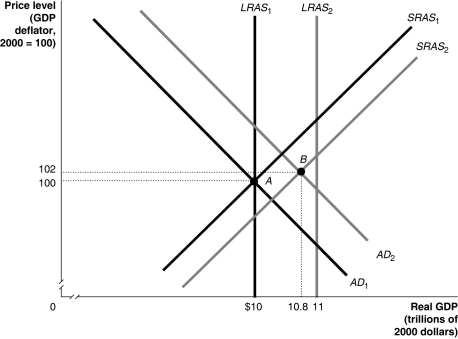 -Refer to Figure 26-6.In the dynamic model of AD-AS in the figure above,if the economy is at point A in year 1 and is expected to go to point B in year 2,and the Federal Reserve pursues no policy,then at point B
 (Multiple Choice)
4.8/5 (83)
(83) If the Federal Reserve targets the interest rate and the money demand curve shifts to the left,then the Fed
(Multiple Choice)
4.8/5 (76)
(76) Since World War II,the Federal Reserve has not been involved in carrying out monetary policy.
(True/False)
4.8/5 (78)
(78) The Federal Home Loan Mortgage Corporation and the Federal National Mortgage Association were established by Congress in order to regulate banks that buy and sell mortgage-backed securities.
(True/False)
4.8/5 (87)
(87) In the countries that have adopted inflation targeting,the inflation rate has typically
(Multiple Choice)
4.9/5 (82)
(82) The Federal Reserve can directly affect its monetary policy ________,which then affect its monetary policy ________.
(Multiple Choice)
4.9/5 (68)
(68) Under the monetary growth rule proposed by the monetarists,the money supply would grow each year at a constant rate equal to the long-run rate of growth of
(Multiple Choice)
4.8/5 (86)
(86) A monetary policy target is a variable that the Fed can affect directly,which then affects one or more of the Fed's policy goals.
(True/False)
4.8/5 (85)
(85) The Fed can simultaneously reduce the inflation rate and stimulate growth through lowering interest rates.
(True/False)
4.9/5 (78)
(78) While many analysts defended the actions taken by the Fed and the Treasury to respond to the financial crisis in 2008,others were critical of these actions.The critics were concerned that by not allowing large firms to fail,
(Multiple Choice)
4.7/5 (79)
(79) Table 26-2
 -Refer to Table 26-2.The hypothetical information in the table shows what the values for real GDP and the price level will be in 2011 if the Federal Reserve does not use monetary policy:
a.If the Fed wants to keep real GDP at its potential level in 2011,should it use an expansionary policy or a contractionary policy? Should the trading desk buy T-bills or sell them?
b.Suppose the Fed's policy is successful in keeping real GDP at its potential level in 2011.State whether each of the following will be higher or lower than if the Fed had taken no action:
(i)Real GDP
(ii)Full-employment real GDP
(iii)The inflation rate
(iv)The unemployment rate
c.Draw an aggregate demand and aggregate supply graph to illustrate your answer.Be sure that your graph contains LRAS curves for 2010 and 2011; SRAS curves 2010 and 2011; AD curve for 2010 and 2011,with and without monetary policy actions; and equilibrium real GDP and the price level in 2011 with and without policy.
-Refer to Table 26-2.The hypothetical information in the table shows what the values for real GDP and the price level will be in 2011 if the Federal Reserve does not use monetary policy:
a.If the Fed wants to keep real GDP at its potential level in 2011,should it use an expansionary policy or a contractionary policy? Should the trading desk buy T-bills or sell them?
b.Suppose the Fed's policy is successful in keeping real GDP at its potential level in 2011.State whether each of the following will be higher or lower than if the Fed had taken no action:
(i)Real GDP
(ii)Full-employment real GDP
(iii)The inflation rate
(iv)The unemployment rate
c.Draw an aggregate demand and aggregate supply graph to illustrate your answer.Be sure that your graph contains LRAS curves for 2010 and 2011; SRAS curves 2010 and 2011; AD curve for 2010 and 2011,with and without monetary policy actions; and equilibrium real GDP and the price level in 2011 with and without policy. (Essay)
4.7/5 (85)
(85) Using the Taylor rule,if the current inflation rate exceeds the target inflation rate and real GDP exceeds potential GDP,then the federal funds target rate ________ the sum of the current inflation rate plus the real equilibrium federal funds rate.
(Multiple Choice)
4.8/5 (86)
(86) Use the money demand and money supply model to show graphically and explain the effect on interest rates of the Federal Reserve's open market sale of Treasury securities.
(Essay)
4.8/5 (75)
(75) What is a banking panic,and what role did banking panics play in the decision by Congress to establish the Federal Reserve?
(Essay)
4.9/5 (76)
(76) 
Filters
- Essay(0)
- Multiple Choice(0)
- Short Answer(0)
- True False(0)
- Matching(0)