



 Chat with AI
Exam 26: Monetary Policy

Exam 1: Economics: Foundations and Models142 Questions
Exam 2: Trade-Offs, comparative Advantage, and the Market System152 Questions
Exam 3: Where Prices Come From: the Interaction of Demand and Supply149 Questions
Exam 4: Economic Efficiency, government Price Setting, and Taxes137 Questions
Exam 5: Externalities, environmental Policy, and Public Goods139 Questions
Exam 6: Elasticity: The Responsiveness of Demand and Supply149 Questions
Exam 7: The Economics of Health Care117 Questions
Exam 8: Firms, the Stock Market, and Corporate Governance140 Questions
Exam 9: Comparative Advantage and the Gains From International Trade124 Questions
Exam 10: Consumer Choice and Behavioral Economics154 Questions
Exam 11: Technology, production, and Costs174 Questions
Exam 12: Firms in Perfectly Competitive Markets153 Questions
Exam 13: Monopolistic Competition: The Competitive Model in a More Realistic Setting137 Questions
Exam 14: Oligopoly: Firms in Less Competitive Markets129 Questions
Exam 15: Monopoly and Antitrust Policy148 Questions
Exam 16: Pricing Strategy134 Questions
Exam 17: The Markets for Labor and Other Factors of Production149 Questions
Exam 18: Public Choice, taxes, and the Distribution of Income134 Questions
Exam 19: GDP: Measuring Total Production and Income135 Questions
Exam 20: Unemployment and Inflation148 Questions
Exam 21: Economic Growth, the Financial System, and Business Cycles130 Questions
Exam 22: Long-Run Economic Growth: Sources and Policies134 Questions
Exam 23: Aggregate Expenditure and Output in the Short Run157 Questions
Exam 24: Aggregate Demand and Aggregate Supply Analysis145 Questions
Exam 25: Money, banks, and the Federal Reserve System144 Questions
Exam 26: Monetary Policy145 Questions
Exam 27: Fiscal Policy155 Questions
Exam 28: Inflation, unemployment, and Federal Reserve Policy135 Questions
Exam 29: Macroeconomics in an Open Economy145 Questions
Exam 30: The International Financial System139 Questions
Select questions type


The Federal Reserve responded to the 2008 financial crisis in several ways.Which of the following is not one of the ways the Fed responded?
(Multiple Choice)
4.9/5  (66)
(66) Suppose the equilibrium real federal funds rate is 2 percent,the target rate of inflation is 2 percent,the current inflation rate is 4 percent,and real GDP is 2 percent above potential real GDP.If the weights for the inflation gap and the output gap are both 1/2,then according to the Taylor rule the federal funds target rate equals
(Multiple Choice)
4.7/5 (82)
(82) The goals of monetary policy tend to be interrelated.For example,when the Fed pursues the goal of ________,it also can achieve the goal of ________ simultaneously.
(Multiple Choice)
4.8/5 (74)
(74) With the Troubled Asset Relief Program (TARP),the Treasury provided funds to banks in exchange for stock.
(True/False)
4.8/5 (90)
(90) Expansionary monetary policy to prevent real GDP from falling below potential real GDP would cause the inflation rate to be relatively ________ and real GDP to be relatively ________.
(Multiple Choice)
4.8/5 (75)
(75) Although the Federal Reserve had traditionally made discount loans only to commercial banks,in response to to the financial crisis in 2008 the Fed made ________ eligible for discount loans as well.
(Multiple Choice)
4.8/5 (86)
(86) The top policy goal for Paul Volcker when he became chairman of the Federal Reserve's Board of Governors in 1979 was
(Multiple Choice)
4.9/5 (80)
(80) When calculating GDP,the Bureau of Economic Analysis revises its quarterly data
(Multiple Choice)
4.9/5 (87)
(87) Expansionary monetary policy refers to the Fed's increasing the money supply and increasing interest rates to increase real GDP.
(True/False)
4.9/5 (83)
(83) Figure 26-7  -Refer to Figure 26-7.In the dynamic AD-AS model,the economy is at point A in year 1 and is expected to go to point B in year 2,and the Federal Reserve pursues policy.This will result in
 (Multiple Choice)
5.0/5 (91)
(91) Use a graph to show the effects of an expansionary monetary policy moving an economy out of recession and to potential real GDP.Explain what happens to aggregate demand,real GDP,and the price level.
(Essay)
4.8/5 (71)
(71) The Federal Reserve System's four monetary policy goals are
(Multiple Choice)
5.0/5 (75)
(75) Figure 26-4 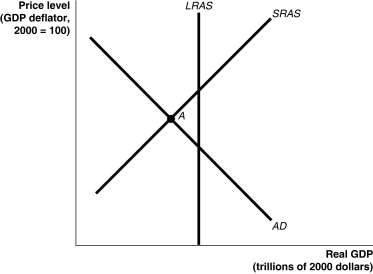 -Refer to Figure 26-4.In the figure above,if the economy is at point A,the appropriate monetary policy by the Federal Reserve would be to
 (Multiple Choice)
4.8/5 (77)
(77) Figure 26-7
-Refer to Figure 26-7.In the dynamic AD-AS model,if the economy is at point A in year 1 and is expected to go to point B in year 2,and the Federal Reserve pursues no policy,then at point B
-Refer to Figure 26-7.In the dynamic AD-AS model,if the economy is at point A in year 1 and is expected to go to point B in year 2,and the Federal Reserve pursues no policy,then at point B (Multiple Choice)
5.0/5 (79)
(79) Firms that participate in regular open market transactions with the Federal Reserve are called
(Multiple Choice)
4.9/5 (76)
(76) The Federal Reserve's two main ________ are the money supply and the interest rate.
(Multiple Choice)
4.8/5 (82)
(82) If the Federal Reserve targets the money supply,and the money demand curve shifts to the left,then the Fed
(Multiple Choice)
4.8/5 (80)
(80) The Federal Reserve does not target both the money supply and an interest rate because
(Multiple Choice)
4.8/5 (80)
(80) When housing prices fall,as they did beginning in 2006 following the housing market bubble,consumption spending on furniture,appliances,and home improvements ________ as many households found it ________ to borrow against the value of their homes.
(Multiple Choice)
4.9/5 (80)
(80) 
Filters
- Essay(0)
- Multiple Choice(0)
- Short Answer(0)
- True False(0)
- Matching(0)