



 Chat with AI
Exam 26: Monetary Policy

Exam 1: Economics: Foundations and Models142 Questions
Exam 2: Trade-Offs, comparative Advantage, and the Market System152 Questions
Exam 3: Where Prices Come From: the Interaction of Demand and Supply149 Questions
Exam 4: Economic Efficiency, government Price Setting, and Taxes137 Questions
Exam 5: Externalities, environmental Policy, and Public Goods139 Questions
Exam 6: Elasticity: The Responsiveness of Demand and Supply149 Questions
Exam 7: The Economics of Health Care117 Questions
Exam 8: Firms, the Stock Market, and Corporate Governance140 Questions
Exam 9: Comparative Advantage and the Gains From International Trade124 Questions
Exam 10: Consumer Choice and Behavioral Economics154 Questions
Exam 11: Technology, production, and Costs174 Questions
Exam 12: Firms in Perfectly Competitive Markets153 Questions
Exam 13: Monopolistic Competition: The Competitive Model in a More Realistic Setting137 Questions
Exam 14: Oligopoly: Firms in Less Competitive Markets129 Questions
Exam 15: Monopoly and Antitrust Policy148 Questions
Exam 16: Pricing Strategy134 Questions
Exam 17: The Markets for Labor and Other Factors of Production149 Questions
Exam 18: Public Choice, taxes, and the Distribution of Income134 Questions
Exam 19: GDP: Measuring Total Production and Income135 Questions
Exam 20: Unemployment and Inflation148 Questions
Exam 21: Economic Growth, the Financial System, and Business Cycles130 Questions
Exam 22: Long-Run Economic Growth: Sources and Policies134 Questions
Exam 23: Aggregate Expenditure and Output in the Short Run157 Questions
Exam 24: Aggregate Demand and Aggregate Supply Analysis145 Questions
Exam 25: Money, banks, and the Federal Reserve System144 Questions
Exam 26: Monetary Policy145 Questions
Exam 27: Fiscal Policy155 Questions
Exam 28: Inflation, unemployment, and Federal Reserve Policy135 Questions
Exam 29: Macroeconomics in an Open Economy145 Questions
Exam 30: The International Financial System139 Questions
Select questions type


Figure 26-6 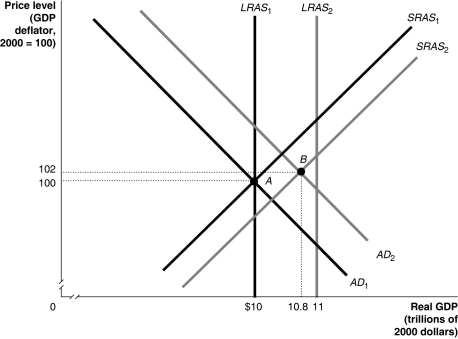 -Refer to Figure 26-6.In the dynamic model of AD-AS in the figure above,if the economy is at point A in year 1 and is expected to go to point B in year 2,the Federal Reserve would most likely
 (Multiple Choice)
4.7/5  (71)
(71) Which of the following would cause the money demand curve to shift to the left?
(Multiple Choice)
4.8/5 (86)
(86) Changes in interest rates affect all four components of aggregate demand.
(True/False)
4.9/5 (89)
(89) Does the money demand curve have a positive slope or a negative slope? Why does it have this slope? Explain why an increase in the variable on the vertical axis of the money demand curve causes either an increase or a decrease in the variable on the horizontal axis of the money demand curve.
(Essay)
4.7/5 (90)
(90) Inflation targeting refers to conducting ________ policy so as to commit the central bank to achieving a ________.
(Multiple Choice)
4.9/5 (86)
(86) The larger the fraction of an investment financed by borrowing,
(Multiple Choice)
5.0/5 (62)
(62) Use the money demand and money supply model to show the money market in equilibrium with an interest rate of 5 percent and the quantity of money of $800 billion.Suppose the Federal Reserve increases the money supply to $850 billion.At the previous equilibrium interest rate of 5 percent,will households and firms now be holding more money or less money than they want to hold,and will they be buying or selling short-term financial assets? At the new equilibrium interest rate,households and firms will desire to hold the entire $850 billion of the money supply.What causes households and firms to want to hold the additional $50 billion of the money supply?
(Essay)
4.9/5 (81)
(81) The Fed uses a "core" price index,one that excludes food and energy prices to measure inflation.It does so because
(Multiple Choice)
4.8/5 (77)
(77) Use the dynamic aggregate demand and aggregate supply model and start with Year 1 in long-run macroeconomic equilibrium.For Year 2,graph aggregate demand,long-run aggregate supply,and short-run aggregate supply such that the condition of the economy will induce the Federal Reserve to conduct an expansionary monetary policy.Briefly explain the condition of the economy and what the Federal Reserve is attempting to do.
(Essay)
4.8/5 (63)
(63) When the Federal Reserve System was established in 1913,its main policy goal was
(Multiple Choice)
5.0/5 (65)
(65) An increase in the interest rate should ________ the demand for dollars and the value of the dollar,and net exports should ________.
(Multiple Choice)
4.7/5 (84)
(84) The Federal Reserve cut the federal funds rate seven times between September 2007 and March 2008.What event led the Fed to make these reductions in the federal funds rate?
(Multiple Choice)
4.9/5 (81)
(81) A borrower defaults on a loan when he stops making payments on the loan.
(True/False)
4.9/5 (86)
(86) Figure 26-5 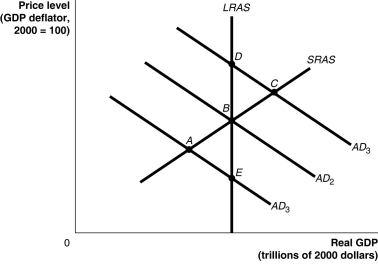 -Refer to Figure 26-5.Suppose the economy is in short-run equilibrium above potential GDP,the unemployment rate is very low,and wages and prices are rising.Using the static AD-AS model in the figure above,the correct Fed policy for this situation would be depicted as a movement from
A) A to B.
B) B to C.
C) C to B.
D) A to E.
E) C to D.
-Refer to Figure 26-5.Suppose the economy is in short-run equilibrium above potential GDP,the unemployment rate is very low,and wages and prices are rising.Using the static AD-AS model in the figure above,the correct Fed policy for this situation would be depicted as a movement from
A) A to B.
B) B to C.
C) C to B.
D) A to E.
E) C to D. (Not Answered)
This question doesn't have any answer yet
If the Fed orders a contractionary monetary policy,describe what will happen to the following variables relative to what would have happened without the policy:
a.The money supply
b.Interest rates
c.Investment
d.Consumption
e.Net Exports
f.The aggregate demand curve
g.Real GDP
h.The price level
(Essay)
4.8/5 (83)
(83) Use the dynamic aggregate demand and aggregate supply model and start with Year 1 in long-run macroeconomic equilibrium.For Year 2,graph aggregate demand,long-run aggregate supply,and short-run aggregate supply such that the condition of the economy will induce the Federal Reserve to conduct a contractionary monetary policy.Briefly explain the condition of the economy and what the Federal Reserve is attempting to do.
(Essay)
4.8/5 (85)
(85) The interest rate that banks charge other banks for overnight loans is the
(Multiple Choice)
4.8/5 (79)
(79) In the Taylor rule,does the target for the federal funds rate respond differently for a recession caused by a decrease in aggregate demand and for a recession caused by a decrease in short-run aggregate supply? Explain whether there is or is not a difference in how the target for the federal funds rate changes.
(Essay)
4.8/5 (70)
(70) Mortgage lenders often resell mortgages in secondary markets.How might this make lenders act differently than if they intended to hold the mortgages themselves?
(Essay)
4.8/5 (80)
(80) In October 2008,Congress passed the ________,under which the Treasury provided funds to banks in exchange for stock.
(Multiple Choice)
4.8/5 (70)
(70) 
Filters
- Essay(0)
- Multiple Choice(0)
- Short Answer(0)
- True False(0)
- Matching(0)