



 Chat with AI
Exam 26: Monetary Policy

Exam 1: Economics: Foundations and Models142 Questions
Exam 2: Trade-Offs, comparative Advantage, and the Market System152 Questions
Exam 3: Where Prices Come From: the Interaction of Demand and Supply149 Questions
Exam 4: Economic Efficiency, government Price Setting, and Taxes137 Questions
Exam 5: Externalities, environmental Policy, and Public Goods139 Questions
Exam 6: Elasticity: The Responsiveness of Demand and Supply149 Questions
Exam 7: The Economics of Health Care117 Questions
Exam 8: Firms, the Stock Market, and Corporate Governance140 Questions
Exam 9: Comparative Advantage and the Gains From International Trade124 Questions
Exam 10: Consumer Choice and Behavioral Economics154 Questions
Exam 11: Technology, production, and Costs174 Questions
Exam 12: Firms in Perfectly Competitive Markets153 Questions
Exam 13: Monopolistic Competition: The Competitive Model in a More Realistic Setting137 Questions
Exam 14: Oligopoly: Firms in Less Competitive Markets129 Questions
Exam 15: Monopoly and Antitrust Policy148 Questions
Exam 16: Pricing Strategy134 Questions
Exam 17: The Markets for Labor and Other Factors of Production149 Questions
Exam 18: Public Choice, taxes, and the Distribution of Income134 Questions
Exam 19: GDP: Measuring Total Production and Income135 Questions
Exam 20: Unemployment and Inflation148 Questions
Exam 21: Economic Growth, the Financial System, and Business Cycles130 Questions
Exam 22: Long-Run Economic Growth: Sources and Policies134 Questions
Exam 23: Aggregate Expenditure and Output in the Short Run157 Questions
Exam 24: Aggregate Demand and Aggregate Supply Analysis145 Questions
Exam 25: Money, banks, and the Federal Reserve System144 Questions
Exam 26: Monetary Policy145 Questions
Exam 27: Fiscal Policy155 Questions
Exam 28: Inflation, unemployment, and Federal Reserve Policy135 Questions
Exam 29: Macroeconomics in an Open Economy145 Questions
Exam 30: The International Financial System139 Questions
Select questions type


Suppose that the Federal Reserve Open Market Committee adheres to the ideas expressed by ________.If the economy moves into a recession,the Fed would recommend that the federal funds target rate decrease as long as the inflation rate did not rise above the publicly announced goal for inflation.
(Multiple Choice)
4.8/5  (89)
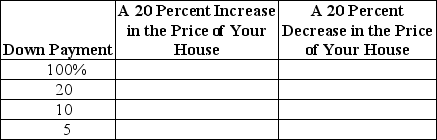
(89) In the following table,fill in the columns for your return on investment if the price of your house increased or decreased by 20 percent,based on the down payments specified in the first column.
Return on Your Investment From…
(Essay)
4.9/5 (75)
(75) The dynamic aggregate demand and aggregate supply model accounts for the price level rising every year.
(True/False)
4.8/5 (77)
(77) Figure 26-7  -Refer to Figure 26-7.In the dynamic AD-AS model,if the economy is at point A in year 1 and is expected to go to point B in year 2,the Federal Reserve would most likely
 (Multiple Choice)
4.9/5 (75)
(75) Which of the following is true about the Federal Reserve and its ability to prevent recessions? The Federal Reserve
(Multiple Choice)
4.9/5 (83)
(83) If the amount you owe on your house is greater than the price of the house,you have
(Multiple Choice)
4.8/5 (84)
(84) The economy suffered a mild recession in 2001.Despite the recession,home sales and durable goods sales remained high.Which of the following is a plausible explanation?
(Multiple Choice)
4.8/5 (81)
(81) Toll Brothers,a residential home builder,did well during the recession in 2001 but did not do so well in 2007 after the housing bubble burst.The reason for this is
(Multiple Choice)
4.8/5 (94)
(94) When the Federal Reserve increases the money supply,at the previous equilibrium interest rate households and firms will now have
(Multiple Choice)
4.8/5 (91)
(91) Figure 26-1  -Refer to Figure 26-1.In the figure,the money demand curve would move from MD1 to MD2 if
 (Multiple Choice)
4.8/5 (78)
(78) In response to already low interest rates doing little to stimulate the economy,the Fed announced a new program in September 2011 under which it would purchase long-term Treasury securities while selling an equal amount of shorter-term Treasury securities.This policy was known as
(Multiple Choice)
4.7/5 (79)
(79) Using the money demand and money supply model,an increase in money demand would cause the equilibrium interest rate to
(Multiple Choice)
4.9/5 (80)
(80) The Federal Reserve's performance in the mid-to-late 1980s,1990s,and early 2000s has received high marks from economists,even without inflation targeting.
(True/False)
4.9/5 (75)
(75) Beginning in 2008,The Federal Reserve and the U.S.Treasury Department responded to the financial crisis by intervening in financial markets in unprecedented ways.Briefly summarize the actions of the Fed and Treasury.
(Essay)
5.0/5 (77)
(77) Figure 26-6  -Refer to Figure 26-6.In the dynamic model of AD-AS in the figure above,the economy is at point A in year 1 and is expected to go to point B in year 2,and the Federal Reserve pursues policy.This will result in
 (Multiple Choice)
4.8/5 (85)
(85) The relationship between GDP and the money supply has gotten stronger since the 1980s.
(True/False)
4.9/5 (69)
(69) According to the Taylor rule,does the target for the federal funds rate respond differently for an increase in inflation caused by an increase in aggregate demand and for an increase in inflation caused by a decrease in short-run aggregate supply? Explain whether there is or is not a difference in how the target for the federal funds rate changes.
(Essay)
4.7/5 (86)
(86) In 2008,the Treasury and Federal Reserve took action to save large financial firms such as Bear Stearns and AIG from failing.Which of the following is one reason why these measures were taken?
(Multiple Choice)
4.8/5 (89)
(89) 
Filters
- Essay(0)
- Multiple Choice(0)
- Short Answer(0)
- True False(0)
- Matching(0)