



 Chat with AI
Exam 13: Biochemical Signaling

Exam 1: Introduction to the Chemistry of Life56 Questions
Exam 2: Water59 Questions
Exam 3: Nucleotides, Nucleic Acids, and Genetic Information68 Questions
Exam 4: Amino Acids68 Questions
Exam 5: Proteins: Primary Structure68 Questions
Exam 6: Proteins: Three-Dimensional Structure60 Questions
Exam 7: Protein Function Part I: Myoglobin and Hemoglobin74 Questions
Exam 8: Carbohydrates66 Questions
Exam 9: Lipids and Biological Membranes59 Questions
Exam 10: Membrane Transport50 Questions
Exam 11: Enzyme Catalysis53 Questions
Exam 12: Enzyme Kinetics, Inhibition and Control55 Questions
Exam 13: Biochemical Signaling50 Questions
Exam 14: Introduction to Metabolism52 Questions
Exam 15: Glycogen Metabolism and Gluconeogenesis50 Questions
Exam 16: Glucose Catabolism50 Questions
Exam 17: Citric Acid Cycle50 Questions
Exam 18: Electron Transport and Oxidative Phosphorylation50 Questions
Exam 19: Photosynthesis50 Questions
Exam 20: Lipid Metabolism51 Questions
Exam 21: Amino Acid Metabolism50 Questions
Exam 22: Mammalian Fuel Metabolism: Integration and Regulation50 Questions
Exam 23: Nucleotide Metabolism50 Questions
Exam 24: Nucleic Acid Structure50 Questions
Exam 25: Dna Replication, Repair and Recombination50 Questions
Exam 26: Transcription and Rna Processing50 Questions
Exam 27: Translation49 Questions
Exam 28: Regulation of Gene Expression50 Questions
Select questions type


Considering the same unidentified proteins discussed in the question 32 above (UPS-1 through UPS-3)what can you conclude from the following observations and the knowledge you gained in this chapter? OBSERVATIONS:
1)UPS-1 is capable of autophosphorylation.
2)UPS-2 becomes phosphorylated only when UPS-1 is phosphorylated.
3)UPS-2, when phosphorylated interacts with UPS-3 and activates the Ras protein.
4)Recombinant UPS-2 protein that has a mutation resulting in the replacement of tyrosine for serine in the binding region loses all function.
5)The proteins Jun and Fos are expressed at high levels in the presence of UPS-1,2,3.
(Multiple Choice)
4.8/5  (70)
(70) Heterotrimeric G proteins
I.consist of three subunits, G , G , and G .
II.function as an autoinhibtory segment.
III.can function as a mediator to adenylate cyclase activity.
IV.are anchored to the cytoplasmic side of the membrane.
(Multiple Choice)
4.7/5 (80)
(80) Matching
-A release of _____ would result in the stimulation of the liver to synthesize glycogen.
(Multiple Choice)
4.9/5 (77)
(77) Somatostatin
I.inhibits the release of insulin.
II.inhibits the release of glucagon.
III.stimulates the release of insulin.
IV.stimulates the release of glucagon.
(Multiple Choice)
4.8/5 (70)
(70) Matching
-A molecule that often functions as a second messenger is ______.
(Multiple Choice)
4.7/5 (91)
(91) The cells of the islets of Langerhans secrete ______ in response to ______ glucose levels in the muscle and/or adipose tissue.
(Multiple Choice)
4.9/5 (90)
(90) Ras is an example of
I.a protein anchoted by prenylation.
II.a heterotrimeric G protein.
III.a kinase activated protein.
IV.a GTP dependent protein.
(Multiple Choice)
4.7/5 (91)
(91) Which of the following are activated either directly or indirectly by a heterotrimeric G protein subunit?
I.phospholipase C
II.Herceptin
III.calmodulin (CaM)sensitive kinase
IV.MAPK
(Multiple Choice)
4.8/5 (77)
(77) Which of the following correctly states an essential step in the function of heterotrimeric G protein function?
(Multiple Choice)
4.8/5 (81)
(81) Which of the following is (are)an advantage(s)of protein phosphorylation in regards to biochemical signaling?
I.Phosphorylation is rapid and specific.
II.Phosphorylation is enzymatically reversible.
III.Phosphorylation can be amplified by cascade systems.
IV.Phosphorylation results in covalent modification of enzymes.
(Multiple Choice)
4.8/5 (78)
(78) Which of the following is (are)associated with cAMP binding to cAMP-dependent protein kinase A?
I.cAMP binds to the regulatory subunits.
II.Tetrameric regulatory subunits and catalytic subunits dissociate.
III.Catalytic subunits phosphorylate multiple targets with specific serine and threonine residues.
IV.cAMP is membrane bound via phosphoinositol attachment.
(Multiple Choice)
4.9/5 (84)
(84) Matching
-Cytosolic calcium ion levels are altered by the _____ signaling pathway.
(Multiple Choice)
4.9/5 (89)
(89) Catecholamines mediate their effects through
I.α-adrenoreceptors.
II.β-adrenoreceptors.
III.receptor tyrosine kinases.
IV.monomeric G protein receptors
.
(Multiple Choice)
4.9/5 (83)
(83) Insulin binds to a receptor that
I.is coupled to a G protein.
II.possesses tyrosine kinase activity.
III.possesses serine/threonine phosphatase activity.
IV.interact with proteins homologous to Src
(Multiple Choice)
4.7/5 (81)
(81) The cells of the islets of Langerhans secrete _____ in response to ____ glucose levels in the liver.
(Multiple Choice)
4.9/5 (77)
(77) Which of the following proteins has a structural motif called an "EF hand"?
(Multiple Choice)
4.8/5 (91)
(91) Recently a researcher has discovered several unidentified proteins (UPS-1 through UPS-3)that are up regulated (produced in higher levels)by the cell in response to the inclusion of high levels of an artificial sweetener called "sugarish".The research ran a PAGE gel of the protein samples after the cells were treated with different concentrations of "sugarish" (0-5 nm).One sample was also treated with the detergent SDS.The results are shown below.Which of the following are possible conclusions given these results and the knowledge you have gained from this chapter? 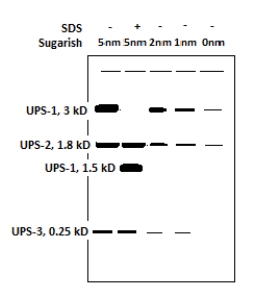 I.UPS-1 functions as a dimer.
II.UPS-1 interacts with UPS-2.
III.UPS-1 interacts with UPS-3.
IV.UPS-2 interacts with UPS-3.
I.UPS-1 functions as a dimer.
II.UPS-1 interacts with UPS-2.
III.UPS-1 interacts with UPS-3.
IV.UPS-2 interacts with UPS-3. (Multiple Choice)
4.8/5 (82)
(82) 
Filters
- Essay(0)
- Multiple Choice(0)
- Short Answer(0)
- True False(0)
- Matching(0)