



 Chat with AI
Exam 12: Enzyme Kinetics, Inhibition and Control

Exam 1: Introduction to the Chemistry of Life56 Questions
Exam 2: Water59 Questions
Exam 3: Nucleotides, Nucleic Acids, and Genetic Information68 Questions
Exam 4: Amino Acids68 Questions
Exam 5: Proteins: Primary Structure68 Questions
Exam 6: Proteins: Three-Dimensional Structure60 Questions
Exam 7: Protein Function Part I: Myoglobin and Hemoglobin74 Questions
Exam 8: Carbohydrates66 Questions
Exam 9: Lipids and Biological Membranes59 Questions
Exam 10: Membrane Transport50 Questions
Exam 11: Enzyme Catalysis53 Questions
Exam 12: Enzyme Kinetics, Inhibition and Control55 Questions
Exam 13: Biochemical Signaling50 Questions
Exam 14: Introduction to Metabolism52 Questions
Exam 15: Glycogen Metabolism and Gluconeogenesis50 Questions
Exam 16: Glucose Catabolism50 Questions
Exam 17: Citric Acid Cycle50 Questions
Exam 18: Electron Transport and Oxidative Phosphorylation50 Questions
Exam 19: Photosynthesis50 Questions
Exam 20: Lipid Metabolism51 Questions
Exam 21: Amino Acid Metabolism50 Questions
Exam 22: Mammalian Fuel Metabolism: Integration and Regulation50 Questions
Exam 23: Nucleotide Metabolism50 Questions
Exam 24: Nucleic Acid Structure50 Questions
Exam 25: Dna Replication, Repair and Recombination50 Questions
Exam 26: Transcription and Rna Processing50 Questions
Exam 27: Translation49 Questions
Exam 28: Regulation of Gene Expression50 Questions
Select questions type


Matching
-Different enzymes that catalyze the same reaction, although may be found in different tissues, are known as ______.
(Multiple Choice)
4.8/5  (92)
(92) Matching
-Assume a first order reaction, the rate of the reaction 2A B is dependent on ______.
(Multiple Choice)
4.8/5 (70)
(70) Enzyme activity in cells is controlled by which of the following?
I.covalent modifications
II.modulation of expression levels
III.feedback inhibition
IV.allosteric effectors
(Multiple Choice)
4.8/5 (87)
(87) The following questions refer to the overall transformation shown in the following reaction:  -For the reaction, the steady state assumption
 (Multiple Choice)
5.0/5 (81)
(81) I propose to design a new drug which will act as an inhibitor for an enzyme.If I have used all current information about the mechanism of this enzyme to design this inhibitor and I carefully engineer it with similar chemical properties of the transition state, what type of inhibitor am I attempting to engineer and how will I know if I have succeeded?
(Multiple Choice)
4.8/5 (80)
(80) The following questions refer to the overall transformation shown in the following reaction:
-Which of the following is (are)true?
-Which of the following is (are)true? (Multiple Choice)
4.8/5 (83)
(83) Enzyme E is responsible for conversion of substrate X to product U.As a result of this conversion electrons are transported to a coenzyme (FAD)within Enzyme E.In order for the reaction to be completed, a second substrate NAD+ must also bind Enzyme E and collect stored electrons (which converts it to product, NADH).The graph below shows the data while varying X, with fixed concentrations of NAD+.What type of multi-substrate mechanism does enzyme E utilize?
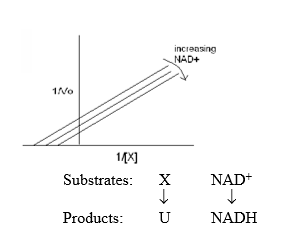
(Multiple Choice)
4.8/5 (73)
(73) From the graph below plotting data that was collected under steady state conditions, velocity on the y-axis in units of μM/s and substrate concentration of the x-axis in units of μM, what is the KM? 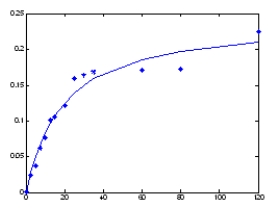
(Multiple Choice)
4.9/5 (73)
(73) The breakdown of dopamine is catalyzed by the enzyme monoamine oxidase (MAO).What is the final concentration of product if the starting dopamine concentration is 0.050 M and the reaction runs for 5 seconds.(Assume the rate constant for the reaction is 0.249 s−1.)
(Multiple Choice)
4.8/5 (80)
(80) Matching
-A lead compound for a new drug should bind to its target protein with a very ______.
(Multiple Choice)
4.8/5 (81)
(81) A Lineweaver-Burk plot is also referred to as
I.a sigmoidal plot.
II.a linear plot.
III.a Michaelis-Menten plot.
IV.a double reciprocal plot.
(Multiple Choice)
4.8/5 (61)
(61) Learning objective: Reaction Kinetics
The following questions refer to the diagram (with boxes where it has been left incomplete): 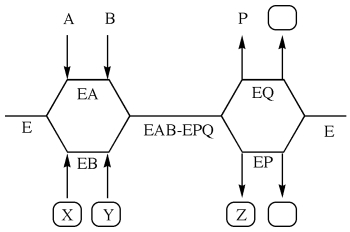 -Which of the following is correct in regards to the diagram above?
 (Multiple Choice)
4.9/5 (81)
(81) ________ clinical trials are focused on evaluating the efficacy of new drug candidates, and usually use _____ test.
(Multiple Choice)
5.0/5 (80)
(80) Pseudo-first-order reaction kinetics would be observed for the reaction A + B C
(Multiple Choice)
4.9/5 (87)
(87) From the graph below plotting data that was collected under steady state conditions, velocity on the y-axis in units of μM/s and substrate concentration of the x-axis in units of μM, what is the Vmax? 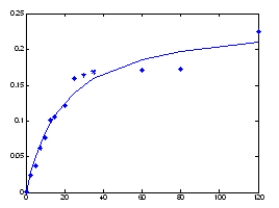
(Multiple Choice)
4.8/5 (82)
(82) Determine the KM and Vmax from the following graph.(Note: On the x-axis the minor tick mark spacing is 0.005; on the y-axis the minor tick mark spacing is 0.002) 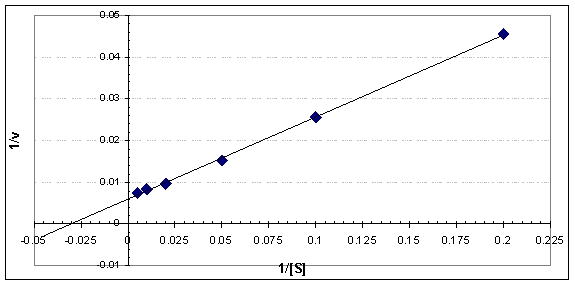
(Multiple Choice)
4.9/5 (74)
(74) Learning objective: Reaction Kinetics
The following questions refer to the diagram (with boxes where it has been left incomplete):
-This diagram refers to a (an)
-This diagram refers to a (an) (Multiple Choice)
4.9/5 (83)
(83) 
Filters
- Essay(0)
- Multiple Choice(0)
- Short Answer(0)
- True False(0)
- Matching(0)