



 Chat with AI
Exam 4: Amino Acids

Exam 1: Introduction to the Chemistry of Life56 Questions
Exam 2: Water59 Questions
Exam 3: Nucleotides, Nucleic Acids, and Genetic Information68 Questions
Exam 4: Amino Acids68 Questions
Exam 5: Proteins: Primary Structure68 Questions
Exam 6: Proteins: Three-Dimensional Structure60 Questions
Exam 7: Protein Function Part I: Myoglobin and Hemoglobin74 Questions
Exam 8: Carbohydrates66 Questions
Exam 9: Lipids and Biological Membranes59 Questions
Exam 10: Membrane Transport50 Questions
Exam 11: Enzyme Catalysis53 Questions
Exam 12: Enzyme Kinetics, Inhibition and Control55 Questions
Exam 13: Biochemical Signaling50 Questions
Exam 14: Introduction to Metabolism52 Questions
Exam 15: Glycogen Metabolism and Gluconeogenesis50 Questions
Exam 16: Glucose Catabolism50 Questions
Exam 17: Citric Acid Cycle50 Questions
Exam 18: Electron Transport and Oxidative Phosphorylation50 Questions
Exam 19: Photosynthesis50 Questions
Exam 20: Lipid Metabolism51 Questions
Exam 21: Amino Acid Metabolism50 Questions
Exam 22: Mammalian Fuel Metabolism: Integration and Regulation50 Questions
Exam 23: Nucleotide Metabolism50 Questions
Exam 24: Nucleic Acid Structure50 Questions
Exam 25: Dna Replication, Repair and Recombination50 Questions
Exam 26: Transcription and Rna Processing50 Questions
Exam 27: Translation49 Questions
Exam 28: Regulation of Gene Expression50 Questions
Select questions type


Matching
-In the tripeptide Lys─Pro─Ile, the C-terminal residue is _________.
(Multiple Choice)
4.9/5  (78)
(78) The pK1, pK2, and pKR for the amino acid histidine are 1.8, 9.3, and 6.0, respectively.At pH 4.0 would be charged predominantly as follows:
(Multiple Choice)
4.9/5 (72)
(72) Matching
-In the peptide Trp─Ser─Val, valine is at the ______.
(Multiple Choice)
4.9/5 (84)
(84) An amide bond between a side-chain carboxylate and an -amino group is also called a(n)
(Multiple Choice)
4.8/5 (93)
(93) Matching
-Glutathione is a tripeptide containing a central ______ residue.
(Multiple Choice)
4.8/5 (89)
(89) Glutamine is an amino acid (pKas are 2.2, and 9.1).Draw the predominant structure of glutamine at pH 1.0.
(Essay)
4.9/5 (89)
(89) Glutamic acid is an amino acid (pKas are 2.1, 4.1 and 9.5).Calculate the isoelectric point of glutamic acid.
(Essay)
4.9/5 (79)
(79) 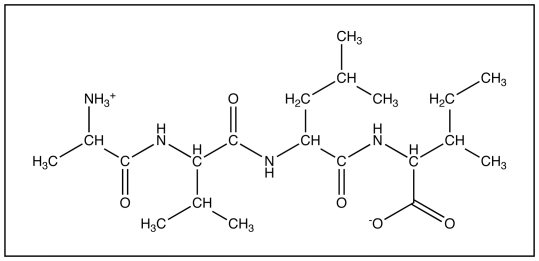
Typically, modified amino acids, those with side chain modifications that are present in proteins
(Multiple Choice)
4.8/5 (77)
(77) Ribosomes use L amino acids to synthesize proteins.These amino acids are called "L" because
(Multiple Choice)
4.8/5 (72)
(72) Which of the following amino acids has a charged polar side chain at pH 7.0?
(Multiple Choice)
4.9/5 (83)
(83) Which of the following amino acids is the least abundant in proteins?
(Multiple Choice)
4.8/5 (91)
(91) Matching
-The net charge of the zwitterion form of Gly is ______.
(Multiple Choice)
4.9/5 (74)
(74) Which of the following amino acids does not have an ionizable side chain?
(Multiple Choice)
4.8/5 (87)
(87) The tripeptide alanyllysylaspartate contains four ionizable groups with pKas of 2.0, 3.9, 9.9, and 10.5.Calculate the pI for this molecule.
(Multiple Choice)
4.9/5 (71)
(71) the diagram below 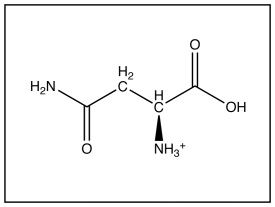 -The ionization of amino acids depends on the pH and the pKas of the ionizable groups.The pK1 and pK2 for the amino acid shown above are 2.1 and 8.8, respectively.At what pH is the amino acid ionized predominantly as shown?
 (Multiple Choice)
5.0/5 (66)
(66) Ribosomes use L amino acids to synthesize proteins.These amino acids are called "L" because
(Multiple Choice)
4.8/5 (76)
(76) The pK1, pK2, and pKR for the amino acid aspartic acid are 2.0, 9.9, and 3.9, respectively.At pH 7.0, aspartic acid would be charged predominantly as follows:
(Multiple Choice)
4.9/5 (88)
(88) 
Filters
- Essay(0)
- Multiple Choice(0)
- Short Answer(0)
- True False(0)
- Matching(0)