



 Chat with AI
Exam 18: Electrochemistry

Exam 1: Chemical Tools: Experimentation and Measurement154 Questions
Exam 2: Atoms, molecules, and Ions275 Questions
Exam 3: Mass Relationships in Chemical Reactions159 Questions
Exam 4: Reactions in Aqueous Solutions211 Questions
Exam 5: Periodicity and the Electronic Structure of Atoms168 Questions
Exam 6: Ionic Compounds: Periodic Trends and Bonding138 Questions
Exam 7: Covalent Bonding and Electron-Dot Structures92 Questions
Exam 8: Covalent Compounds: Bonding Theories and Molecular Structure205 Questions
Exam 9: Thermochemistry: Chemical Energy170 Questions
Exam 10: Gases: Their Properties and Behavior188 Questions
Exam 11: Liquids, solids, and Phase Changes141 Questions
Exam 12: Solutions and Their Properties198 Questions
Exam 13: Chemical Kinetics190 Questions
Exam 14: Chemical Equilibrium171 Questions
Exam 15: Aqueous Equilibria: Acids and Bases231 Questions
Exam 16: Applications of Aqueous Equilibria201 Questions
Exam 17: Thermodynamics: Entropy, free Energy, and Equilibrium150 Questions
Exam 18: Electrochemistry212 Questions
Exam 19: Nuclear Chemistry176 Questions
Exam 20: Transition Elements and Coordination Chemistry190 Questions
Exam 21: Metals and Solid-State Materials154 Questions
Exam 22: The Main-Group Elements294 Questions
Exam 23: Connections to Organic and Biological Chemistry290 Questions
Select questions type


In the galvanic cell represented by the shorthand notation
Al(s)|Al3+(aq)||Fe3+(aq)|Fe(s)
the anode is ________ and the cathode is ________.
(Short Answer)
4.8/5  (80)
(80) Consider the following galvanic cell. 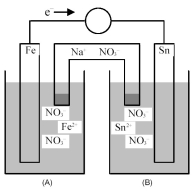 -What is the quantitative change in the cell voltage on increasing the ion concentration in the anode compartment by a factor of 10?
 (Multiple Choice)
4.9/5 (83)
(83) For the galvanic cell reaction,expressed below using shorthand notation,what half-reaction occurs at the cathode? Zn(s)∣ Zn2+(aq)∣∣ Ni2+(aq)∣ Ni(s)
(Multiple Choice)
4.8/5 (78)
(78) Based on the balanced chemical equation shown below,determine the molarity of a solution containing Fe2+(aq),if 40.00 mL of the Fe2+(aq)solution is required to completely react with 30.00 mL of a 0.125 M potassium bromate,KBrO3(aq),solution.The chemical equation for the reaction is: 6 Fe2+(aq)+ BrO3-(aq)+ 6 H+(aq)→ 6 Fe3+(aq)+ Br-(aq)+ 3 H2O(l).
(Multiple Choice)
4.8/5 (79)
(79) Using the following standard reduction potentials, Fe3+(aq)+ e- → Fe2+(aq)E° = +0.77 V
Cd2+(aq)+ 2 e- →Cd(s)E° = -0.40 V
Calculate the standard cell potential for the cell reaction given below,and determine whether or not this reaction is spontaneous under standard conditions.
Cd2+(aq)+ 2 Fe2+(aq)→ 2 Fe3+(aq)+ Cd(s)
(Multiple Choice)
5.0/5 (73)
(73) What is the relationship between the standard cell potentials,E°,for the following two galvanic cell reactions? I.3 Cu2+(aq)+ 2 Al(s)→ 3 Cu(s)+ 2 Al3+(aq)
II.30 Cu2+(aq)+ 22 Al(s)→ 30 Cu(s)+ 22 Al3+(aq)
(Multiple Choice)
4.7/5 (73)
(73) When suspected drunk drivers are tested with a Breathalyzer,the alcohol (ethanol)in the exhaled breath is oxidized to acetic acid with an acidic solution of potassium dichromate: 3 CH3CH2OH(aq)+ 2 Cr2O7-2 (aq)+ 16 H+(aq)3CH3CO2H(aq)+ 4Cr+3(aq)+ 11H2O (l)
What is the value of E for the reaction when the concentrations of ethanol,acetic acid,Cr2O7-2,and Cr+3,are 1.0M and the pH is 4.00? (Eº for this cell is 1.30V and the temperature is 298K).
Equations to solve this problem are below.
Ε = ε° -  lnQ
Ε = 1.30 -
 ln

lnQ
Ε = 1.30 - ln (Multiple Choice)
4.9/5 (74)
(74) What is the standard cell potential for the reaction below? Pb(s)+ Br2(l)→ Pb2+(aq)+ 2 Br-(aq)
The standard reduction potential is -0.13 V for the Pb2+/Pb half-cell and +1.09 V for the Br2/Br- half-cell.
(Multiple Choice)
5.0/5 (88)
(88) A galvanic cell employs the reaction Ni2+(aq)+ Cu(s)→ Ni(s)+ Cu2+(aq)
And KNO3 is the salt used in the salt bridge.During the course of the reaction
(Multiple Choice)
4.8/5 (87)
(87) The cell reaction for a lead storage battery is: Pb(s)+ PbO2(s)+ 2 H+(aq)+ 2 HSO4-(aq)→ 2 PbSO4(s)+ 2 H2O(l)
E° = +1.92 V
To provide a potential of about 12 V,one could
(Multiple Choice)
4.9/5 (87)
(87) Consider the following standard reduction potentials, Al3+(aq)+ 3 e- → Al(s)E° = -1.66 V
I2(s)+ 2 e- → 2 I-(aq)E° = +0.54 V
Under standard conditions,
(Multiple Choice)
5.0/5 (70)
(70) Based on the half-reactions and their respective standard reduction potentials below,the strongest reducing agent is ________,and the strongest oxidizing agent is ________.
Fe3+(aq)+ e- → Fe2+(aq)0.77 V
Cu2+(aq)+ 2 e- → Cu (aq)0.15 V
Zn2+(aq)+ 2 e- → Zn(s)-0.76 V
(Short Answer)
4.8/5 (76)
(76) For the hypothetical reaction A + Bx → Ax + B,E° = 1.30 V and ΔG° = -251 kJ.For this reaction the value of x = ________.
(Short Answer)
4.7/5 (61)
(61) What is the oxidation half reaction in the following chemical reaction? Mn(s)+ 2 H+(aq)→ Mn2+(aq)+ H2(g)
(Multiple Choice)
4.9/5 (88)
(88) What is the balanced equation for the galvanic cell reaction expressed using shorthand notation below? Pt(s)|Sn2+(aq)|Sn4+(aq)∣∣Cl2(l)|Cl-(aq)|Pt(s)
(Multiple Choice)
4.7/5 (92)
(92) Given that E° = +0.897 V,calculate E at 25°C for Pb(s)∣ Pb2+(0.0400 M)∣∣ Fe3+(0.200 M),Fe2+(0.0100 M)∣ Pt(s)
(Multiple Choice)
4.8/5 (72)
(72) When the equation below is balanced in acidic solution using the smallest whole numbers,the coefficient in front of the H2O(l)is ________.
Fe2+(aq)+ BrO3-(aq)→ Fe3+(aq)+ Br-(aq)
(Short Answer)
4.9/5 (69)
(69) The gas OF2 can be produced from the electrolysis of an aqueous solution of KF,as shown in the equation below. OF2(g)+ 2 H+(aq)+ 4 e- → H2O(l)+ 2 F-(aq)E° = +2.15 V
Using the given standard reduction potential,calculate the amount of OF2 that is produced,and the electrode at which the OF2 is produced,upon the passage of 0.240 faradays through an aqueous KF solution.
(Multiple Choice)
4.8/5 (66)
(66) 
Filters
- Essay(0)
- Multiple Choice(0)
- Short Answer(0)
- True False(0)
- Matching(0)