



 Chat with AI
Exam 18: Electrochemistry

Exam 1: Chemical Tools: Experimentation and Measurement154 Questions
Exam 2: Atoms, molecules, and Ions275 Questions
Exam 3: Mass Relationships in Chemical Reactions159 Questions
Exam 4: Reactions in Aqueous Solutions211 Questions
Exam 5: Periodicity and the Electronic Structure of Atoms168 Questions
Exam 6: Ionic Compounds: Periodic Trends and Bonding138 Questions
Exam 7: Covalent Bonding and Electron-Dot Structures92 Questions
Exam 8: Covalent Compounds: Bonding Theories and Molecular Structure205 Questions
Exam 9: Thermochemistry: Chemical Energy170 Questions
Exam 10: Gases: Their Properties and Behavior188 Questions
Exam 11: Liquids, solids, and Phase Changes141 Questions
Exam 12: Solutions and Their Properties198 Questions
Exam 13: Chemical Kinetics190 Questions
Exam 14: Chemical Equilibrium171 Questions
Exam 15: Aqueous Equilibria: Acids and Bases231 Questions
Exam 16: Applications of Aqueous Equilibria201 Questions
Exam 17: Thermodynamics: Entropy, free Energy, and Equilibrium150 Questions
Exam 18: Electrochemistry212 Questions
Exam 19: Nuclear Chemistry176 Questions
Exam 20: Transition Elements and Coordination Chemistry190 Questions
Exam 21: Metals and Solid-State Materials154 Questions
Exam 22: The Main-Group Elements294 Questions
Exam 23: Connections to Organic and Biological Chemistry290 Questions
Select questions type


What is the molarity of a potassium triiodide solution,KI3(aq),if 30.00 mL of the solution is required to completely react with 25.00 mL of a 0.200 M thiosulfate solution,Na2S2O3(aq)? The chemical equation for the reaction is: 
(Multiple Choice)
4.9/5  (82)
(82) Aluminum requires relatively little protection from corrosion because
(Multiple Choice)
4.9/5 (84)
(84) A constant current is passed through a solution containing Cu2+(aq)resulting in the deposition of 4.40 g of Cu at the cathode.Assuming a current efficiency of 100%,if this same current is passed through a solution of TcO4- for the same amount of time,how many grams of Tc would form at the cathode?
(Multiple Choice)
4.9/5 (74)
(74) At 25°C,E° = +1.88 V for a cell based on the reaction 3 AgCl(s)+ Al(s)→ 3 Ag(s)+ Al3+(aq)+ 3 Cl-(aq).
Find the cell potential E if [Al3+] = 0.20 M and [Cl-] = 0.010 M.
(Multiple Choice)
4.9/5 (83)
(83) Consider the following galvanic cell. 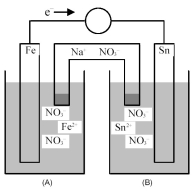 -What is the quantitative change in the cell voltage on increasing the ion concentration in the cathode compartment by a factor of 10?
 (Multiple Choice)
4.9/5 (75)
(75)  -Consider the following table of standard half-cell potentials: A2 + 2 e- → 2 A- E° = + 1.12 V
B4+ + 2 e- → B2+ E° = +0.30 V
C3+ + 3 e- → C E° = -1.66 V
D2+ + 2 e- → D E° = -2.77 V
Which substance is the strongest oxidizing agent?
-Consider the following table of standard half-cell potentials: A2 + 2 e- → 2 A- E° = + 1.12 V
B4+ + 2 e- → B2+ E° = +0.30 V
C3+ + 3 e- → C E° = -1.66 V
D2+ + 2 e- → D E° = -2.77 V
Which substance is the strongest oxidizing agent? (Multiple Choice)
4.9/5 (70)
(70) Determine the number of water molecules necessary to balance the following chemical equation. Cr2O72-(aq)+ Cl-(aq)+ H+(aq)→ Cr3+(aq)+ Cl2(g)+ ________ H2O(l)
(Multiple Choice)
4.9/5 (75)
(75) The shorthand notation for the galvanic cell reaction Fe3+(aq)+ 2 I-(aq)→ Fe2+(aq)+ I2(s)requires an inert electrode on
(Multiple Choice)
4.8/5 (68)
(68) Which of the following statements concerning the electrorefining of copper in not true?
(Multiple Choice)
4.9/5 (83)
(83) Determine the number of water molecules necessary to balance the reduction half reaction of  that occurs in a basic solution.
 (Multiple Choice)
4.8/5 (80)
(80) The galvanic cell represented by the shorthand notation below contains KNO3(aq)in the salt bridge.During the reaction ________ ions flow into the anode compartment,and ________ ions flow into the cathode compartment.
Pt(s)|H2(g)|H+(aq)|| Sn4+(aq)|Sn2+(aq)|Pt(s)
(Short Answer)
4.9/5 (82)
(82) 
Filters
- Essay(0)
- Multiple Choice(0)
- Short Answer(0)
- True False(0)
- Matching(0)