



 Chat with AI
Exam 18: Electrochemistry

Exam 1: Chemical Tools: Experimentation and Measurement154 Questions
Exam 2: Atoms, molecules, and Ions275 Questions
Exam 3: Mass Relationships in Chemical Reactions159 Questions
Exam 4: Reactions in Aqueous Solutions211 Questions
Exam 5: Periodicity and the Electronic Structure of Atoms168 Questions
Exam 6: Ionic Compounds: Periodic Trends and Bonding138 Questions
Exam 7: Covalent Bonding and Electron-Dot Structures92 Questions
Exam 8: Covalent Compounds: Bonding Theories and Molecular Structure205 Questions
Exam 9: Thermochemistry: Chemical Energy170 Questions
Exam 10: Gases: Their Properties and Behavior188 Questions
Exam 11: Liquids, solids, and Phase Changes141 Questions
Exam 12: Solutions and Their Properties198 Questions
Exam 13: Chemical Kinetics190 Questions
Exam 14: Chemical Equilibrium171 Questions
Exam 15: Aqueous Equilibria: Acids and Bases231 Questions
Exam 16: Applications of Aqueous Equilibria201 Questions
Exam 17: Thermodynamics: Entropy, free Energy, and Equilibrium150 Questions
Exam 18: Electrochemistry212 Questions
Exam 19: Nuclear Chemistry176 Questions
Exam 20: Transition Elements and Coordination Chemistry190 Questions
Exam 21: Metals and Solid-State Materials154 Questions
Exam 22: The Main-Group Elements294 Questions
Exam 23: Connections to Organic and Biological Chemistry290 Questions
Select questions type


The initial concentrations of Ag+(aq)and Cu2+(aq)are both 1.0 M.What will happen to the cell voltage if 5.0 M AgNO3 is added to the compartment containing the 1.0 M Ag+(aq)? The cell voltage will
(Multiple Choice)
4.7/5  (70)
(70) What is the molarity of a potassium triiodide solution,KI3(aq),if 30.00 mL of the solution is required to completely react with 25.00 mL of a 0.500 M thiosulfate solution,K2S2O3(aq)? The chemical equation for the reaction is: 2 S2O32-(aq)+ I3-(aq)→ S4O62-(aq)+ 3 I-(aq).
(Multiple Choice)
4.8/5 (84)
(84) Shown below is an electrochemical cell with anode a and cathode c.Both the anode and the cathode are inert electrodes.The liquid shown in compartment b of the cell is molten potassium chloride,KCl(l). 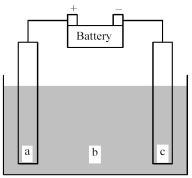 -Determine the direction of electron flow and the direction of ion flow.
 (Multiple Choice)
4.9/5 (79)
(79) Write the overall cell reaction for the galvanic cell given below. Pt(s)∣ H2(g)∣ H+(aq)∣∣ Cl2(g)∣ Cl-(aq)∣ Pt(s)
(Multiple Choice)
4.9/5 (87)
(87) The initial concentrations of Ag+(aq)and Cu2+(aq)are both 1.0 M.What will happen to the cell voltage if  Cu(NO3)2 is added to the compartment containing the 1.0 M Cu2+(aq)? The cell voltage will
 (Multiple Choice)
4.8/5 (91)
(91)  -Based on the following information, Cl2(g)+ 2 e- → 2 Cl-(aq)E° = 1.36 V
Zn2+(aq)+ 2 e- → 2 Zn(s)E° = -0.76 V
Which of the following chemical species is the strongest reducing agent?
-Based on the following information, Cl2(g)+ 2 e- → 2 Cl-(aq)E° = 1.36 V
Zn2+(aq)+ 2 e- → 2 Zn(s)E° = -0.76 V
Which of the following chemical species is the strongest reducing agent? (Multiple Choice)
4.9/5 (61)
(61) A fuel cell is a galvanic cell in which the reactant is a fuel such as
(Multiple Choice)
4.7/5 (72)
(72) A galvanic cell consists of a Al3+/Al half-cell and a standard hydrogen electrode.If the Al3+/Al half-cell standard cell functions as the anode,and the standard cell potential is 1.66 V,what is the standard reduction potential for the Al3+/Al half-cell?
(Multiple Choice)
4.8/5 (82)
(82) Which of the following reactions is most suitable for a fuel cell?
(Multiple Choice)
4.8/5 (67)
(67) In the galvanic cell represented by the shorthand notation below,electrons are lost by ________ and gained by ________.
Pt(s)|Sn2+(aq)|Sn4+(aq)|| Br2(l)|Br-(aq)|Pt(s)
(Short Answer)
4.8/5 (74)
(74) Based on the half-reactions and their respective standard reduction potentials below,the strongest reducing agent is ________,and the strongest oxidizing agent is ________. Ag+(aq)+ e- → Ag(s)0.80 V
2 H+(aq)+ 2 e- → H2(g)0.00 V
Pb2+(aq)+ 2 e- → Pb(s)-0.13 V
(Multiple Choice)
5.0/5 (83)
(83) Which requires the most electricity (in terms of faradays of charge transferred)per gram of useful product formed?
(Multiple Choice)
4.8/5 (78)
(78) Shown below is a galvanic cell with anode compartment b containing anode a and cathode compartment d containing cathode c.Electrons flow through wire f,ions flow through salt bridge e,and the cell potential is read using voltmeter g.
This galvanic cell uses the reaction: 
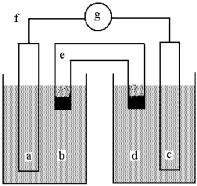 -Identify and give the sign of each electrode.
 (Multiple Choice)
4.7/5 (81)
(81) During an electrochemical reaction,electrons move through the external circuit toward the ________ and positive ions in the cell move toward the ________.
(Multiple Choice)
4.8/5 (64)
(64) If the cell reaction involves ions in solution,as the cell reaction in a galvanic cell continues,
(Multiple Choice)
4.9/5 (85)
(85) What are the coefficients in front of NO3-(aq)and Cu(s)when the following redox equation is balanced in an acidic solution: ________ NO3-(aq)+ ________ Cu(s)→ ________ NO(g)+ ________ Cu2+(aq)?
(Multiple Choice)
4.8/5 (83)
(83) Based on the balanced chemical equation shown below,determine the molarity of a solution containing Fe2+(aq),if 40.00 mL of the Fe2+(aq)solution is required to completely react with 30.00 mL of a 0.500 M potassium bromate,KBrO3(aq),solution.The chemical equation for the reaction is: 6 Fe2+(aq)+ BrO3-(aq)+ 6 H+(aq)→ 6 Fe3+(aq)+ Br-(aq)+ 3 H2O(l).
(Multiple Choice)
4.8/5 (92)
(92) Redox reactions occurring in acid are evident by the appearance of ________ in the balanced equation,and redox reactions occurring in base are evident by the appearance of ________ in the balanced equation.
(Short Answer)
4.8/5 (71)
(71) What are the coefficients in front of NO3-(aq)and Zn(s)when the following equation is balanced in a basic solution? ________ NO3-(aq)+ ________ Ni(s)→ ________ Ni2+(aq)+ ________ NO(g)
(Multiple Choice)
4.9/5 (75)
(75) 
Filters
- Essay(0)
- Multiple Choice(0)
- Short Answer(0)
- True False(0)
- Matching(0)