



 Chat with AI
Exam 13: Chemical Kinetics

Exam 1: Chemistry: The Study of Change153 Questions
Exam 2: Atoms, Molecules, and Ions141 Questions
Exam 3: Mass Relationships in Chemical Reactions168 Questions
Exam 4: Reactions in Aqueous Solution161 Questions
Exam 5: Gases109 Questions
Exam 6: Thermo-Chemistry111 Questions
Exam 7: Quantum Theory and the Electronic Structure of Atoms115 Questions
Exam 8: Periodic Relationships Among the Elements119 Questions
Exam 9: Chemical Bonding I: Basic Concepts118 Questions
Exam 10: Chemical Bonding Ii: Molecular Geometry and Hybridization of Atomic Orbitals122 Questions
Exam 11: Intermolecular Forces and Liquids and Solids140 Questions
Exam 12: Physical Properties of Solutions109 Questions
Exam 13: Chemical Kinetics114 Questions
Exam 14: Chemical Equilibrium100 Questions
Exam 15: Acids and Bases163 Questions
Exam 16: Acid-Base Equilibria and Solubility Equilibria110 Questions
Exam 17: Chemistry in the Atmosphere41 Questions
Exam 18: Entropy, Free Energy, and Equilibrium112 Questions
Exam 19: Electrochemistry138 Questions
Exam 20: Metallurgy and the Chemistry of Metals58 Questions
Exam 21: Nonmetallic Elements and Their Compounds41 Questions
Exam 22: Transition Metal Chemistry and Coordination Compounds80 Questions
Exam 23: Nuclear Chemistry112 Questions
Exam 24: Organic Chemistry57 Questions
Exam 25: Synthetic and Natural Organic Polymers42 Questions
Select questions type


A first-order reaction has a rate constant of 3.00 10-3 s-1. The time required for the reaction to be 75.0% complete is
(Multiple Choice)
4.8/5  (91)
(91) The activation energy for a certain reaction is 113 kJ/mol. By what factor (how many times)will the rate constant increase when the temperature is raised from 310 K to 325 K?
(Short Answer)
4.8/5 (76)
(76) In which of the forms listed below would 0.5 g aluminum react the fastest with gaseous chlorine at 25°C?
(Multiple Choice)
4.9/5 (78)
(78) For the first-order reaction, A products, if half of the initial concentration of A reacts in 20 min, then the remaining half will completely react in the next 20 min.
(True/False)
4.7/5 (61)
(61) The Arrhenius equation is k = Ae-Ea/RT. The slope of a plot of ln k vs.1/T is equal to
(Multiple Choice)
4.8/5 (77)
(77) Peroxodisulfate ion can oxidize iodide ions to iodine according to the balanced equation S2O82- + 2I - 2SO42- + I2.
The reaction is catalyzed by certain chemical species. Identify the catalyst in the following mechanism:
Step 1: Fe3+ + 2I - Fe2+ + I2
step 2: S2O82- + Fe2+ 2SO42- + Fe3+
(Multiple Choice)
4.9/5 (85)
(85) A city's water supply is contaminated with a toxin at a concentration of 0.63 mg/L.For the water to be safe for drinking, the concentration of this toxin must be below 1.5 x 10⁻³ mg/L.Fortunately, this toxin decomposes to a safe mixture of products by first-order kinetics with a rate constant of 0.27 day-1.How long will it take for the water to be safe to drink?
(Multiple Choice)
4.9/5 (85)
(85) What is the rate law that corresponds to the data shown for the reaction 2A + B C? 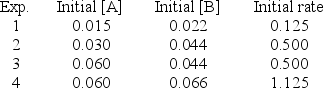
(Short Answer)
5.0/5 (90)
(90) The graphs below all refer to the same reaction. What is the order of this reaction? 
(Multiple Choice)
4.7/5 (97)
(97) A certain first-order reaction A B is 25% complete in 42 min at 25°C. What is the half-life of the reaction?
(Multiple Choice)
4.9/5 (79)
(79) Chlorine dioxide reacts in basic water to form chlorite and chlorate according to the following chemical equation: 2ClO2(aq)+ 2OH-(aq) ClO2-(aq)+ ClO3-(aq)+ H2O(l)
A kinetic study of this reaction under a certain set of conditions yielded the data below.  Which one of the following is the rate law for this reaction?
 (Multiple Choice)
4.9/5 (69)
(69) For the hypothetical reaction A + 3B 2C, the rate of appearance of C given by ( [C]/ t)may also be expressed as
(Multiple Choice)
5.0/5 (81)
(81) A certain reaction A products is second order in A. If this reaction is 10.% complete after 20.s, how long would it take for the reaction to be 90.% complete?
(Multiple Choice)
4.8/5 (64)
(64) The reaction A + 2B products was found to have the rate law, rate = k[A] [B]2.Predict by what factor the rate of reaction will increase when the concentration of A is doubled and the concentration of B is also doubled.
(Multiple Choice)
4.8/5 (68)
(68) The activation energy of a certain uncatalyzed reaction is 64 kJ/mol. In the presence of a catalyst, the Ea is 55 kJ/mol. How many times faster is the catalyzed than the uncatalyzed reaction at 400°C? Assume that the frequency factor remains the same.
(Multiple Choice)
5.0/5 (79)
(79) The activation energy for the reaction CH3CO CH3 + CO is 71 kJ/mol. How many times greater is the rate constant for this reaction at 170°C than at 150°C?
(Multiple Choice)
4.8/5 (82)
(82) The isomerization of cyclopropane to form propene is a first-order reaction.  At 760 K, 15% of a sample of cyclopropane changes to propene in 6.8 min.What is the half-life of cyclopropane at 760 K?
 (Multiple Choice)
4.9/5 (66)
(66) The reaction 2NO2(g) 2NO(g)+ O2(g)is suspected to be second order in NO2. Which of the following kinetic plots would be the most useful to confirm whether or not the reaction is second order?
(Multiple Choice)
4.9/5 (86)
(86) 
Filters
- Essay(0)
- Multiple Choice(0)
- Short Answer(0)
- True False(0)
- Matching(0)