



 Chat with AI
Exam 13: Chemical Kinetics

Exam 1: Chemistry: The Study of Change153 Questions
Exam 2: Atoms, Molecules, and Ions141 Questions
Exam 3: Mass Relationships in Chemical Reactions168 Questions
Exam 4: Reactions in Aqueous Solution161 Questions
Exam 5: Gases109 Questions
Exam 6: Thermo-Chemistry111 Questions
Exam 7: Quantum Theory and the Electronic Structure of Atoms115 Questions
Exam 8: Periodic Relationships Among the Elements119 Questions
Exam 9: Chemical Bonding I: Basic Concepts118 Questions
Exam 10: Chemical Bonding Ii: Molecular Geometry and Hybridization of Atomic Orbitals122 Questions
Exam 11: Intermolecular Forces and Liquids and Solids140 Questions
Exam 12: Physical Properties of Solutions109 Questions
Exam 13: Chemical Kinetics114 Questions
Exam 14: Chemical Equilibrium100 Questions
Exam 15: Acids and Bases163 Questions
Exam 16: Acid-Base Equilibria and Solubility Equilibria110 Questions
Exam 17: Chemistry in the Atmosphere41 Questions
Exam 18: Entropy, Free Energy, and Equilibrium112 Questions
Exam 19: Electrochemistry138 Questions
Exam 20: Metallurgy and the Chemistry of Metals58 Questions
Exam 21: Nonmetallic Elements and Their Compounds41 Questions
Exam 22: Transition Metal Chemistry and Coordination Compounds80 Questions
Exam 23: Nuclear Chemistry112 Questions
Exam 24: Organic Chemistry57 Questions
Exam 25: Synthetic and Natural Organic Polymers42 Questions
Select questions type


The isomerization of cyclopropane to form propene is a first-order reaction.  At 760 K, 85% of a sample of cyclopropane changes to propene in 79.0 min. Determine the rate constant for this reaction at 760 K.
 (Multiple Choice)
4.8/5  (68)
(68) Substitute natural gas can be synthesized by passing carbon monoxide and hydrogen over Ni or Co at 400°C. 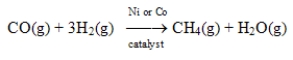 This process is an example of homogeneous catalysis.
 (True/False)
4.9/5 (77)
(77) Chlorine dioxide reacts in basic water to form chlorite and chlorate according to the following chemical equation: 2ClO2(aq)+ 2OH-(aq) ClO2-(aq)+ ClO3-(aq)+ H2O(l)
Under a certain set of conditions, the initial rate of disappearance of chlorine dioxide was determined to be 2.30 x 10⁻¹ M/s.What is the initial rate of appearance of chlorite ion under thos same conditions?
(Multiple Choice)
4.9/5 (78)
(78) It takes 42.0 min for the concentration of a reactant in a first-order reaction to drop from 0.45 M to 0.32 M at 25°C. How long will it take for the reaction to be 90% complete?
(Multiple Choice)
5.0/5 (84)
(84) For the overall chemical reaction shown below, which one of the following statements can be rightly assumed? 2H2S(g)+ O2(g) 2S(s)+ 2H2O(l)
(Multiple Choice)
4.8/5 (76)
(76) A rate constant will have the units mol L-1 s-1 when the reaction is overall
(Multiple Choice)
4.9/5 (76)
(76) The rate law for the reaction H2O2 + 2H+ + 2I - I2 + 2H2O is rate = k[H2O2][I -]. The following mechanism has been suggested.  Identify all intermediates included in this mechanism.
 (Multiple Choice)
4.8/5 (78)
(78) Given that Ea for a certain biological reaction is 48 kJ/mol and that the rate constant is 2.5 10-2 s-1 at 15°C, what is the rate constant at 37°C?
(Multiple Choice)
4.9/5 (80)
(80) At a certain temperature, the data below were collected for the reaction below.
2ICl + H2 I2 + 2HCl.
Determine the rate constant for the reaction. 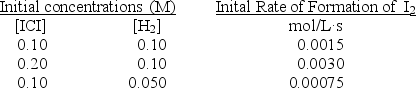
(Short Answer)
4.7/5 (97)
(97) For the reaction X2 + Y + Z XY + XZ, it is found that the rate equation is rate = k [X2][Y]. Why does the concentration of Z have no effect on the rate?
(Multiple Choice)
4.9/5 (91)
(91) Nitrous oxide (N2O)decomposes at 600°C according to the balanced equation 2N2O(g) 2N2(g)+ O2(g)
A reaction mechanism involving three steps is shown below. Identify all of the catalysts in the following mechanism.
Cl2(g) 2Cl(g)
N2O(g)+ Cl(g) N2(g)+ ClO(g)(occurs twice)
ClO(g)+ ClO(g) Cl2(g)+ O2(g)
(Multiple Choice)
4.8/5 (71)
(71) Benzoyl chloride, C6H5COCl, reacts with water to form benzoic acid, C6H5COOH, and hydrochloric acid. This first-order reaction is 25% complete after 26 s. How much longer would one have to wait in order to obtain 99% conversion of benzoyl chloride to benzoic acid?
(Multiple Choice)
4.8/5 (81)
(81) The data below were determined for the reaction shown below. S2O82- + 3I - (aq) 2SO42- + I3-  The rate law for this reaction must be:
 (Multiple Choice)
4.8/5 (96)
(96) Nitrogen pentoxide decomposes by a first-order process yielding N2O4 and oxygen.
2N2O5 2N2O4 + O2
At a given temperature, the half-life of N2O5 is 0.90 hr. What is the first-order rate constant for N2O5 decomposition?
(Short Answer)
4.9/5 (76)
(76) If Ea for a certain biological reaction is 50.kJ/mol, by what factor (how many times)will the rate of this reaction increase when body temperature increases from 37°C (normal)to 40°C (fever)?
(Multiple Choice)
4.7/5 (66)
(66) The first-order decomposition of phosphene to phosphorus and hydrogen 4PH3(g) P4(g)+ 6H2(g)
Has a half-life of 35.0 s at 680°C. Starting with 520 mmHg of pure phosphene in an 8.00-L flask at 680°C, how long will it take for the total pressure in the flask to rise to 1.000 atm?
(Multiple Choice)
4.9/5 (84)
(84) For the reaction C6H14(g) C6H6(g)+ 4H2(g), P(H2)/ t was found to be 2.5 * 10-2 atm/s, where P(H2)is the change in pressure of hydrogen. Determine P(C6H14)/ t for this reaction at the same time.
(Multiple Choice)
4.8/5 (70)
(70) 
Filters
- Essay(0)
- Multiple Choice(0)
- Short Answer(0)
- True False(0)
- Matching(0)