



 Chat with AI
Exam 22: Transition Metal Chemistry and Coordination Compounds

Exam 1: Chemistry: The Study of Change153 Questions
Exam 2: Atoms, Molecules, and Ions141 Questions
Exam 3: Mass Relationships in Chemical Reactions168 Questions
Exam 4: Reactions in Aqueous Solution161 Questions
Exam 5: Gases109 Questions
Exam 6: Thermo-Chemistry111 Questions
Exam 7: Quantum Theory and the Electronic Structure of Atoms115 Questions
Exam 8: Periodic Relationships Among the Elements119 Questions
Exam 9: Chemical Bonding I: Basic Concepts118 Questions
Exam 10: Chemical Bonding Ii: Molecular Geometry and Hybridization of Atomic Orbitals122 Questions
Exam 11: Intermolecular Forces and Liquids and Solids140 Questions
Exam 12: Physical Properties of Solutions109 Questions
Exam 13: Chemical Kinetics114 Questions
Exam 14: Chemical Equilibrium100 Questions
Exam 15: Acids and Bases163 Questions
Exam 16: Acid-Base Equilibria and Solubility Equilibria110 Questions
Exam 17: Chemistry in the Atmosphere41 Questions
Exam 18: Entropy, Free Energy, and Equilibrium112 Questions
Exam 19: Electrochemistry138 Questions
Exam 20: Metallurgy and the Chemistry of Metals58 Questions
Exam 21: Nonmetallic Elements and Their Compounds41 Questions
Exam 22: Transition Metal Chemistry and Coordination Compounds80 Questions
Exam 23: Nuclear Chemistry112 Questions
Exam 24: Organic Chemistry57 Questions
Exam 25: Synthetic and Natural Organic Polymers42 Questions
Select questions type


In the following pair of complex ions, choose the one that absorbs light at a longer wavelength.

Free
(Multiple Choice)
5.0/5  (80)
(80) Correct Answer: Verified
A
Draw and label the geometric isomers of [CrF2Cl4]3-?
Free
(Essay)
4.9/5 (81)
(81) Correct Answer:Verified
Verified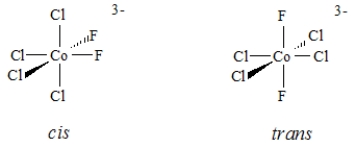
Predict the number of unpaired electrons in the [CrCl6]4- ion.
Free
(Short Answer)
4.8/5 (77)
(77) Correct Answer:Verified
Verified4
Predict the number of unpaired electrons in the [Fe(CN)6]3- ion.
(Short Answer)
5.0/5 (83)
(83) The ion [Co(NH3)6]2+ is octahedral and high spin. This complex is
(Multiple Choice)
4.7/5 (77)
(77) The correct formula for the dibromobis(oxalato)cobaltate(III)ion is [Co(C2O4)Br2]3+.
(True/False)
4.8/5 (77)
(77) Predict the number of unpaired electrons in the [Cr(en)3]2+ ion.
(Short Answer)
4.9/5 (81)
(81) In the coordination compound [Cr(NH3)(en)2Cl]Br2, the coordination number (C.N.)and oxidation number (O.N.)of the metal atom are, respectively,
(Multiple Choice)
4.8/5 (83)
(83) The numbers of geometrical isomers and optical isomers of the complex ion [Co(en)3]3+ are, respectively,
(Multiple Choice)
4.8/5 (94)
(94) In the coordination compound [Co(en)2Cl2]Cl, the coordination number and oxidation number of the central atom are, respectively,
(Multiple Choice)
4.9/5 (79)
(79) Bidentate and polydentate ligands are also called chelating agents.
(True/False)
4.8/5 (83)
(83) In the complex ion [ML6]n+, Mn+ has six d electrons and L is a weak field ligand.According to crystal field theory, the magnetic properties of the complex ion correspond to how many unpaired electrons?
(Multiple Choice)
4.7/5 (79)
(79) The total number of electrons in the 3d orbitals of Ti3+ is
(Multiple Choice)
4.9/5 (83)
(83) Write the chemical formula of the dibromobis(oxalato)cobaltate(III)ion.
(Essay)
4.9/5 (87)
(87) In the complex ion [ML6]n+, Mn+ has seven d electrons and L is a weak field ligand.According to crystal field theory, the magnetic properties of the complex ion correspond to how many unpaired electrons?
(Multiple Choice)
4.7/5 (77)
(77) 
Filters
- Essay(0)
- Multiple Choice(0)
- Short Answer(0)
- True False(0)
- Matching(0)