



 Chat with AI
Exam 9: Chemical Bonding I: Basic Concepts

Exam 1: Chemistry: The Study of Change153 Questions
Exam 2: Atoms, Molecules, and Ions141 Questions
Exam 3: Mass Relationships in Chemical Reactions168 Questions
Exam 4: Reactions in Aqueous Solution161 Questions
Exam 5: Gases109 Questions
Exam 6: Thermo-Chemistry111 Questions
Exam 7: Quantum Theory and the Electronic Structure of Atoms115 Questions
Exam 8: Periodic Relationships Among the Elements119 Questions
Exam 9: Chemical Bonding I: Basic Concepts118 Questions
Exam 10: Chemical Bonding Ii: Molecular Geometry and Hybridization of Atomic Orbitals122 Questions
Exam 11: Intermolecular Forces and Liquids and Solids140 Questions
Exam 12: Physical Properties of Solutions109 Questions
Exam 13: Chemical Kinetics114 Questions
Exam 14: Chemical Equilibrium100 Questions
Exam 15: Acids and Bases163 Questions
Exam 16: Acid-Base Equilibria and Solubility Equilibria110 Questions
Exam 17: Chemistry in the Atmosphere41 Questions
Exam 18: Entropy, Free Energy, and Equilibrium112 Questions
Exam 19: Electrochemistry138 Questions
Exam 20: Metallurgy and the Chemistry of Metals58 Questions
Exam 21: Nonmetallic Elements and Their Compounds41 Questions
Exam 22: Transition Metal Chemistry and Coordination Compounds80 Questions
Exam 23: Nuclear Chemistry112 Questions
Exam 24: Organic Chemistry57 Questions
Exam 25: Synthetic and Natural Organic Polymers42 Questions
Select questions type


Carbonic acid, H2CO3, is a weak acid that contributes to the taste and produces the carbon dioxide bubbles in all carbonated beverages.Write a Lewis structure for H2CO3,

Free
(Essay)
4.8/5  (81)
(81) Correct Answer: Verified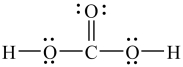
The number of resonance structures for the nitrate ion that satisfy the octet rule is
Free
(Multiple Choice)
4.7/5 (85)
(85) Correct Answer:Verified
VerifiedC
Which one of the following is most likely to be an ionic compound?
Free
(Multiple Choice)
4.8/5 (82)
(82) Correct Answer:Verified
VerifiedA
Which one of the following molecules has an atom with an expanded octet?
(Multiple Choice)
4.8/5 (97)
(97) Which one of the following is most likely to be a covalent compound?
(Multiple Choice)
4.9/5 (69)
(69) Calculate the energy change for the reaction K(g)+ Br(g) K+(g)+ Br- (g)
Given the following ionization energy (IE)and electron affinity (EA)values 
(Multiple Choice)
4.9/5 (80)
(80) Which of the following is a useful guideline for the application of formal charges in neutral molecules?
(Multiple Choice)
4.7/5 (75)
(75) Which one of the following ionic solids would have the largest lattice energy?
(Multiple Choice)
4.8/5 (76)
(76) Assuming the octet rule is obeyed, how many covalent bonds will a nitrogen atom form to give a formal charge of zero?
(Multiple Choice)
4.8/5 (72)
(72) Nitrous oxide, N2O, is sometimes called "laughing gas". What is the formal charge on the central nitrogen atom in the best Lewis structure for nitrous oxide? (The atom connectivity is N-N-O.)
(Multiple Choice)
4.9/5 (92)
(92) Write the chemical equation for which the enthalpy of reaction is the lattice energy of KCl(s).
(Essay)
4.7/5 (75)
(75) Write a Lewis structure for the chlorate ion, ClO3-, that expands the octet to minimize formal charge and if necessary places negative formal charges on the most electronegative atom(s).
(Essay)
4.7/5 (73)
(73) Use bond energies to estimate the enthalpy of formation of HBr(g). BE(H-H)= 436 kJ/mol
BE(Br-Br)= 192 kJ/mol
BE(H-Br)= 366 kJ/mol
(Multiple Choice)
4.8/5 (94)
(94) Write a Lewis structure for the phosphate ion, PO43-, that obeys the octet rule, showing all non-zero formal charges, and give the total number of resonance structures for PO43- that obey the octet rule.
(Essay)
4.7/5 (68)
(68) Write a Lewis structure for SO3 that expands the octet to minimize formal charge and if necessary places negative formal charges on the most electronegative atom(s).
(Essay)
4.9/5 (87)
(87) Write a Lewis structure for the chlorite ion, ClO2-, that expands the octet to minimize formal charge and if necessary places negative formal charges on the most electronegative atom(s).
(Essay)
4.9/5 (74)
(74) 
Filters
- Essay(0)
- Multiple Choice(0)
- Short Answer(0)
- True False(0)
- Matching(0)