



 Chat with AI
Exam 13: Chemical Kinetics

Exam 1: Chemistry: The Study of Change153 Questions
Exam 2: Atoms, Molecules, and Ions141 Questions
Exam 3: Mass Relationships in Chemical Reactions168 Questions
Exam 4: Reactions in Aqueous Solution161 Questions
Exam 5: Gases109 Questions
Exam 6: Thermo-Chemistry111 Questions
Exam 7: Quantum Theory and the Electronic Structure of Atoms115 Questions
Exam 8: Periodic Relationships Among the Elements119 Questions
Exam 9: Chemical Bonding I: Basic Concepts118 Questions
Exam 10: Chemical Bonding Ii: Molecular Geometry and Hybridization of Atomic Orbitals122 Questions
Exam 11: Intermolecular Forces and Liquids and Solids140 Questions
Exam 12: Physical Properties of Solutions109 Questions
Exam 13: Chemical Kinetics114 Questions
Exam 14: Chemical Equilibrium100 Questions
Exam 15: Acids and Bases163 Questions
Exam 16: Acid-Base Equilibria and Solubility Equilibria110 Questions
Exam 17: Chemistry in the Atmosphere41 Questions
Exam 18: Entropy, Free Energy, and Equilibrium112 Questions
Exam 19: Electrochemistry138 Questions
Exam 20: Metallurgy and the Chemistry of Metals58 Questions
Exam 21: Nonmetallic Elements and Their Compounds41 Questions
Exam 22: Transition Metal Chemistry and Coordination Compounds80 Questions
Exam 23: Nuclear Chemistry112 Questions
Exam 24: Organic Chemistry57 Questions
Exam 25: Synthetic and Natural Organic Polymers42 Questions
Select questions type


Nitric acid is formed by the gas-phase hydrolysis of N2O5. For the reaction N2O5 + H2O 2HNO3, Ea(forward)= 15 kJ/mol and Ea(reverse)= 51 kJ/mol. Calculate Hrxn.

Free
(Short Answer)
4.8/5  (90)
(90) Correct Answer: Verified
-36 kJ/mol
A first-order reaction has a rate constant of 7.5 10-3 /s. The time required for the reaction to be 60% complete is
Free
(Multiple Choice)
4.9/5 (83)
(83) Correct Answer:Verified
VerifiedD
At 30°C, by how much is a reaction's activation energy decreased by the addition of a catalyst if the catalyst triples the reaction rate?
Free
(Multiple Choice)
4.9/5 (88)
(88) Correct Answer:Verified
VerifiedA
A city's water supply is contaminated with a toxin at a concentration of 0.63 mg/L.Fortunately, this toxin decomposes to a safe mixture of products by first-order kinetics with a rate constant of 0.27 day-1.How long will it take for half of the toxin to decompose?
(Multiple Choice)
4.9/5 (85)
(85) The rate constant for the first-order decomposition of C4H8 at 500°C is 9.2 10-3 s-1.How long will it take for 10.0% of a 0.100 M sample of C4H8 to decompose at 500°C?
(Short Answer)
4.8/5 (91)
(91) An experimental drug, D, is known to decompose in the blood stream.Tripling the concentration of the drug increases the decomposition rate by a factor of nine.Write the rate law for decomposition of D and give the units of the rate constant.
(Essay)
4.7/5 (82)
(82) For the following exothermic reaction, the rate law at 298 K is rate = k [H2][I2].
H2(g)+ I2(g) 2HI(g)
Predict the effect of each of the following changes on the initial rate of the reaction:
a.Addition of hydrogen gas at constant temperature and volume
b.Increase in volume of the reaction vessel at constant temperature
c.Addition of a catalyst
d.Increase in temperature
(Essay)
4.9/5 (91)
(91) For the reaction represented below, the experimental rate law is given by rate = k [(CH3)3CCl].
(CH3)3CCl(aq)+ OH- (CH3)3COH(aq)+ Cl-
If some solid sodium hydroxide were added to a solution in which [(CH3)3CCl] = 0.01 M and
[NaOH] = 0.10 M, which of the following would be true? (Assume the temperature and volume remain constant.)
(Multiple Choice)
4.8/5 (77)
(77) With respect to the figure below, which choice correctly identifies all the numbered positions? 

(Short Answer)
4.8/5 (78)
(78) At a certain temperature, the data below were collected for the reaction below.
2ICl + H2 I2 + 2HCl.
Determine the rate law for the reaction. 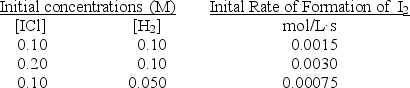
(Short Answer)
4.7/5 (78)
(78) The first-order reaction SO2Cl2 SO2 + Cl2 is 10% complete in 80.min. How long would it take for the reaction to be 95% complete?
(Multiple Choice)
4.9/5 (87)
(87) The rate law for the reaction 2NO2 + O3 N2O5 + O2 is rate = k[NO2][O3]. Which one of the following mechanisms is consistent with this rate law?
(Multiple Choice)
4.7/5 (83)
(83) The first-order decomposition of SO2Cl2 to sulfur dioxide gas and chlorine gas at 320°C has a half-life of 8.75 hr. If one begins with 600.mmHg of pure SO2Cl2 in a 5.00-L flask at 320°C, how long does it take for the total pressure in the flask to rise to 1.000 atm?
(Multiple Choice)
4.9/5 (87)
(87) For the reaction X + Y Z, the reaction rate is found to depend only upon the concentration of X. A plot of 1/X verses time gives a straight line.  What is the rate law for this reaction?
 (Multiple Choice)
4.8/5 (72)
(72) The activation energy for the following reaction is 60.kJ/mol. Sn2+ + 2Co3+ Sn4+ + 2Co2+
By what factor (how many times)will the rate constant increase when the temperature is raised from 10°C to 28°C?
(Multiple Choice)
4.8/5 (71)
(71) The reaction A + 2B products has the rate law, rate = k[A][B]3. If the concentration of B is doubled while that of A is unchanged, by what factor will the rate of reaction increase?
(Multiple Choice)
4.8/5 (80)
(80) At a particular temperature the first-order gas-phase reaction N2O5 2NO2 + 1/2O2 has a half-life for the disappearance of dinitrogen pentoxide of 5130 s. Suppose 0.450 atm of N2O5 is introduced into an evacuated 2.00 L flask. What will be the total gas pressure inside the flask after 3.00 hours?
(Multiple Choice)
5.0/5 (88)
(88) For the reaction whose rate law is rate = k[X], a plot of which of the following is a straight line?
(Multiple Choice)
5.0/5 (79)
(79) The gas phase reaction of nitrogen dioxide and carbon monoxide was found by experiment to be second-order with respect to NO2, and zeroth-order with respect to CO below 25°C. NO2 + CO NO + CO2
Which one of the following mechanisms is consistent with the observed reaction order?
(Multiple Choice)
4.9/5 (70)
(70) 
Filters
- Essay(0)
- Multiple Choice(0)
- Short Answer(0)
- True False(0)
- Matching(0)