



 Chat with AI
Exam 13: Chemical Kinetics

Exam 1: Chemistry: The Study of Change153 Questions
Exam 2: Atoms, Molecules, and Ions141 Questions
Exam 3: Mass Relationships in Chemical Reactions168 Questions
Exam 4: Reactions in Aqueous Solution161 Questions
Exam 5: Gases109 Questions
Exam 6: Thermo-Chemistry111 Questions
Exam 7: Quantum Theory and the Electronic Structure of Atoms115 Questions
Exam 8: Periodic Relationships Among the Elements119 Questions
Exam 9: Chemical Bonding I: Basic Concepts118 Questions
Exam 10: Chemical Bonding Ii: Molecular Geometry and Hybridization of Atomic Orbitals122 Questions
Exam 11: Intermolecular Forces and Liquids and Solids140 Questions
Exam 12: Physical Properties of Solutions109 Questions
Exam 13: Chemical Kinetics114 Questions
Exam 14: Chemical Equilibrium100 Questions
Exam 15: Acids and Bases163 Questions
Exam 16: Acid-Base Equilibria and Solubility Equilibria110 Questions
Exam 17: Chemistry in the Atmosphere41 Questions
Exam 18: Entropy, Free Energy, and Equilibrium112 Questions
Exam 19: Electrochemistry138 Questions
Exam 20: Metallurgy and the Chemistry of Metals58 Questions
Exam 21: Nonmetallic Elements and Their Compounds41 Questions
Exam 22: Transition Metal Chemistry and Coordination Compounds80 Questions
Exam 23: Nuclear Chemistry112 Questions
Exam 24: Organic Chemistry57 Questions
Exam 25: Synthetic and Natural Organic Polymers42 Questions
Select questions type


The activation energy for the following first-order reaction is 102 kJ/mol. N2O5(g) 2NO2(g)+ 1/2O2(g)
The value of the rate constant (k)is 1.35 10-4 s-1 at 35°C. What is the value of k at 0°C?
(Multiple Choice)
4.9/5  (82)
(82) When the concentrations of reactant molecules are increased, the rate of reaction increases.The best explanation for this phenomenon is that as the reactant concentration increases,
(Multiple Choice)
4.9/5 (74)
(74) The oxidation of iodide ions by arsenic acid in acidic aqueous solution occurs according to the net reaction H3AsO4 + 3I - + 2 H3O + H3AsO3 + I3- + H2O.The experimental rate law for this reaction is
Rate = k [H3AsO4] [I-] [H3O+].
According to the rate law for the reaction, an increase in the concentration of hydronium ion has what effect on this reaction?
(Essay)
4.8/5 (79)
(79) In the reaction, 2N2O 2N2 + O2, oxygen and nitrogen gases are formed at the same rate (mol/L·s).
(True/False)
4.8/5 (59)
(59) At 25°C, by what factor is the reaction rate increased by a catalyst that reduces the activation energy of the reaction by 1.00 kJ/mol?
(Multiple Choice)
4.9/5 (85)
(85) The rate constant of a first-order reaction, A products, can be determined from a graph of ln[A] versus t.
(True/False)
4.8/5 (82)
(82) The isomerization of cyclopropane follows first order kinetics. The rate constant at 700 K is 6.20 10-4 min-1, and the half-life at 760 K is 29.0 min. Calculate the activation energy for this reaction.
(Multiple Choice)
4.7/5 (97)
(97) Calculate the activation energy, in kJ/mol, for the redox reaction Sn2+ + 2Co3+ Sn4+ + 2Co2+. 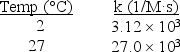
(Multiple Choice)
4.7/5 (77)
(77) The following initial rate data apply to the reaction below. F2(g)+ 2Cl2O(g) 2FClO2(g)+ Cl2(g)  Which of the following is the rate law (rate equation)for this reaction?
 (Multiple Choice)
4.9/5 (80)
(80) A nuclear stress test utilizes a gamma-emitting radioisotope such as thallium-201 to follow the flow of blood through the heart - first at rest, and then under stress.The first-order rate constant for the decay of thallium-201 is 9.5 x 10⁻³ hr-1.Calculate how long it takes for the amount of thallium-201 to fall to 5.0% of its original value.
(Short Answer)
4.8/5 (84)
(84) Nitric acid is formed by the gas-phase hydrolysis of N2O5. Draw an energy profile curve for the reaction N2O5 + H2O 2HNO3 given that Ea(forward)= 15 kJ and Ea(reverse)= 51 kJ/mol.Label the activation energies of the forward and reverse reactions and label H for the reaction.
(Essay)
4.8/5 (91)
(91) What is the slope of an Arrhenius plot for the following reaction? 2NOCl 2NO + Cl2 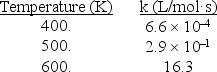
(Multiple Choice)
4.9/5 (61)
(61) Ammonium ion (NH4+)reacts with nitrite ion (NO2-)to yield nitrogen gas and liquid water.The following initial rates of reaction have been measured for the given reactant concentrations.  Which of the following is the rate law (rate equation)for this reaction?
 (Multiple Choice)
4.9/5 (92)
(92) The isomerization of methyl isocyanide, CH3NC CH3CN, follows first-order kinetics.The half-lives were found to be 161 min at 199°C and 12.5 min at 230°C. Calculate the activation energy for this reaction.
(Multiple Choice)
4.7/5 (75)
(75) 
Filters
- Essay(0)
- Multiple Choice(0)
- Short Answer(0)
- True False(0)
- Matching(0)