



 Chat with AI
Exam 13: Chemical Kinetics

Exam 1: Chemistry: The Study of Change153 Questions
Exam 2: Atoms, Molecules, and Ions141 Questions
Exam 3: Mass Relationships in Chemical Reactions168 Questions
Exam 4: Reactions in Aqueous Solution161 Questions
Exam 5: Gases109 Questions
Exam 6: Thermo-Chemistry111 Questions
Exam 7: Quantum Theory and the Electronic Structure of Atoms115 Questions
Exam 8: Periodic Relationships Among the Elements119 Questions
Exam 9: Chemical Bonding I: Basic Concepts118 Questions
Exam 10: Chemical Bonding Ii: Molecular Geometry and Hybridization of Atomic Orbitals122 Questions
Exam 11: Intermolecular Forces and Liquids and Solids140 Questions
Exam 12: Physical Properties of Solutions109 Questions
Exam 13: Chemical Kinetics114 Questions
Exam 14: Chemical Equilibrium100 Questions
Exam 15: Acids and Bases163 Questions
Exam 16: Acid-Base Equilibria and Solubility Equilibria110 Questions
Exam 17: Chemistry in the Atmosphere41 Questions
Exam 18: Entropy, Free Energy, and Equilibrium112 Questions
Exam 19: Electrochemistry138 Questions
Exam 20: Metallurgy and the Chemistry of Metals58 Questions
Exam 21: Nonmetallic Elements and Their Compounds41 Questions
Exam 22: Transition Metal Chemistry and Coordination Compounds80 Questions
Exam 23: Nuclear Chemistry112 Questions
Exam 24: Organic Chemistry57 Questions
Exam 25: Synthetic and Natural Organic Polymers42 Questions
Select questions type


Nitric oxide gas (NO)reacts with chlorine gas according to the chemical equation given below. NO +  Cl2 NOCl
The following initial rates of reaction have been measured for the given reagent concentrations.
 Which of the following is the rate law (rate equation)for this reaction?
Cl2 NOCl
The following initial rates of reaction have been measured for the given reagent concentrations. Which of the following is the rate law (rate equation)for this reaction? (Multiple Choice)
4.8/5  (73)
(73) Hydrogen peroxide decomposes to water and oxygen gas, and the activation energy for this process is 42 kJ/mol.The hydrogen peroxide formed in biological processes is harmful to tissue, but the enzyme catalase catalyzes the decomposition hydrogen peroxide by lowering the activation energy to 7.0 kJ/mol.Assuming the frequency factor is the same for both processes and independent of temperature, calculate the temperature required for the uncatalyzed decomposition to proceed at the same rate as the enzyme-catalyzed decomposition at 37°C (normal human body temperature).Is this a reasonable temperature for a biological organism?
(Short Answer)
5.0/5 (81)
(81) Aspirin, C9H8O4, slowly decomposes at room temperature by reacting with water in the atmosphere to produce acetic acid, HC2H3O2, and 2-hydroxybenzoic acid, C7H6O3 (this is why old bottles of aspirin often smell like vinegar):
C9H8O4 + H2O HC2H3O2 + C7H6O3
Concentration and rate data for this reaction are given below. 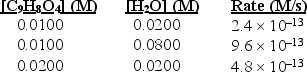 Write the rate law for this reaction and calculate k (be sure to include the correct units).
 (Essay)
4.8/5 (75)
(75) The activation energy for the reaction O + O3 2O2 is 25 kJ/mol, and the enthalpy change is H = -388 kJ/mol. What is the activation energy for the decomposition of O2 by the reverse reaction?
(Multiple Choice)
4.9/5 (84)
(84) Sucrose, C12H22O11, reacts slowly with water in the presence of an acid to form two other sugars, glucose and fructose, both of which have the same molecular formulas, but different structures.
C12H22O11 + H2O C6H12O6 (glucose)+ C6H12O6 (fructose)
The reaction is first order and has a rate constant of 6.2 10-5/s at 35°C when the H+ concentration is 0.10 M.Suppose that the initial concentration of sucrose in the solution is 0.40 M. What will the sucrose concentration be after 2.0 hours?
(Short Answer)
4.8/5 (86)
(86) For the chemical reaction A C, a plot of 1/[A]t versus time was found to give a straight line with a positive slope. What is the order of reaction?
(Multiple Choice)
4.7/5 (86)
(86) Which one of the following units would not be an acceptable way to express reaction rate?
(Multiple Choice)
4.8/5 (85)
(85) For the chemical reaction system described by the diagram below, which statement is true? 
(Multiple Choice)
4.9/5 (88)
(88) The thermal decomposition of acetaldehyde, CH3CHO CH4 + CO, is a second-order reaction. The following data were obtained at 518°C.  Based on the data given, what is the half-life for the disappearance of acetaldehyde?
 (Multiple Choice)
4.9/5 (77)
(77) At 25°C, the second-order reaction NOCl(g) NO(g)+ 1/2Cl2(g) is 50% complete after 5.82 hours when the initial concentration of NOCl is 4.46 mol/L. How long will it take for the reaction to be 75% complete?
(Multiple Choice)
4.8/5 (63)
(63) The isomerization of cyclopropane to propene follows first-order kinetics.  At 700 K, the rate constant for this reaction is 6.2 10-4 min-1. How many minutes are required for 10.0% of a sample of cyclopropane to isomerize to propene?
 (Multiple Choice)
4.9/5 (75)
(75) For the first-order reaction 2N2O5 2N2O4 + O2 at a particular temperature, the half-life of N2O5 is 0.90 hr. What fraction of the initial concentration of N2O5 will remain after 2.4 hours?
(Short Answer)
4.9/5 (90)
(90) For the chemical reaction A B + C, a plot of [A]t versus time is found to give a straight line with a negative slope. What is the order of reaction with respect to A?
(Multiple Choice)
4.8/5 (84)
(84) A certain first-order reaction A B is 25% complete in 42 min at 25°C. What is its rate constant?
(Multiple Choice)
4.8/5 (78)
(78) The oxidation of iodide ions by arsenic acid in acidic aqueous solution occurs according to the net reaction H3AsO4 + 3I- + 2 H3O+ H3AsO3 + I3- + H2O.The experimental rate law for this reaction is rate = k [H3AsO4] [I-] [H3O+].What is the order of the reaction with respect to I-?
(Short Answer)
4.8/5 (79)
(79) For what order reaction does the half-life get longer as the initial concentration increases?
(Multiple Choice)
4.7/5 (87)
(87) The rate constant for a certain first-order reaction is 0.40/min.What is the initial rate in mole/L·min, if the initial concentration of the compound involved is 0.50 mol/L?
(Short Answer)
4.9/5 (73)
(73) At 700 K, the rate constant for the following reaction is 6.2 10-4 min-1.  How many minutes are required for 20% of a sample of cyclopropane to isomerize to propene?
 (Multiple Choice)
4.7/5 (89)
(89) Sucrose, C12H22O11, reacts slowly with water in the presence of an acid to form two other sugars, glucose and fructose, both of which have the same molecular formulas, but different structures.
C12H22O11 + H2O C6H12O6 (glucose)+ C6H12O6 (fructose)
The reaction is first order and has a rate constant of 6.2 10-5 /s at 35°C when the H+ concentration is 0.10 M.Suppose that the initial concentration of sucrose in the solution is 0.40 M. How many minutes will it take for the sucrose concentration to drop to 0.30 M?
(Short Answer)
4.9/5 (79)
(79) 
Filters
- Essay(0)
- Multiple Choice(0)
- Short Answer(0)
- True False(0)
- Matching(0)