



 Chat with AI
Exam 13: Chemical Kinetics

Exam 1: Chemistry: The Study of Change153 Questions
Exam 2: Atoms, Molecules, and Ions141 Questions
Exam 3: Mass Relationships in Chemical Reactions168 Questions
Exam 4: Reactions in Aqueous Solution161 Questions
Exam 5: Gases109 Questions
Exam 6: Thermo-Chemistry111 Questions
Exam 7: Quantum Theory and the Electronic Structure of Atoms115 Questions
Exam 8: Periodic Relationships Among the Elements119 Questions
Exam 9: Chemical Bonding I: Basic Concepts118 Questions
Exam 10: Chemical Bonding Ii: Molecular Geometry and Hybridization of Atomic Orbitals122 Questions
Exam 11: Intermolecular Forces and Liquids and Solids140 Questions
Exam 12: Physical Properties of Solutions109 Questions
Exam 13: Chemical Kinetics114 Questions
Exam 14: Chemical Equilibrium100 Questions
Exam 15: Acids and Bases163 Questions
Exam 16: Acid-Base Equilibria and Solubility Equilibria110 Questions
Exam 17: Chemistry in the Atmosphere41 Questions
Exam 18: Entropy, Free Energy, and Equilibrium112 Questions
Exam 19: Electrochemistry138 Questions
Exam 20: Metallurgy and the Chemistry of Metals58 Questions
Exam 21: Nonmetallic Elements and Their Compounds41 Questions
Exam 22: Transition Metal Chemistry and Coordination Compounds80 Questions
Exam 23: Nuclear Chemistry112 Questions
Exam 24: Organic Chemistry57 Questions
Exam 25: Synthetic and Natural Organic Polymers42 Questions
Select questions type


A certain reaction A products is second order in A. If this reaction is 85% complete in 12 minutes, how long would it take for the reaction to be 15% complete?
(Multiple Choice)
4.8/5  (83)
(83) When acetaldehyde at a pressure of 364 mmHg is introduced into an evacuated 500.mL flask at 518°C, the half-life for the second-order decomposition process, CH3CHO CH4 + CO, is 410.s.What will the total pressure in the flask be after 1.00 hour?
(Multiple Choice)
5.0/5 (73)
(73) Nitric oxide reacts with chlorine to form nitrosyl chloride, NOCl. Use the following data to determine the rate equation for the reaction. NO + 1/2Cl2 NOCl 
(Multiple Choice)
4.8/5 (74)
(74) Use the table of data shown below to calculate the average rate of the reaction AB between 10 s and 20 s. 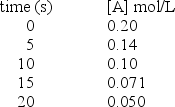
(Essay)
4.9/5 (78)
(78) The reaction A + 2B products has been found to have the rate law, rate = k[A] [B]2. While holding the concentration of A constant, the concentration of B is increased from x to 3x. Predict by what factor the rate of reaction increases.
(Multiple Choice)
4.9/5 (66)
(66) The reaction C4H10 C2H6 + C2H4 has an activation energy (Ea)of 350 kJ/mol, and the Ea of the reverse reaction is 260 kJ/mol. Estimate H, in kJ/mol, for the reaction as written above.
(Multiple Choice)
4.9/5 (85)
(85) At 25°C the rate constant for the first-order decomposition of a pesticide solution is 6.40 10-3 min-1. If the starting concentration of pesticide is 0.0314 M, what concentration will remain after 62.0 min at 25°C?
(Multiple Choice)
4.9/5 (90)
(90) For the reaction BrO3- + 5Br-+ 6H+ 3Br2 + 3H2O at a particular time, - [BrO3-]/ t = 1.5 * 10-2 M/s. What is - [Br-]/ t at the same instant?
(Multiple Choice)
4.7/5 (78)
(78) The following reaction in aqueous solution was found to be first order in [OH-], first order in [C2H5Br], and inverse first order in Br-.
C2H5Br + OH- C2H5OH + Br-
Which one of the following mechanisms is consistent with the observed reaction order?
(Multiple Choice)
4.8/5 (91)
(91) Use the following data to determine the rate law for the reaction shown below. 2NO + H2 N2O + H2O 
(Multiple Choice)
4.8/5 (92)
(92) The reaction A + 2B products was found to follow the rate law: rate = k[A]2[B].Predict by what factor the rate of reaction will increase when the concentration of A is doubled, the concentration of B is tripled, and the temperature remains constant.
(Multiple Choice)
4.8/5 (91)
(91) At a particular temperature the first-order gas-phase reaction 2N2O5 2N2O4 + O2 has a half-life for the disappearance of dinitrogen pentoxide of 3240 s. If 1.00 atm of N2O5 is introduced into an evacuated 5.00 L flask, what will be the total pressure of the gases in the flask after 1.50 hours?
(Multiple Choice)
4.9/5 (81)
(81) The rate law predicted by the following two-step mechanism is rate = k[A][B]. 
(True/False)
4.9/5 (91)
(91) For the hypothetical reaction A + 3B 2C, the rate should be expressed as
(Multiple Choice)
4.8/5 (91)
(91) A rate constant with the units L2 mol-2 s-1 is consistent with a
(Multiple Choice)
4.8/5 (79)
(79) For the chemical reaction system described by the diagram below, which statement is true?  If the Ea for the forward reaction is 25 kJ/mol and the enthalpy of reaction is -95 kJ/mol, what is Ea for the reverse reaction?
 (Multiple Choice)
5.0/5 (91)
(91) For the following reaction, P(C6H14)/ t was found to be -6.2 *10-3 atm/s. C6H14(g) C6H6(g)+ 4H2(g)
Determine P(H2)/ t for this reaction at the same time.
(Multiple Choice)
4.9/5 (82)
(82) Which one of the following changes would alter the rate constant (k)for the reaction 2A + B products?
(Multiple Choice)
4.9/5 (77)
(77) An increase in the temperature of the reactants causes an increase in the rate of reaction. The best explanation for this behavior is that as the temperature increases,
(Multiple Choice)
4.8/5 (80)
(80) The thermal decomposition of acetaldehyde, CH3CHO CH4 + CO, is a second-order reaction. The following data were obtained at 518°C.  Calculate the rate constant for the decomposition of acetaldehyde from the above data.
 (Multiple Choice)
4.8/5 (81)
(81) 
Filters
- Essay(0)
- Multiple Choice(0)
- Short Answer(0)
- True False(0)
- Matching(0)