



 Chat with AI
Exam 18: Entropy, Free Energy, and Equilibrium

Exam 1: Chemistry: The Study of Change153 Questions
Exam 2: Atoms, Molecules, and Ions141 Questions
Exam 3: Mass Relationships in Chemical Reactions168 Questions
Exam 4: Reactions in Aqueous Solution161 Questions
Exam 5: Gases109 Questions
Exam 6: Thermo-Chemistry111 Questions
Exam 7: Quantum Theory and the Electronic Structure of Atoms115 Questions
Exam 8: Periodic Relationships Among the Elements119 Questions
Exam 9: Chemical Bonding I: Basic Concepts118 Questions
Exam 10: Chemical Bonding Ii: Molecular Geometry and Hybridization of Atomic Orbitals122 Questions
Exam 11: Intermolecular Forces and Liquids and Solids140 Questions
Exam 12: Physical Properties of Solutions109 Questions
Exam 13: Chemical Kinetics114 Questions
Exam 14: Chemical Equilibrium100 Questions
Exam 15: Acids and Bases163 Questions
Exam 16: Acid-Base Equilibria and Solubility Equilibria110 Questions
Exam 17: Chemistry in the Atmosphere41 Questions
Exam 18: Entropy, Free Energy, and Equilibrium112 Questions
Exam 19: Electrochemistry138 Questions
Exam 20: Metallurgy and the Chemistry of Metals58 Questions
Exam 21: Nonmetallic Elements and Their Compounds41 Questions
Exam 22: Transition Metal Chemistry and Coordination Compounds80 Questions
Exam 23: Nuclear Chemistry112 Questions
Exam 24: Organic Chemistry57 Questions
Exam 25: Synthetic and Natural Organic Polymers42 Questions
Select questions type


For the reaction CuS(s)+ H2(g)  H2S(g)+ Cu(s),
G°f (CuS)= -53.6 kJ/mol
G°f (H2S)= -33.6 kJ/mol
H°f (CuS)= -53.1 kJ/mol
H°f (H2S)= - 20.6 kJ/mol
Will this reaction proceed spontaneously at 298 K and 1 atm pressure?
H2S(g)+ Cu(s),
G°f (CuS)= -53.6 kJ/mol
G°f (H2S)= -33.6 kJ/mol
H°f (CuS)= -53.1 kJ/mol
H°f (H2S)= - 20.6 kJ/mol
Will this reaction proceed spontaneously at 298 K and 1 atm pressure? 
Free
(Short Answer)
4.8/5  (78)
(78) Correct Answer: Verified
No
The entropy change on vaporization ( Svap)of a compound or element is
Free
(Multiple Choice)
4.9/5 (83)
(83) Correct Answer:Verified
VerifiedB
The element oxygen was prepared by Joseph Priestley in 1774 by heating mercury(II)oxide: HgO(s)\9\to\) Hg(l)+ 1/2O2(g), H° = 90.84 kJ/mol.
Estimate the temperature at which this reaction will become spontaneous under standard state conditions.
S°(Hg)= 76.02 J/K·mol
S°(O2)= 205.0 J/K·mol
S°(HgO)= 70.29 J/K·mol
Free
(Multiple Choice)
4.9/5 (77)
(77) Correct Answer:Verified
VerifiedE
Rubidium has a heat of vaporization of 69.0 kJ/mol at its boiling point (686°C).Calculate S for this process, Rb(l) Rb(g), at 1 atm and 686°C.
(Short Answer)
4.9/5 (81)
(81) Predict the sign of S for the reaction 6CO2(g)+ 6H2O(g) C6H12O6(g)+ 6O2(g).
(Short Answer)
4.9/5 (88)
(88) For the reaction SbCl5(g)  SbCl3(g)+ Cl2(g),
G°f (SbCl5)= -334.34 kJ/mol
G°f (SbCl3)= -301.25 kJ/mol
H°f (SbCl5)= -394.34 kJ/mol
H°f (SbCl3)= -313.80 kJ/mol
Will this reaction proceed spontaneously at 298 K and 1 atm pressure?
SbCl3(g)+ Cl2(g),
G°f (SbCl5)= -334.34 kJ/mol
G°f (SbCl3)= -301.25 kJ/mol
H°f (SbCl5)= -394.34 kJ/mol
H°f (SbCl3)= -313.80 kJ/mol
Will this reaction proceed spontaneously at 298 K and 1 atm pressure? (Short Answer)
4.8/5 (79)
(79) 
Choose the substance with the higher entropy per mole at a given temperature: 1 mole of N2(g)in a 22.4 L container or 1 mole of N2(g)in a 2.24 L container.
(Essay)
4.9/5 (80)
(80) A sample of solid naphthalene is introduced into an evacuated flask. Use the data below to calculate the equilibrium vapor pressure of naphthalene (C10H8)in the flask at 35°C. 
(Multiple Choice)
4.8/5 (75)
(75) The heat of vaporization of water is 2.27 kJ/g. What is Svap per mole at the normal boiling point?
(Short Answer)
4.8/5 (82)
(82) For a given substance the entropy always increases in the following order:
S (gas)< S (liq)< S (solid).
(True/False)
4.9/5 (73)
(73) Hvap for ethanol is 38.7 kJ/mol at its boiling point (78°C).What is Ssurr when 1.00 mole of ethanol is boiled?
(Short Answer)
4.8/5 (71)
(71) Aluminum forms a layer of aluminum oxide when exposed to air which protects the bulk metal from further corrosion. 4Al(s)+ 3O2(g) 2Al2O3(s)
Calculate G° for this reaction, given that G°f of aluminum oxide is -1576.4 kJ/mol.
(Multiple Choice)
4.9/5 (73)
(73) Find the temperature at which Kp = 4.00 for the reaction N2O4(g)  2NO2(g).[Given: at 25°C, for NO2(g), H°f = 33.85 kJ/mol, S° = 240.46 J/mol·K; for N2O4(g), H°f = 9.66 kJ/mol, S° = 304.3 J/mol·K; assume that H° and S° are independent of temperature.]
 (Multiple Choice)
4.8/5 (87)
(87) Predict the normal boiling point of triethylborane (C6H15B)using the following data: 
(Multiple Choice)
4.9/5 (77)
(77) Arrange these reactions according to increasing S.
1)H2O(g) H2O(l)
2)2NO(g) N2(g)+ O2(g)
3)MgCO3(s) MgO(s)+ CO2(g)
(Multiple Choice)
4.9/5 (73)
(73) The entropy change S° for the reaction NH4Cl(s) NH3(g)+ HCl(g)will be negative.
(True/False)
4.9/5 (80)
(80) For the reaction HCONH2(g)  NH3(g)+ CO(g), Kc = 4.84 at 400 K. If H° for this reaction is 29 kJ/mol, find Kc at 500 K.
 (Multiple Choice)
4.7/5 (87)
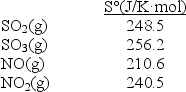
(87) Calculate Kp at 298 K for the reaction SO2(g)+ NO2(g) SO3(g)+ NO(g). 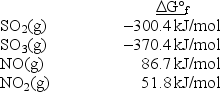
(Multiple Choice)
5.0/5 (73)
(73) Using the thermodynamic data provided below, calculate Ka2 for H2CO3(aq)at 25°. 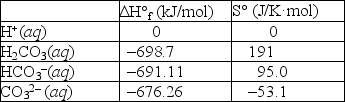
(Essay)
4.9/5 (74)
(74) 
Filters
- Essay(0)
- Multiple Choice(0)
- Short Answer(0)
- True False(0)
- Matching(0)