



 Chat with AI
Exam 18: Entropy, Free Energy, and Equilibrium

Exam 1: Chemistry: The Study of Change153 Questions
Exam 2: Atoms, Molecules, and Ions141 Questions
Exam 3: Mass Relationships in Chemical Reactions168 Questions
Exam 4: Reactions in Aqueous Solution161 Questions
Exam 5: Gases109 Questions
Exam 6: Thermo-Chemistry111 Questions
Exam 7: Quantum Theory and the Electronic Structure of Atoms115 Questions
Exam 8: Periodic Relationships Among the Elements119 Questions
Exam 9: Chemical Bonding I: Basic Concepts118 Questions
Exam 10: Chemical Bonding Ii: Molecular Geometry and Hybridization of Atomic Orbitals122 Questions
Exam 11: Intermolecular Forces and Liquids and Solids140 Questions
Exam 12: Physical Properties of Solutions109 Questions
Exam 13: Chemical Kinetics114 Questions
Exam 14: Chemical Equilibrium100 Questions
Exam 15: Acids and Bases163 Questions
Exam 16: Acid-Base Equilibria and Solubility Equilibria110 Questions
Exam 17: Chemistry in the Atmosphere41 Questions
Exam 18: Entropy, Free Energy, and Equilibrium112 Questions
Exam 19: Electrochemistry138 Questions
Exam 20: Metallurgy and the Chemistry of Metals58 Questions
Exam 21: Nonmetallic Elements and Their Compounds41 Questions
Exam 22: Transition Metal Chemistry and Coordination Compounds80 Questions
Exam 23: Nuclear Chemistry112 Questions
Exam 24: Organic Chemistry57 Questions
Exam 25: Synthetic and Natural Organic Polymers42 Questions
Select questions type


Calculate G° for the reaction 3NO2(g)+ H2O(l) 2HNO3(l)+ NO(g). 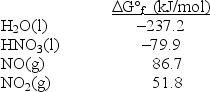
(Multiple Choice)
4.8/5  (72)
(72) Which species will have the greatest absolute entropy at 25°C?
(Multiple Choice)
4.8/5 (87)
(87) Calculate the equilibrium constant for the decomposition of water 2H2O(l)  2H2(g)+ O2(g)
At 25°C, given that G°f (H2O(l))= -237.2 kJ/mol.
2H2(g)+ O2(g)
At 25°C, given that G°f (H2O(l))= -237.2 kJ/mol. (Multiple Choice)
4.9/5 (79)
(79) The following reaction is spontaneous under standard state conditions at 25°C:
AgCl(s) Ag+(aq)+ Cl-(aq)( G° = 55 kJ/mol)
(True/False)
4.9/5 (62)
(62) Which one of the following reactions would you expect to have the lowest S°?
(Multiple Choice)
4.9/5 (85)
(85) Which of these species has the highest entropy (S°)at 25°C?
(Multiple Choice)
5.0/5 (88)
(88) Consider the reaction CO(g)+ 2H2(g)  CH3OH(l)at 25°C.
G°f (CO)= -137.3 kJ/mol
G°f (CH3OH)= -166.3 kJ/mol
H°f (CO)= -110.5 kJ/mol
H°f (CH3OH)= -238.7 kJ/mol
S°(CO)= 197.9 J/K·mol
S°(CH3OH)= 126.8 J/K·mol
Calculate value of the equilibrium constant (Kp)for this reaction at 25°C.
CH3OH(l)at 25°C.
G°f (CO)= -137.3 kJ/mol
G°f (CH3OH)= -166.3 kJ/mol
H°f (CO)= -110.5 kJ/mol
H°f (CH3OH)= -238.7 kJ/mol
S°(CO)= 197.9 J/K·mol
S°(CH3OH)= 126.8 J/K·mol
Calculate value of the equilibrium constant (Kp)for this reaction at 25°C. (Short Answer)
4.7/5 (75)
(75) At 1500°C the equilibrium constant for the reaction CO(g)+ 2H2(g)  CH3OH(g)has the value Kp = 1.4 10-7. Calculate G° for this reaction at 1500°C.
 (Multiple Choice)
4.9/5 (85)
(85) For the reaction H2(g)+ S(s) H2S(g), H° = -20.2 kJ/mol and S° = +43.1 J/K·mol.Which of these statements is true?
(Multiple Choice)
4.8/5 (79)
(79) Assuming S° and H° do not vary with temperature, at what temperature will the reaction shown below become spontaneous?
C(s)+ H2O(g) H2(g)+ CO(s)( S° = 133.6 J/K·mol; H° = 131.3 kJ/mol)
(Short Answer)
4.9/5 (83)
(83) In the gas phase, formic acid forms a dimmer, 2HCOOH(g)  (HCOOH)2(g). For this reaction, H° = -60.1 kJ/mol and G° = -13.9 kJ/mol at 25°C. Find the equilibrium constant (Kp)for this reaction at 75 °C.
 (Multiple Choice)
4.9/5 (78)
(78) For the reaction 2C(graphite)+ H2(g) C2H2(g), G°= +209.2 kJ/mol at 25°C. If P(H2)= 100.atm, and P(C2H2)= 0.10 atm, calculate G for this reaction.
(Multiple Choice)
4.8/5 (81)
(81) The standard free energy of formation of gaseous hydrogen iodide is 1.30 kJ/mol at 25°C.Find Kp for the reaction H2(g)+ I2(s)  2HI(g)at this temperature.
 (Multiple Choice)
4.9/5 (76)
(76) For the reaction SbCl5(g)  SbCl3(g)+ Cl2(g),
G°f (SbCl5)= -334.34 kJ/mol
G°f (SbCl3)= -301.25 kJ/mol
H°f (SbCl5)= -394.34 kJ/mol
H°f (SbCl3)= -313.80 kJ/mol
Calculate G at 800 K and 1 atm pressure (assume S° and H° do not change with temperature).
SbCl3(g)+ Cl2(g),
G°f (SbCl5)= -334.34 kJ/mol
G°f (SbCl3)= -301.25 kJ/mol
H°f (SbCl5)= -394.34 kJ/mol
H°f (SbCl3)= -313.80 kJ/mol
Calculate G at 800 K and 1 atm pressure (assume S° and H° do not change with temperature). (Short Answer)
4.8/5 (75)
(75) Using the thermodynamic data provided below, calculate Ksp for ZnS(s)at 25°. 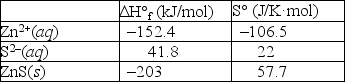
(Essay)
4.8/5 (86)
(86) Which response includes all the following processes that are accompanied by an increase in entropy?
1)2SO2(g)+ O2(g) SO3(g)
2)H2O(l) H2O(s)
3)Br2(l) Br2(g)
4)H2O2(l) H2O(l)+ 1/2O2(g)
(Multiple Choice)
4.8/5 (74)
(74) Choose the substance with the higher entropy per mole at a given temperature: Br2(l)or Br2(g).
(Short Answer)
4.8/5 (89)
(89) Sulfur can be separated from lead in the mineral galena, PbS(s), by "roasting" the ore in the presence of oxygen as shown in the following reaction:
2PbS(s)+ 3O2(g) 2PbO(s)+ 2SO2(g)
Determine G for the above reaction at 850°C. 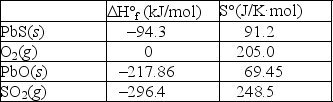
(Short Answer)
4.8/5 (84)
(84) Choose the substance with the higher entropy per mole at a given temperature: CO2(g)or CO2(aq).
(Short Answer)
4.7/5 (85)
(85) 
Filters
- Essay(0)
- Multiple Choice(0)
- Short Answer(0)
- True False(0)
- Matching(0)