



 Chat with AI
Exam 18: Entropy, Free Energy, and Equilibrium

Exam 1: Chemistry: The Study of Change153 Questions
Exam 2: Atoms, Molecules, and Ions141 Questions
Exam 3: Mass Relationships in Chemical Reactions168 Questions
Exam 4: Reactions in Aqueous Solution161 Questions
Exam 5: Gases109 Questions
Exam 6: Thermo-Chemistry111 Questions
Exam 7: Quantum Theory and the Electronic Structure of Atoms115 Questions
Exam 8: Periodic Relationships Among the Elements119 Questions
Exam 9: Chemical Bonding I: Basic Concepts118 Questions
Exam 10: Chemical Bonding Ii: Molecular Geometry and Hybridization of Atomic Orbitals122 Questions
Exam 11: Intermolecular Forces and Liquids and Solids140 Questions
Exam 12: Physical Properties of Solutions109 Questions
Exam 13: Chemical Kinetics114 Questions
Exam 14: Chemical Equilibrium100 Questions
Exam 15: Acids and Bases163 Questions
Exam 16: Acid-Base Equilibria and Solubility Equilibria110 Questions
Exam 17: Chemistry in the Atmosphere41 Questions
Exam 18: Entropy, Free Energy, and Equilibrium112 Questions
Exam 19: Electrochemistry138 Questions
Exam 20: Metallurgy and the Chemistry of Metals58 Questions
Exam 21: Nonmetallic Elements and Their Compounds41 Questions
Exam 22: Transition Metal Chemistry and Coordination Compounds80 Questions
Exam 23: Nuclear Chemistry112 Questions
Exam 24: Organic Chemistry57 Questions
Exam 25: Synthetic and Natural Organic Polymers42 Questions
Select questions type


Consider the gas phase reaction shown below.
CH4(g)+ CF4(g) CH3F(g)+ CHF3(g)
Will the standard entropy increase, decrease, or remain if the reaction proceeds from reactants to products, as written? Explain your reasoning.
(Essay)
4.8/5  (76)
(76) Calculate S° at 25°C for the reduction of PbO(s), 2PbO(s)+ C(s) 2Pb(s)+ CO2(g)given these absolute entropies: 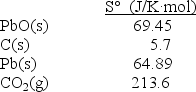
(Multiple Choice)
4.9/5 (80)
(80) The equilibrium constant for the reaction AgBr(s)  Ag+(aq)+ Br- (aq)is the solubility product constant, Ksp = 7.7 10-13 at 25°C. Calculate G for the reaction when [Ag+] = 1.0 10-2 M and [Br-] = 1.0 10-3 M. Is the reaction spontaneous or nonspontaneous at these concentrations?
 (Multiple Choice)
4.8/5 (78)
(78) The equilibrium constant at 427°C for the reaction N2(g)+ 3H2(g)  2NH3(g)is Kp = 9.4 10-5. Calculate the value of G° for the reaction under these conditions.
 (Multiple Choice)
4.9/5 (85)
(85) Find the temperature at which Kp = 42.0 for the reaction H2(g)+ I2(g)  2HI(g).[Given: at 25°C, for H2(g), H°f = 0, S° = 131.0 J/mol·K; for I2(g), H°f = 62.26 kJ/mol, S° = 260.6 J/mol·K; for HI(g), H°f = 25.9 kJ/mol, S° = 206.3 J/mol·K; assume that H° and S° are independent of temperature.]
 (Multiple Choice)
4.8/5 (87)
(87) Is the reaction SiO2(s)+ Pb(s) PbO2(s)+ Si(s)spontaneous?
G°f (PbO2)= -217 kJ/mol
G°f (SiO2)= -856 kJ/mol
(Short Answer)
4.8/5 (82)
(82) Which one of the following reactions would you expect to have highest S°?
(Multiple Choice)
4.8/5 (76)
(76) Consider the reaction CO(g)+ 2H2(g)  CH3OH(l)at 25°C.
G°f (CO)= -137.3 kJ/mol
G°f (CH3OH)= -166.3 kJ/mol
H°f (CO)= -110.5 kJ/mol
H°f (CH3OH)= -238.7 kJ/mol
S°(CO)= 197.9 J/K·mol
S°(CH3OH)= 126.8 J/K·mol
Calculate G° at 25°C.
CH3OH(l)at 25°C.
G°f (CO)= -137.3 kJ/mol
G°f (CH3OH)= -166.3 kJ/mol
H°f (CO)= -110.5 kJ/mol
H°f (CH3OH)= -238.7 kJ/mol
S°(CO)= 197.9 J/K·mol
S°(CH3OH)= 126.8 J/K·mol
Calculate G° at 25°C. (Short Answer)
4.8/5 (77)
(77) Using the thermodynamic data provided below, calculate Ka1 for H2CO3(aq)at 25°. 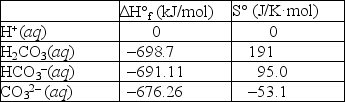
(Essay)
4.9/5 (84)
(84) Which of these species has the highest entropy (S°)at 25°C?
(Multiple Choice)
4.9/5 (79)
(79) For the reaction 3H2(g)+ N2(g)  2NH3(g), Kc = 9.0 at 350°C. In what direction does this reaction proceed at 350°C under standard state conditions?
 (Short Answer)
5.0/5 (76)
(76) Given the following data, estimate the boiling point of carbon disulfide, CS2, assuming that S° and H° are temperature-independent. 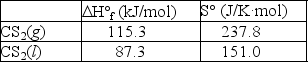
(Short Answer)
4.9/5 (70)
(70) 
Filters
- Essay(0)
- Multiple Choice(0)
- Short Answer(0)
- True False(0)
- Matching(0)