



 Chat with AI
Exam 18: Entropy, Free Energy, and Equilibrium

Exam 1: Chemistry: The Study of Change153 Questions
Exam 2: Atoms, Molecules, and Ions141 Questions
Exam 3: Mass Relationships in Chemical Reactions168 Questions
Exam 4: Reactions in Aqueous Solution161 Questions
Exam 5: Gases109 Questions
Exam 6: Thermo-Chemistry111 Questions
Exam 7: Quantum Theory and the Electronic Structure of Atoms115 Questions
Exam 8: Periodic Relationships Among the Elements119 Questions
Exam 9: Chemical Bonding I: Basic Concepts118 Questions
Exam 10: Chemical Bonding Ii: Molecular Geometry and Hybridization of Atomic Orbitals122 Questions
Exam 11: Intermolecular Forces and Liquids and Solids140 Questions
Exam 12: Physical Properties of Solutions109 Questions
Exam 13: Chemical Kinetics114 Questions
Exam 14: Chemical Equilibrium100 Questions
Exam 15: Acids and Bases163 Questions
Exam 16: Acid-Base Equilibria and Solubility Equilibria110 Questions
Exam 17: Chemistry in the Atmosphere41 Questions
Exam 18: Entropy, Free Energy, and Equilibrium112 Questions
Exam 19: Electrochemistry138 Questions
Exam 20: Metallurgy and the Chemistry of Metals58 Questions
Exam 21: Nonmetallic Elements and Their Compounds41 Questions
Exam 22: Transition Metal Chemistry and Coordination Compounds80 Questions
Exam 23: Nuclear Chemistry112 Questions
Exam 24: Organic Chemistry57 Questions
Exam 25: Synthetic and Natural Organic Polymers42 Questions
Select questions type


Arrange these compounds in order of increasing standard molar entropy at 25°C: C3H8(g), C2H4(g), ZnS(s), and H2O(l).
(Multiple Choice)
4.9/5  (67)
(67) Which of these species would you expect to have the lowest standard entropy (S°)?
(Multiple Choice)
4.9/5 (78)
(78) Choose the substance with the higher entropy per mole at a given temperature: O2(g)at 5 atm or O2(g)at 0.5 atm.
(Short Answer)
4.9/5 (82)
(82) Using the thermodynamic data provided below, calculate the standard change in entropy when one mole of sodium nitrate is dissolved in water? 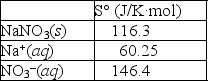 Will the solubility of sodium nitrate increase or decrease if the temperature of the system is increased?
 (Essay)
4.9/5 (85)
(85) Given the following data, calculate the boiling point of HCOOH (formic acid). 
(Short Answer)
4.9/5 (68)
(68) Predict the sign of S for the process Ni(s, 50°C) Ni(s, 25°C).
(Short Answer)
4.9/5 (79)
(79) Consider the reaction CO(g)+ 2H2(g)  CH3OH(l)at 25°C.
G°f (CO)= -137.3 kJ/mol
G°f (CH3OH)= -166.3 kJ/mol
H°f (CO)= -110.5 kJ/mol
H°f (CH3OH)= -238.7 kJ/mol
S°(CO)= 197.9 J/K·mol
S°(CH3OH)= 126.8 J/K·mol
Calculate S°(H2(g)).
CH3OH(l)at 25°C.
G°f (CO)= -137.3 kJ/mol
G°f (CH3OH)= -166.3 kJ/mol
H°f (CO)= -110.5 kJ/mol
H°f (CH3OH)= -238.7 kJ/mol
S°(CO)= 197.9 J/K·mol
S°(CH3OH)= 126.8 J/K·mol
Calculate S°(H2(g)). (Short Answer)
4.9/5 (81)
(81) Which of these species would you expect to have the highest standard entropy (S°)?
(Multiple Choice)
4.7/5 (76)
(76) 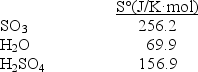
Which of these species would you expect to have the lowest standard entropy (S°)?
(Multiple Choice)
4.8/5 (89)
(89) Melting an ionic solid always results in an increase in entropy.
(True/False)
4.8/5 (76)
(76) Using the thermodynamic data provided below, calculate the standard change in entropy when one mole of sodium sulfate is dissolved in water? 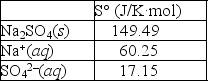 Will the solubility of sodium nitrate increase or decrease if the temperature of the system is increased?
 (Essay)
5.0/5 (79)
(79) Predict the sign of S for the process N2(g, 10 atm) N2(g, 1atm).
(Short Answer)
4.8/5 (83)
(83) Sodium carbonate can be made by heating sodium bicarbonate: 2NaHCO3(s) Na2CO3(s)+ CO2(g)+ H2O(g)
Given that H° = 128.9 kJ/mol and G° = 33.1 kJ/mol at 25°C, above what minimum temperature will the reaction become spontaneous under standard state conditions?
(Multiple Choice)
4.7/5 (72)
(72) For the reaction 3H2(g)+ N2(g)  2NH3(g), Kc = 9.0 at 350°C. In what direction does the reaction proceed when 1.0 mol NH3, 5.0 mol N2, and 5.0 mol H2 are mixed in a 2.5 L reactor?
 (Short Answer)
4.9/5 (92)
(92) For the reaction CuS(s)+ H2(g)  H2S(g)+ Cu(s),
G°f (CuS)= -53.6 kJ/mol
G°f (H2S)= -33.6 kJ/mol
H°f (CuS)= -53.1 kJ/mol
H°f (H2S)= -20.6 kJ/mol
Calculate G at 798 K and 1 atm pressure (assume S° and H° do not change with temperature).
H2S(g)+ Cu(s),
G°f (CuS)= -53.6 kJ/mol
G°f (H2S)= -33.6 kJ/mol
H°f (CuS)= -53.1 kJ/mol
H°f (H2S)= -20.6 kJ/mol
Calculate G at 798 K and 1 atm pressure (assume S° and H° do not change with temperature). (Short Answer)
4.9/5 (80)
(80) Sulfur can be separated from lead in the mineral galena, PbS(s), by "roasting" the ore in the presence of oxygen as shown in the following reaction: 2PbS(s)+ 3O2(g) 2PbO(s)+ 2SO2(g)
Calculate S° for this reaction using the thermodynamic data provided below. 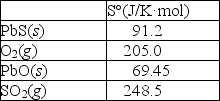
(Multiple Choice)
4.8/5 (93)
(93) Which response includes all of the following processes that are accompanied by an increase in entropy?
1)I2(s) I2(g)
2)2I(g) I2(g)
3)2NH3(g) N2(g)+ 3H2(g)
4)Mg2+(aq)+ 2OH-(aq) Mg(OH)2(s)
(Multiple Choice)
5.0/5 (71)
(71) 
Filters
- Essay(0)
- Multiple Choice(0)
- Short Answer(0)
- True False(0)
- Matching(0)