



 Chat with AI
Exam 18: Entropy, Free Energy, and Equilibrium

Exam 1: Chemistry: The Study of Change153 Questions
Exam 2: Atoms, Molecules, and Ions141 Questions
Exam 3: Mass Relationships in Chemical Reactions168 Questions
Exam 4: Reactions in Aqueous Solution161 Questions
Exam 5: Gases109 Questions
Exam 6: Thermo-Chemistry111 Questions
Exam 7: Quantum Theory and the Electronic Structure of Atoms115 Questions
Exam 8: Periodic Relationships Among the Elements119 Questions
Exam 9: Chemical Bonding I: Basic Concepts118 Questions
Exam 10: Chemical Bonding Ii: Molecular Geometry and Hybridization of Atomic Orbitals122 Questions
Exam 11: Intermolecular Forces and Liquids and Solids140 Questions
Exam 12: Physical Properties of Solutions109 Questions
Exam 13: Chemical Kinetics114 Questions
Exam 14: Chemical Equilibrium100 Questions
Exam 15: Acids and Bases163 Questions
Exam 16: Acid-Base Equilibria and Solubility Equilibria110 Questions
Exam 17: Chemistry in the Atmosphere41 Questions
Exam 18: Entropy, Free Energy, and Equilibrium112 Questions
Exam 19: Electrochemistry138 Questions
Exam 20: Metallurgy and the Chemistry of Metals58 Questions
Exam 21: Nonmetallic Elements and Their Compounds41 Questions
Exam 22: Transition Metal Chemistry and Coordination Compounds80 Questions
Exam 23: Nuclear Chemistry112 Questions
Exam 24: Organic Chemistry57 Questions
Exam 25: Synthetic and Natural Organic Polymers42 Questions
Select questions type


In the gas phase, methyl isocyanate (CH3NC)isomerizes to acetonitrile (CH3CN), H3C-N C (g)  H3C-C N (g)
With H° = -89.5 kJ/mol and G° = - 73.8 kJ/mol at 25°C. Find the equilibrium constant for this reaction at 100°C.
H3C-C N (g)
With H° = -89.5 kJ/mol and G° = - 73.8 kJ/mol at 25°C. Find the equilibrium constant for this reaction at 100°C. (Multiple Choice)
4.9/5  (71)
(71) For the reaction H2O2(g) H2O(g)+ 1/2O2(g), H° = -106 kJ/mol and S° = 58 J/K·mol at 25°C. Calculate G° for this reaction at this temperature.
(Short Answer)
4.9/5 (79)
(79) For the reaction SbCl5(g)  SbCl3(g)+ Cl2(g),
G°f (SbCl5)= -334.34 kJ/mol
G°f (SbCl3)= -301.25 kJ/mol
H°f (SbCl5)= -394.34 kJ/mol
H°f (SbCl3)= -313.80 kJ/mol
Calculate the value of the equilibrium constant (Kp)for this reaction at 298 K.
SbCl3(g)+ Cl2(g),
G°f (SbCl5)= -334.34 kJ/mol
G°f (SbCl3)= -301.25 kJ/mol
H°f (SbCl5)= -394.34 kJ/mol
H°f (SbCl3)= -313.80 kJ/mol
Calculate the value of the equilibrium constant (Kp)for this reaction at 298 K. (Short Answer)
4.8/5 (69)
(69) For the reaction CuS(s)+ H2(g)  H2S(g)+ Cu(s),
G°f (CuS)= -53.6 kJ/mol
G°f (H2S)= -33.6 kJ/mol
H°f (CuS)= -53.1 kJ/mol
H°f (H2S)= -20.6 kJ/mol
Calculate the value of the equilibrium constant (Kp)at 798 K and 1 atm pressure.
H2S(g)+ Cu(s),
G°f (CuS)= -53.6 kJ/mol
G°f (H2S)= -33.6 kJ/mol
H°f (CuS)= -53.1 kJ/mol
H°f (H2S)= -20.6 kJ/mol
Calculate the value of the equilibrium constant (Kp)at 798 K and 1 atm pressure. (Short Answer)
4.8/5 (74)
(74) How does the entropy change when a gas is converted to a liquid?
(Short Answer)
4.8/5 (85)
(85) The reaction rates of many spontaneous reactions are actually very slow. Which of these statements is the best explanation for this observation?
(Multiple Choice)
4.8/5 (80)
(80) The free energy of formation of nitric oxide, NO, at 1000 K (roughly the temperature in an automobile engine during ignition)is about 78 kJ/mol.Calculate the equilibrium constant Kp for the reaction N2(g)+ O2(g)  2NO(g)at this temperature.
 (Short Answer)
4.9/5 (83)
(83) The solubility product constant at 25°C for AgI(s)in water has the value 8.3 10-17.Calculate Grxn at 25°C for the process AgI(s)  Ag+(aq)+ I- (aq)where [Ag+] = 9.1 10-9 and [I-] = 9.1 10-9.
 (Multiple Choice)
4.8/5 (76)
(76) Given the following data, estimate the boiling point of bromine, Br2, assuming that S° and H° are temperature-independent. 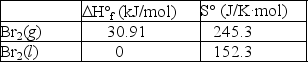
(Short Answer)
4.9/5 (73)
(73) Calculate the free energy of formation of NaBr(s)given the following information:
NaBr(s) Na(s)+ 1/2Br2(l), G° = 349 kJ/mol
(Short Answer)
4.8/5 (82)
(82) The normal freezing point of ammonia is -78°C. Predict the signs of H, S, and G for ammonia when it freezes at -80°C and 1 atm: NH3(l) NH3(s) 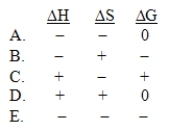
(Short Answer)
4.8/5 (83)
(83) For the reaction 3H2(g)+ N2(g)  2NH3(g), Kc = 9.0 at 350°C. What is the value of G at this temperature when 1.0 mol NH3, 5.0 mol N2, and 5.0 mol H2 are mixed in a 2.5 L reactor?
 (Short Answer)
4.8/5 (79)
(79) Dissolving an ionic solid in water always results in an increase in entropy.
(True/False)
4.8/5 (80)
(80) Nitrosyl chloride (NOCl)decomposes at elevated temperatures according to the equation 2NOCl(g)  2NO(g)+ Cl2(g). Calculate Kp for this reaction at 227°C.( H° = 81.2 kJ/mol, S° = 128 J/K·mol)
 (Multiple Choice)
4.8/5 (75)
(75) Calculate G° for the combustion of ethanol vapor, C2H5OH(g), at 750°C in oxygen to form carbon dioxide and water vapor. The following data is valid at 25°C: 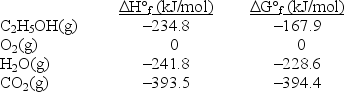
(Multiple Choice)
4.8/5 (69)
(69) Find the temperature at which the reaction N2O4(g)  2NO2(g)will be in equilibrium when both gases are present at partial pressures of 1.00 atm.

2NO2(g)will be in equilibrium when both gases are present at partial pressures of 1.00 atm. (Multiple Choice)
4.8/5 (71)
(71) At 700 K, the equilibrium constant for the reaction CO(g)+ H2O(g)  CO2(g)+ H2(g)is 5.10.What is G° for this reaction at this temperature?
 (Short Answer)
4.8/5 (77)
(77) Without reference to a table, arrange these reactions according to increasing S.
1)CH4(g)+ H2O(g) CO(g)+ 3H2(g)
2)C(s)+ O2(g) CO2(g)
3)H2O2(l) H2O(l)+ 1/2O2(g)
(Multiple Choice)
4.7/5 (78)
(78) The following reaction is nonspontaneous at 25°C:
Cu2O(s) 2Cu(s)+ 1/2O2(g), G° = 141 kJ/mol
If S° = 75.8 J/K·mol, what is the lowest temperature at which the reaction will be spontaneous?
(Short Answer)
4.9/5 (83)
(83) 
Filters
- Essay(0)
- Multiple Choice(0)
- Short Answer(0)
- True False(0)
- Matching(0)