Multiple Choice
Chlorine dioxide reacts in basic water to form chlorite and chlorate according to the following chemical equation: 2ClO2(aq) + 2OH-(aq) ClO2-(aq) + ClO3-(aq) + H2O(l)
A kinetic study of this reaction under a certain set of conditions yielded the data below. 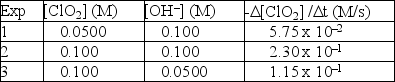 Which one of the following is the rate law for this reaction?
A) rate = k[ClO2][OH-]
B) rate = k[ClO2]2[OH-]
C) rate = k[ClO2][OH-]2
D) rate = k[ClO2]2[OH-]2
E) rate = k[ClO2]4[OH-]
Correct Answer:

Verified
Correct Answer:
Verified
Q12: The activation energy of a certain uncatalyzed
Q19: The activation energy for the reaction
Q86: Peroxodisulfate ion can oxidize iodide ions to
Q87: A city's water supply is contaminated with
Q88: What is the rate law that corresponds
Q89: The graphs below all refer to the
Q93: A certain reaction A <font face="symbol"></font> products
Q113: The reaction A + 2B
Q121: For the hypothetical reaction A +
Q128: A certain first-order reaction A