



 Chat with AI
Exam 14: Chemical Equilibrium

Exam 1: Chemistry: the Study of Change168 Questions
Exam 2: Atoms, Molecules, and Ions156 Questions
Exam 3: Mass Relationships in Chemical Reactions194 Questions
Exam 4: Reactions in Aqueous Solutions186 Questions
Exam 5: Gases121 Questions
Exam 6: Thermochemistry118 Questions
Exam 7: Quantum Theory and the Electronic Structure of Atoms136 Questions
Exam 8: Periodic Relationships Among the Elements144 Questions
Exam 9: Chemical Bonding I: Basic Concepts137 Questions
Exam 10: Chemical Bonding Ii: Molecular Geometry and Hybridization of Atomic Orbitals147 Questions
Exam 11: Intermolecular Forces and Liquids and Solids149 Questions
Exam 12: Physical Properties of Solutions122 Questions
Exam 13: Chemical Kinetics130 Questions
Exam 14: Chemical Equilibrium109 Questions
Exam 15: Acids and Bases178 Questions
Exam 16: Acid-Base Equilibria and Solubility Equilibria131 Questions
Exam 17: Entropy Free Energy and Equilibrium128 Questions
Exam 18: Electrochemistry154 Questions
Exam 19: Nuclear Chemistry133 Questions
Exam 20: Chemistry in the Atmosphere50 Questions
Exam 21: Metallurgy and the Chemistry of Metals63 Questions
Exam 22: Nonmetallic Elements and Their Compounds52 Questions
Exam 23: Transition Metal Chemistry and Coordination Compounds92 Questions
Exam 24: Organic Chemistry67 Questions
Exam 25: Synthetic and Natural Organic Polymers50 Questions
Select questions type


Consider the following equilibrium,
4NH3(g)+ 3O2(g)  2N2(g)+ 6H2O(g)+ 1531 kJ
State whether the concentrations of the reactants would increase, decrease, or remain constant after ammonia was added to the system.
2N2(g)+ 6H2O(g)+ 1531 kJ
State whether the concentrations of the reactants would increase, decrease, or remain constant after ammonia was added to the system. (Short Answer)
5.0/5  (94)
(94) At 400ºC, Kc = 64 for the equilibrium H2(g)+ I2(g)  2HI(g).If 3.00 mol H2 and 3.00 mol I2 are introduced into an empty 4.0 L vessel, find the equilibrium concentration of HI at 400ºC.
 (Multiple Choice)
4.8/5 (79)
(79) The equilibrium constant expression for the reaction 2BrF5 (g)  Br2 (g)+ 5F2 (g)is
 (Multiple Choice)
4.9/5 (82)
(82) Calculate Kc for the reaction 2HI(g)  H2(g)+ I2(g)given that the concentrations of each species at equilibrium are as follows: [HI] = 0.85 mol/L, [I2] = 0.60 mol/L, [H2] = 0.27 mol/L.
 (Multiple Choice)
4.8/5 (79)
(79) Concerning the following reaction at equilibrium: 3Fe(s)+ 4H2O(g)  Fe3O4(s)+ 4H2(g), increasing the concentration of the Fe(s)would:
 (Multiple Choice)
4.8/5 (80)
(80) A reaction with an equilibrium constant Kc = 1.5 x 10⁻²⁵ would consist of which of the following at equilibrium:
(Multiple Choice)
4.9/5 (69)
(69) The solubility of silver bromide can be increased by dissolving it in a solution containing the thiosulfate anion. AgBr(s)  Ag+ (aq)+ Br- (aq)K1 = 7.7 x 10⁻¹³
Ag+(aq)+ 2S2O32- (aq)
 Ag(S2O3)23- (aq)K2 = 4.7 x 10¹³
What is the value of the equilibrium constant for the overall reaction?
AgBr(s)+ 2S2O32-(aq)
 Ag(S2O3)23-(aq)+ Br-(aq)
Ag+ (aq)+ Br- (aq)K1 = 7.7 x 10⁻¹³
Ag+(aq)+ 2S2O32- (aq)
Ag(S2O3)23- (aq)K2 = 4.7 x 10¹³
What is the value of the equilibrium constant for the overall reaction?
AgBr(s)+ 2S2O32-(aq)
Ag(S2O3)23-(aq)+ Br-(aq) (Multiple Choice)
4.8/5 (81)
(81) For the following reaction at equilibrium in a reaction vessel, which one of these changes would cause the Br2 concentration to increase? 2NOBr(g)  2NO(g)+ Br2(g), Hºrxn= 30 kJ/mol
 (Multiple Choice)
4.8/5 (93)
(93) In which of these gas-phase equilibria is the yield of products increased by increasing the total pressure on the reaction mixture?
(Multiple Choice)
4.9/5 (67)
(67) Consider the reaction N2(g)+ 3H2(g)  2NH3(g).If we use a catalyst, which way will the reaction shift?
 (Essay)
4.8/5 (73)
(73) What is the correct equilibrium constant expression for this reaction?
2HI(g)  H2(g)+ I2(g)
 (Essay)
4.7/5 (73)
(73) Consider the following equilibria: 2SO3(g)  2SO2(g)+ O2(g)Kc = 2.3 × 10⁻⁷
2NO3(g)
 2NO2(g)+ O2(g)Kc = 1.4 × 10⁻³
Calculate the equilibrium constant for the reaction
SO2(g)+ NO3(g)
 SO3(g)+ NO2(g)
2SO2(g)+ O2(g)Kc = 2.3 × 10⁻⁷
2NO3(g)
2NO2(g)+ O2(g)Kc = 1.4 × 10⁻³
Calculate the equilibrium constant for the reaction
SO2(g)+ NO3(g)
SO3(g)+ NO2(g) (Multiple Choice)
4.7/5 (76)
(76) When the substances in the equation below are at equilibrium, at pressure P and temperature T, the equilibrium can be shifted to favor the products by CuO(s)+ H2(g)  H2O(g)+ Cu(s) Hºrxn = -2.0 kJ/mol
 (Multiple Choice)
4.8/5 (77)
(77) Equilibrium constants are known for the following reactions:
S(s)+ 3/2O2(g)  SO3(g)Kc = 9.2 × 10²³
SO3(g)
 SO2(g)+ 1/2O2(g)Kc = 4.8 × 10- 4
Thus, for the reaction S(s)+ O2(g)
 SO2(g), Kc = 4.4 × 10²⁰.
SO3(g)Kc = 9.2 × 10²³
SO3(g)
SO2(g)+ 1/2O2(g)Kc = 4.8 × 10- 4
Thus, for the reaction S(s)+ O2(g)
SO2(g), Kc = 4.4 × 10²⁰. (True/False)
4.7/5 (64)
(64) For the reaction at equilibrium: 3Fe(s)+ 4H2O(g)  Fe3O4(s)+ 4H2(g), removing some of the product, Fe3O4(s), would:
 (Multiple Choice)
4.9/5 (81)
(81) The equilibrium constants for the chemical reaction N2(g)+ O2(g)  2NO(g)are KP = 1.1 × 10⁻³ and 3.6 × 10⁻³ at 2,200 K and 2,500 K, respectively.
Which one of these statements is true?
2NO(g)are KP = 1.1 × 10⁻³ and 3.6 × 10⁻³ at 2,200 K and 2,500 K, respectively.
Which one of these statements is true? (Multiple Choice)
4.8/5 (83)
(83) The equilibrium between carbon dioxide gas and carbonic acid is very important in biology and environmental science. CO2 (aq)+ H2O (l)
 H2CO3 (aq)
Which one of the following is the correct equilibrium constant expression (Kc)for this reaction?
H2CO3 (aq)
Which one of the following is the correct equilibrium constant expression (Kc)for this reaction? (Multiple Choice)
4.9/5 (78)
(78) Given the following data for the reaction: A(g)+ 2B(s)  AB2(g)
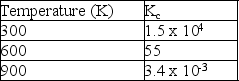 Is the reaction endothermic or exothermic?
AB2(g) Is the reaction endothermic or exothermic? (Short Answer)
5.0/5 (83)
(83) The Kc for the reaction CO2(g)+ H2(g)  H2O(g)+ CO(g)is 1.6 at about 990ºC.Calculate the number of moles of carbon dioxide in the final equilibrium system obtained by initially adding 1.00 mol of H2, 2.00 mol of CO2, 0.750 mol of H2O, and 1.00 mol of CO to a 5.00 L reactor at 990ºC.
 (Short Answer)
4.9/5 (72)
(72)  2HI(g), KP = Kc.

Filters
- Essay(0)
- Multiple Choice(0)
- Short Answer(0)
- True False(0)
- Matching(0)