



 Chat with AI
Exam 14: Chemical Equilibrium

Exam 1: Chemistry: the Study of Change168 Questions
Exam 2: Atoms, Molecules, and Ions156 Questions
Exam 3: Mass Relationships in Chemical Reactions194 Questions
Exam 4: Reactions in Aqueous Solutions186 Questions
Exam 5: Gases121 Questions
Exam 6: Thermochemistry118 Questions
Exam 7: Quantum Theory and the Electronic Structure of Atoms136 Questions
Exam 8: Periodic Relationships Among the Elements144 Questions
Exam 9: Chemical Bonding I: Basic Concepts137 Questions
Exam 10: Chemical Bonding Ii: Molecular Geometry and Hybridization of Atomic Orbitals147 Questions
Exam 11: Intermolecular Forces and Liquids and Solids149 Questions
Exam 12: Physical Properties of Solutions122 Questions
Exam 13: Chemical Kinetics130 Questions
Exam 14: Chemical Equilibrium109 Questions
Exam 15: Acids and Bases178 Questions
Exam 16: Acid-Base Equilibria and Solubility Equilibria131 Questions
Exam 17: Entropy Free Energy and Equilibrium128 Questions
Exam 18: Electrochemistry154 Questions
Exam 19: Nuclear Chemistry133 Questions
Exam 20: Chemistry in the Atmosphere50 Questions
Exam 21: Metallurgy and the Chemistry of Metals63 Questions
Exam 22: Nonmetallic Elements and Their Compounds52 Questions
Exam 23: Transition Metal Chemistry and Coordination Compounds92 Questions
Exam 24: Organic Chemistry67 Questions
Exam 25: Synthetic and Natural Organic Polymers50 Questions
Select questions type


Given the following information: 2A(g)+ B(g)  A2B(g)Kp1
2A(g)+ C2(g)
 2AC(g)Kp2
3/2A2(g)+ B(g)+ C(g)
 AC(g)+ A2B(g)Kp3
Which relationship represents the equilibrium constant for the reaction:
3A2(g)+ 3B(g)+ 2C(g)
 3A2B(g)+ C2(g)Knet = ?
A2B(g)Kp1
2A(g)+ C2(g)
2AC(g)Kp2
3/2A2(g)+ B(g)+ C(g)
AC(g)+ A2B(g)Kp3
Which relationship represents the equilibrium constant for the reaction:
3A2(g)+ 3B(g)+ 2C(g)
3A2B(g)+ C2(g)Knet = ? (Multiple Choice)
4.9/5  (69)
(69) Given the following data for the reaction: A(g)+ 2B(s)  AB2(g)
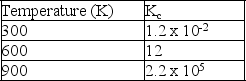 Is the reaction endothermic or exothermic?
AB2(g) Is the reaction endothermic or exothermic? (Short Answer)
4.7/5 (81)
(81) Hydrogen iodide decomposes according to the equation:
2HI(g)  H2(g)+ I2(g), Kc = 0.0156 at 400ºC
A 0.660 mol sample of HI was injected into a 2.00 L reaction vessel held at 400ºC.
Calculate the concentration of HI at equilibrium.
H2(g)+ I2(g), Kc = 0.0156 at 400ºC
A 0.660 mol sample of HI was injected into a 2.00 L reaction vessel held at 400ºC.
Calculate the concentration of HI at equilibrium. (Short Answer)
4.8/5 (92)
(92) For the reaction at equilibrium 2SO3  2SO2 + O2 ( Hºrxn= 198 kJ/mol), increasing the reaction temperature would:
 (Multiple Choice)
4.7/5 (86)
(86) Kp for the reaction of SO2(g)with O2 to produce SO3(g)is 3 × 1024 .Calculate Kc for this equilibrium at 25ºC.(The relevant reaction is 2SO2(g)+ O2(g)  2SO3(g).)
 (Multiple Choice)
4.9/5 (79)
(79) For the following reaction at equilibrium, which change will cause the equilibrium to shift to the left? 2NOBr(g)  2NO(g)+ Br2(g), Hºrxn = 30 kJ/mol
 (Multiple Choice)
4.9/5 (80)
(80) For the reaction at equilibrium: CO(g)+ H2O(g)  CO2(g)+ H2(g), increasing the volume of the container would:
 (Multiple Choice)
4.8/5 (80)
(80) Solid ammonium hydrogen sulfide is introduced into a 2.00-L flask, and the flask is sealed.If this solid decomposes according to the equation below NH4HS(s)
 NH3(g)+ H2S(g), Kp = 0.108 at 25°C,
What is the minimum mass of ammonium hydrogen sulfide that must be present in the flask initially if equilibrium is to be established at 25°C?
NH3(g)+ H2S(g), Kp = 0.108 at 25°C,
What is the minimum mass of ammonium hydrogen sulfide that must be present in the flask initially if equilibrium is to be established at 25°C? (Multiple Choice)
4.7/5 (72)
(72) At 700 K, the reaction 2SO2(g)+ O2(g)  2SO3(g)has the equilibrium constant Kc = 4.3 × 10⁶ , and the following concentrations are present: [SO2] = 0.10 M; [SO3] = 10.M; [O2] = 0.10 M.Which of the following is true based on the above?
 (Multiple Choice)
4.8/5 (58)
(58) Hydrogen iodide decomposes according to the equation 2HI(g)  H2(g)+ I2(g), for which Kc = 0.0156 at 400ºC.0.550 mol HI was injected into a 2.00 L reaction vessel at 400ºC.Calculate the concentration of H2 at equilibrium.
 (Multiple Choice)
4.9/5 (84)
(84) The Kc for the reaction CO2(g)+ H2(g)  H2O(g)+ CO(g)is 1.6 at about 990ºC.Calculate the number of moles of water in the final equilibrium system obtained by initially adding 1.00 mol of H2, 2.00 mol of CO2, 0.750 mol of H2O, and 1.00 mol of CO to a 5.00 L reactor at 990ºC.
 (Short Answer)
5.0/5 (94)
(94) Calcium carbonate decomposes at high temperatures to give calcium oxide and carbon dioxide as shown below.
CaCO3(s)  CaO(s)+ CO2(g)
The KP for this reaction is 1.16 at 800°C.A 5.00 L vessel containing 10.0 g of CaCO3(s)was evacuated to remove the air, sealed, and then heated to 800°C.Ignoring the volume occupied by the solid, what will be the mass of the solid in the vessel once equilibrium is reached?
CaO(s)+ CO2(g)
The KP for this reaction is 1.16 at 800°C.A 5.00 L vessel containing 10.0 g of CaCO3(s)was evacuated to remove the air, sealed, and then heated to 800°C.Ignoring the volume occupied by the solid, what will be the mass of the solid in the vessel once equilibrium is reached? (Short Answer)
4.8/5 (79)
(79) Consider the following equilibrium,
4NH3(g)+ 3O2(g)  2N2(g)+ 6H2O(g)+ 1531 kJ
State whether the concentrations of the products would increase, decrease, or remain constant when the temperature is increased.
2N2(g)+ 6H2O(g)+ 1531 kJ
State whether the concentrations of the products would increase, decrease, or remain constant when the temperature is increased. (Short Answer)
5.0/5 (72)
(72) At 700 K, the reaction 2SO2(g)+ O2(g)  2SO3(g)has the equilibrium constant Kc = 4.3 × 10⁶, and the following concentrations are present: [SO2] = 0.010 M; [SO3] = 10.M; [O2] = 0.010 M.Which of the following is true based on the above?
 (Multiple Choice)
4.8/5 (84)
(84) The reaction 2SO3(g)  2SO2(g)+ O2(g)is endothermic.If the temperature is increased,
 (Multiple Choice)
4.9/5 (86)
(86) If the reaction 2H2S(g)  2H2(g)+ S2(g)is carried out at 1065°C, Kp = 0.0120.Starting from pure H2S introduced into an evacuated vessel at 1065°C, what will the total pressure in the vessel be at equilibrium if the equilibrated mixture contains 0.300 atm of H2(g)?
 (Multiple Choice)
4.9/5 (85)
(85) Consider the two gaseous equilibria:
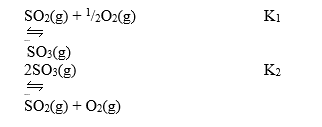 The values of the equilibrium constants K1 and K2 are related by
 (Multiple Choice)
4.7/5 (77)
(77) Consider the reaction N2(g)+ 3H2(g)
 2NH3(g).The production of ammonia is an exothermic reaction.Will heating the equilibrium system increase or decrease the amount of ammonia produced?
 (Essay)
4.9/5 (71)
(71) Concerning the following reaction at equilibrium: 3Fe(s)+ 4H2O(g)  Fe3O4(s)+ 4H2(g), increasing the volume of the container would:
 (Multiple Choice)
4.8/5 (78)
(78) What conditions are used in the Haber process to enhance the yield of ammonia? Explain why each condition affects the yield in terms of the Le Châtelier principle.
(Essay)
4.8/5 (71)
(71) 
Filters
- Essay(0)
- Multiple Choice(0)
- Short Answer(0)
- True False(0)
- Matching(0)