



 Chat with AI
Exam 14: Chemical Equilibrium

Exam 1: Chemistry: the Study of Change168 Questions
Exam 2: Atoms, Molecules, and Ions156 Questions
Exam 3: Mass Relationships in Chemical Reactions194 Questions
Exam 4: Reactions in Aqueous Solutions186 Questions
Exam 5: Gases121 Questions
Exam 6: Thermochemistry118 Questions
Exam 7: Quantum Theory and the Electronic Structure of Atoms136 Questions
Exam 8: Periodic Relationships Among the Elements144 Questions
Exam 9: Chemical Bonding I: Basic Concepts137 Questions
Exam 10: Chemical Bonding Ii: Molecular Geometry and Hybridization of Atomic Orbitals147 Questions
Exam 11: Intermolecular Forces and Liquids and Solids149 Questions
Exam 12: Physical Properties of Solutions122 Questions
Exam 13: Chemical Kinetics130 Questions
Exam 14: Chemical Equilibrium109 Questions
Exam 15: Acids and Bases178 Questions
Exam 16: Acid-Base Equilibria and Solubility Equilibria131 Questions
Exam 17: Entropy Free Energy and Equilibrium128 Questions
Exam 18: Electrochemistry154 Questions
Exam 19: Nuclear Chemistry133 Questions
Exam 20: Chemistry in the Atmosphere50 Questions
Exam 21: Metallurgy and the Chemistry of Metals63 Questions
Exam 22: Nonmetallic Elements and Their Compounds52 Questions
Exam 23: Transition Metal Chemistry and Coordination Compounds92 Questions
Exam 24: Organic Chemistry67 Questions
Exam 25: Synthetic and Natural Organic Polymers50 Questions
Select questions type


Consider the chemical reaction 2NH3(g)  N2(g)+ 3H2(g).The equilibrium is to be established in a 1.0 L container at 1,000 K, where Kc = 4.0 × 10⁻².Initially, 1,220 moles of NH3(g)are present.Calculate Kp for the reaction.
 (Short Answer)
4.9/5  (70)
(70) The equilibrium between carbon dioxide gas and carbonic acid is very important in biology and environmental science, and is shown below.
CO2(aq)+ H2O(l)
 H2CO3(aq)
Based on the equilibrium constant reported for this reaction (Kc = 1.70 × 10⁻³), there will be more carbon dioxide in solution than carbonic acid.
H2CO3(aq)
Based on the equilibrium constant reported for this reaction (Kc = 1.70 × 10⁻³), there will be more carbon dioxide in solution than carbonic acid. (True/False)
4.8/5 (79)
(79) Which of these situations will result if some CH4(g)is removed from the reaction CO(g)+ 3H2(g)  CH4(g)+ H2O(g)at equilibrium?
 (Multiple Choice)
4.8/5 (81)
(81) For the following reaction at equilibrium, which gives a change that will shift the position of equilibrium to favor formation of more products? 2NOBr(g)  2NO(g)+ Br2(g), Hºrxn = 30 kJ/mol
 (Multiple Choice)
4.9/5 (69)
(69) When the reaction 2O3(g)  3O2(g), for which Kp = 3.0 × 1026 at 773ºC, is at equilibrium, the mixture will contain very little O2 as compared to O3.
 (True/False)
4.8/5 (80)
(80) Consider the reaction N2(g)+ O2(g)  2NO(g), for which Kc = 0.10 at 2,000ºC.Starting with initial concentrations of 0.040 M of N2 and 0.040 M of O2, determine the equilibrium concentration of NO.
 (Multiple Choice)
4.9/5 (80)
(80) For the following reaction at equilibrium in a reaction vessel, which change will cause the Br2 concentration to decrease? 2NOBr(g)  2NO(g)+ Br2(g), Hºrxn= 30 kJ/mol
 (Multiple Choice)
4.8/5 (96)
(96) Equilibrium is established for the reaction 2X(s)+ Y(g)  2Z(g)at 500K, Kc = 100.Determine the concentration of Z in equilibrium with 0.2 mol X and 0.50 M Y at 500K.
 (Multiple Choice)
4.8/5 (69)
(69) The data below refer to the following reaction:
2NO(g)+ Br2(g)  2NOBr(g)
 Calculate Kc.
2NOBr(g) Calculate Kc. (Short Answer)
4.9/5 (88)
(88) Calculate Kp for the reaction 2NOCl(g)  2NO(g)+ Cl2(g)at 400°C if Kc at 400°C for this reaction is 2.1 × 10⁻².
 (Multiple Choice)
4.9/5 (76)
(76) Consider the equilibrium C(s)+ H2O(g)  CO(g)+ H2(g), H = 2296 J.What will happen to the concentration of carbon if gaseous water is added to the system?
 (Short Answer)
4.7/5 (82)
(82) At 250ºC, the equilibrium constant Kp for the reaction PCl5(g)  PCl3(g)+ Cl2(g)is 1.80.Sufficient PCl5 is put into a reaction vessel to give an initial pressure of 2.74 atm at 250ºC.Calculate the pressure of PCl5 after the system has reached equilibrium.
 (Multiple Choice)
4.8/5 (79)
(79) Kp for the reaction 4CuO(s)  2Cu2O(s)+ O2(g)is 0.49 at 1024 °C.Calculate Kc at this temperature
 (Multiple Choice)
4.8/5 (87)
(87) For the equilibrium reaction 2SO2(g)+ O2(g)  2SO3(g), Hºrxn = -198 kJ/mol.Which one of these factors would cause the equilibrium constant to increase?
 (Multiple Choice)
4.9/5 (87)
(87) For the reaction H2(g)+ I2(g)  2HI(g), Kc = 50.2 at 445ºC.If [H2] = [I2] = [HI] = 1.75 × 10⁻³ M at 445ºC.Which of the following is true based on the above?
 (Multiple Choice)
5.0/5 (97)
(97) For the reaction SO2(g)+ NO2(g)  SO3(g)+ NO(g), the equilibrium constant is 18.0 at 1,200ºC.If 1.0 mole of SO2 and 2.0 moles of NO2 are placed in a 20.L container, what concentration of SO3 will be present at equilibrium?
 (Multiple Choice)
4.9/5 (73)
(73) Consider the following reactions and their associated equilibrium constants: 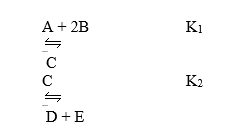 For the reaction A + 2B
 D + E, having equilibrium constant Kc,
For the reaction A + 2B D + E, having equilibrium constant Kc, (Multiple Choice)
4.8/5 (81)
(81) Consider the chemical reaction 2NH3(g)  N2(g)+ 3H2(g).The equilibrium is to be established in a 1.0 L container at 1,000 K, where Kc = 4.0 × 10⁻².Initially, 1,220 moles of NH3(g)are present.Estimate the equilibrium concentration of N2(g).
 (Short Answer)
4.9/5 (82)
(82) The brown gas NO2 and the colorless gas N2O4 exist in equilibrium, 2NO2  N2O4.In an experiment, 0.625 mole of N2O4 was introduced into a 5.00 L vessel and was allowed to decompose until equilibrium was reached.The concentration of N2O4 at equilibrium was 0.0750 M.Calculate Kc for the reaction.
 (Multiple Choice)
4.8/5 (89)
(89) A solution was prepared such that the initial concentrations of Cu2+(aq)and CN-(aq)were 0.0120 M and 0.0400 M, respectively.These ions react according to the following chemical equation
 What will be the concentration of Cu2+(aq)at equilibrium?
 (Short Answer)
4.8/5 (65)
(65) 
Filters
- Essay(0)
- Multiple Choice(0)
- Short Answer(0)
- True False(0)
- Matching(0)