



 Chat with AI
Exam 12: Chemical Kinetics

Exam 1: Chemistry: Matter and Measurement219 Questions
Exam 2: Atoms, molecules, and Ions257 Questions
Exam 3: Formulas, equations, and Moles208 Questions
Exam 4: Reactions in Aqueous Solutions174 Questions
Exam 5: Periodicity and the Atomic Structure of Atoms158 Questions
Exam 6: Ionic Bonds and Some Main-Group Chemistry173 Questions
Exam 7: Covalent Bonds and Molecular Structure232 Questions
Exam 8: Thermochemistry: Chemical Energy163 Questions
Exam 9: Gases: Their Properties and Behavior182 Questions
Exam 10: Liquids,solids,and Phase Changes186 Questions
Exam 11: Solutions and Their Properties192 Questions
Exam 12: Chemical Kinetics206 Questions
Exam 13: Chemical Equilibrium166 Questions
Exam 14: Aqueous Equilibria: Acids and Bases224 Questions
Exam 15: Applications of Aqueous Equilibria190 Questions
Exam 16: Thermodynamics: Entropy, free Energy, and Equilibrium144 Questions
Exam 17: Electrochemistry176 Questions
Exam 18: Hydrogen, oxygen, and Water175 Questions
Exam 19: The Main-Group Elements202 Questions
Exam 20: Transition Elements and Coordination Chemistry185 Questions
Exam 21: Metals and Solid-State Materials149 Questions
Exam 22: Nuclear Chemistry85 Questions
Exam 23: Organic and Biological Chemistry285 Questions
Select questions type


A reaction with an activation energy,Ea = 51.2 kJ/mol will proceed ________ times faster when the temperature is raised from 20 °C to 30 °C.
(Short Answer)
4.8/5  (75)
(75) A gas molecule at 298 K and 1 atm pressure undergoes a collision with another gas molecule approximately every ________ seconds.
(Multiple Choice)
4.8/5 (68)
(68) The following reaction is first order in A and first order in B:
A + B → Products Rate = k[A][B]
What is the rate constant k of this reaction in vessel (b)relative to the rate constant k of this reaction in vessel (a)? Each vessel has the same volume.Shaded spheres represent A molecules,and unshaded spheres represent B molecules. 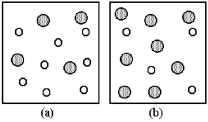
(Multiple Choice)
4.9/5 (86)
(86) The first-order isomerization reaction: cyclopropane → propene,has a rate constant of
1)10 × 10-4s-1 at 470°C and 5.70 × 10⁻⁴s-1 at 500°C.What is the activation energy,Ea,for the reaction?
(Multiple Choice)
4.8/5 (87)
(87) Iodine-123,used in thyroid therapy,has a half-life of 13.27 hours.How many half-lives are required for a 160 mg sample of iodine-123 to decay to 5.0 mg?
(Multiple Choice)
4.9/5 (98)
(98) The reaction that occurs in a Breathalyzer,a device used to determine the alcohol level in a person's bloodstream,is given below.If the rate of appearance of Cr2(SO4)3 is 1.64 mol/min at a particular moment,what is the rate of disappearance of C2H6O at that moment? 
(Multiple Choice)
4.8/5 (68)
(68) A reaction is second order in NO and first order in O2 has a rate constant,k = 1.4 × 10⁴ M-2s-1.What is the initial rate of reaction when the concentrations of NO and O2 are 0.015 M and 0.030 M,respectively?
(Short Answer)
4.8/5 (87)
(87) Given the following hypothetical reaction: 2 E(g)+ F(g)+ G(g)→ products.
If the rate law is: Rate = k[E]2[F]-1,what is the order of reaction with respect to E?
(Multiple Choice)
4.9/5 (70)
(70) The following reaction is first order,C2H6 → 2 CH3.If the rate constant is equal to 5.5 × 10⁻⁴ s-1 at 1000 K,how long will it take for 0.35 mol of C2H6 in a 1.00 L container to decrease to 0.20 mol in the same container?
(Multiple Choice)
4.9/5 (80)
(80) The slowest step in a reaction mechanism is called the ________ step.
(Multiple Choice)
4.8/5 (86)
(86) The aquation of tris(1,10-phenanthroline)iron(II)in acid solution takes place according to the equation:
Fe(phen)32+ + 3 H3O+ + 3 H2O → Fe(H2O)62+ + 3 phenH+
If the activation energy is 126 kJ/mol and frequency factor is 8.62 × 10¹⁷ s-1,at what temperature is the rate constant equal to 3.63 × 10⁻³ s-1 for the first-order reaction?
(Multiple Choice)
4.8/5 (75)
(75) Platinum in the catalytic converter of an automobile catalyzes the conversion of CO to CO2 is an example of a ________ (heterogeneous,homogeneous)catalyst.
(Short Answer)
4.9/5 (80)
(80) Molecular hydrogen can be made from methane gas by the reaction below.How is the rate of disappearance of CH4 related to the rate of appearance of H2?  = ?
CH4 (g)+ H2O (l)→ CO (g)+ 3H2 (g)
= ?
CH4 (g)+ H2O (l)→ CO (g)+ 3H2 (g) (Multiple Choice)
4.7/5 (86)
(86) A mechanism for a naturally occurring reaction that destroys ozone is:
Step 1: O3(g)+ HO(g)→ HO2(g)+ O2(g)
Step 2: HO2(g)+ O(g)→ HO(g)+ O2(g)
Which species is a catalyst and what type of catalysis is occurring?
(Multiple Choice)
4.9/5 (80)
(80) A gaseous compound,C,undergoes catalytic decomposition at an initial rate of 0.45 M/s when
[C]o = 3.0 × 10⁻³ M and 0.45 M/s when [C]o = 9.0 × 10⁻³ M.Therefore,this is a ________ order reaction.
(Short Answer)
4.8/5 (77)
(77) The following set of data was obtained by the method of initial rates for the reaction:
S2O82-(aq)+ 3 I-(aq)→ 2 SO42-(aq)+ I3-(aq)
What is the initial rate when S2O82- is 0.15 M and I- is 0.15 M? 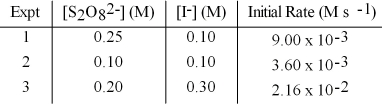
(Multiple Choice)
4.9/5 (95)
(95) The decomposition of dinitrogen pentoxide is described by the chemical equation
2 N2O5(g)→ 4 NO2(g)+ O2(g)
If the rate of disappearance of N2O5 is equal to 1.60 mol/min at a particular moment,what is the rate of appearance of NO2 at that moment?
(Multiple Choice)
4.9/5 (73)
(73) The following reaction is second order in A and first order in B:
A + B → Products Rate = k[A]2[B]
What is the initial rate of this reaction in vessel (b)relative to the initial rate of this reaction in vessel (a)? Each vessel has the same volume.Shaded spheres represent A molecules,and unshaded spheres represent B molecules present at the beginning of the reaction. 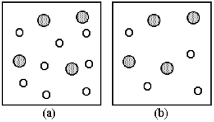
(Multiple Choice)
4.8/5 (61)
(61) A three-step mechanism has been suggested for the formation of carbonyl chloride:
Step 1: Cl2 → 2 Cl
Step 2: Cl + CO → COCl
Step 3: COCl + Cl2 → COCl2 + Cl
Which species is an intermediate in the mechanism?
(Multiple Choice)
4.8/5 (68)
(68) Consider the first-order decomposition of A molecules (shaded spheres)in two vessels of equal volume.What is the half-life of decomposition in vessel (b)relative to the half-life of decomposition in vessel (a)? 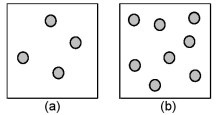
(Multiple Choice)
4.7/5 (94)
(94) 
Filters
- Essay(0)
- Multiple Choice(0)
- Short Answer(0)
- True False(0)
- Matching(0)