



 Chat with AI
Exam 12: Chemical Kinetics

Exam 1: Chemistry: Matter and Measurement219 Questions
Exam 2: Atoms, molecules, and Ions257 Questions
Exam 3: Formulas, equations, and Moles208 Questions
Exam 4: Reactions in Aqueous Solutions174 Questions
Exam 5: Periodicity and the Atomic Structure of Atoms158 Questions
Exam 6: Ionic Bonds and Some Main-Group Chemistry173 Questions
Exam 7: Covalent Bonds and Molecular Structure232 Questions
Exam 8: Thermochemistry: Chemical Energy163 Questions
Exam 9: Gases: Their Properties and Behavior182 Questions
Exam 10: Liquids,solids,and Phase Changes186 Questions
Exam 11: Solutions and Their Properties192 Questions
Exam 12: Chemical Kinetics206 Questions
Exam 13: Chemical Equilibrium166 Questions
Exam 14: Aqueous Equilibria: Acids and Bases224 Questions
Exam 15: Applications of Aqueous Equilibria190 Questions
Exam 16: Thermodynamics: Entropy, free Energy, and Equilibrium144 Questions
Exam 17: Electrochemistry176 Questions
Exam 18: Hydrogen, oxygen, and Water175 Questions
Exam 19: The Main-Group Elements202 Questions
Exam 20: Transition Elements and Coordination Chemistry185 Questions
Exam 21: Metals and Solid-State Materials149 Questions
Exam 22: Nuclear Chemistry85 Questions
Exam 23: Organic and Biological Chemistry285 Questions
Select questions type


The first-order reaction,SO2Cl2 → SO2 + Cl2,has a half-life of 8.75 hours at 593 K.How long will it take for the concentration of SO2Cl2 to fall to 16.5% of its initial value?
(Multiple Choice)
4.8/5  (69)
(69) The fraction of collisions with sufficient energy to react is equal to
(Multiple Choice)
4.8/5 (74)
(74) For the zeroth-order reaction: A → products,what will happen to the rate of reaction if the concentration of A is doubled?
(Multiple Choice)
4.9/5 (95)
(95) Neptunium-239 has a half-life of 2.35 days.How many days must elapse for a sample of 239Np to decay to 1.00% of its original quantity?
(Multiple Choice)
4.9/5 (80)
(80) The following set of data was obtained by the method of initial rates for the reaction:
S2O82-(aq)+ 3 I-(aq)→ 2 SO42-(aq)+ I3-(aq)
What is the rate law for the reaction? 
(Multiple Choice)
4.7/5 (79)
(79) The following set of data was obtained by the method of initial rates for the reaction:
2 HgCl2(aq)+ C2O42-(aq)→ 2 Cl-(aq)+ 2 CO2(g)+ Hg2Cl2(s)
What is the value of the rate constant,k? 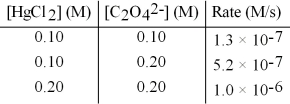
(Multiple Choice)
4.9/5 (87)
(87) A researcher needs 5.00 mg of 128Ba for an experiment.If the half-life of 128Ba is 2.43 days,how many milligrams of 128BaCl2 must she order from the manufacturer if it takes 4.50 days to ship the material from the manufacturer to the university? (Assume the molar mass of 128Ba is 128 g/mol. )
(Multiple Choice)
4.9/5 (86)
(86) What is the overall reaction order for the reaction that has the rate law: Rate = k[ O2] [ NO ]2?
(Multiple Choice)
4.9/5 (82)
(82) The following set of data was obtained by the method of initial rates for the reaction:
2 HgCl2(aq)+ C2O42-(aq)→ 2 Cl-(aq)+ 2 CO2(g)+ Hg2Cl2(s)
What is the rate law for the reaction? 
(Multiple Choice)
4.8/5 (76)
(76) Which statement below regarding the half-life of a zeroth-order reaction is true?
(Multiple Choice)
4.9/5 (86)
(86) The following pictures represent the progress of a reaction in which two A molecules combine to give a more complex molecule A2,2A → A2. 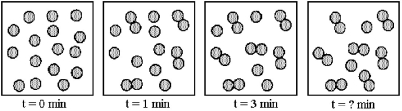 -What is the order of reaction with respect to A?
 (Multiple Choice)
4.9/5 (81)
(81) Neptunium-239 has a half-life of 2.35 days.How many days must elapse for a sample of 239Np to decay to 0.100% of its original quantity?
(Multiple Choice)
4.9/5 (75)
(75) The first-order reaction,SO2Cl2 → SO2 + Cl2,has a rate constant equal to 2.20 × 10⁻⁵ s-1 at 593 K.What percentage of the initial amount SO2Cl2 will remain after 6.00 hours?
(Multiple Choice)
4.8/5 (74)
(74) The reaction below is first order in H2 and second order in NO.What is the rate law for this reaction?
2 H2(g)+ 2 NO(g)→ N2(g)+ 2 H2O(g)
(Multiple Choice)
4.8/5 (81)
(81) A three-step mechanism has been suggested for the formation of carbonyl chloride:
Step 1: Cl2→ 2 Cl (fast,equilibrium)
Step 2: Cl + CO → COCl (fast,equilibrium)
Step 3: COCl + Cl2 → COCl2 + Cl (slow)
What is the molecularity of the rate-determining step?
(Multiple Choice)
4.7/5 (78)
(78) The first-order reaction,SO2Cl2 → SO2 + Cl2,has a rate constant equal to 2.20 × 10⁻⁵ s-1 at
593 K.What percentage of the initial amount of SO2Cl2 will remain after 2.00 hours?
(Multiple Choice)
4.9/5 (100)
(100) For a particular first-order reaction,it takes 48 minutes for the concentration of the reactant to decrease to 25% of its initial value.What is the value for rate constant (in s-1)for the reaction?
(Multiple Choice)
4.8/5 (77)
(77) The aquation of tris(1,10-phenanthroline)iron(II)in acid solution takes place according to the equation:
Fe(phen)32+ + 3 H3O+ + 3 H2O → Fe(H2O)62+ + 3 phenH+
If the activation energy,Ea,is 126 kJ/mol and the rate constant at 30°C is 9.8 × 10⁻³ min-1,what is the frequency factor,A?
(Multiple Choice)
4.9/5 (77)
(77) The relative initial rates of the reaction A2 + B2 → products in vessels (a)-(d)are 1:1:4:4.Unshaded spheres represent A2 molecules,and shaded spheres represent B2 molecules present at the beginning of the reaction.  -What is the order of reaction with respect to B2?
 (Multiple Choice)
4.8/5 (74)
(74) 
Filters
- Essay(0)
- Multiple Choice(0)
- Short Answer(0)
- True False(0)
- Matching(0)