



 Chat with AI
Exam 12: Chemical Kinetics

Exam 1: Chemistry: Matter and Measurement219 Questions
Exam 2: Atoms, molecules, and Ions257 Questions
Exam 3: Formulas, equations, and Moles208 Questions
Exam 4: Reactions in Aqueous Solutions174 Questions
Exam 5: Periodicity and the Atomic Structure of Atoms158 Questions
Exam 6: Ionic Bonds and Some Main-Group Chemistry173 Questions
Exam 7: Covalent Bonds and Molecular Structure232 Questions
Exam 8: Thermochemistry: Chemical Energy163 Questions
Exam 9: Gases: Their Properties and Behavior182 Questions
Exam 10: Liquids,solids,and Phase Changes186 Questions
Exam 11: Solutions and Their Properties192 Questions
Exam 12: Chemical Kinetics206 Questions
Exam 13: Chemical Equilibrium166 Questions
Exam 14: Aqueous Equilibria: Acids and Bases224 Questions
Exam 15: Applications of Aqueous Equilibria190 Questions
Exam 16: Thermodynamics: Entropy, free Energy, and Equilibrium144 Questions
Exam 17: Electrochemistry176 Questions
Exam 18: Hydrogen, oxygen, and Water175 Questions
Exam 19: The Main-Group Elements202 Questions
Exam 20: Transition Elements and Coordination Chemistry185 Questions
Exam 21: Metals and Solid-State Materials149 Questions
Exam 22: Nuclear Chemistry85 Questions
Exam 23: Organic and Biological Chemistry285 Questions
Select questions type


The reaction below is first order in H2 and one-half order in Br2.The rate law for this reaction is ________.
H2(g)+ Br2(g)→ 2 HBr(g)
(Short Answer)
4.9/5  (85)
(85) A concentration-time study of the gas phase reaction 2 A3 → 3 A2 produced the data in the table below.
Time (s)[A3] (M)[A2] (M)
0 4)00 × 10-4 0
10 2.00 × 10⁻⁴ 3.00 × 10⁻⁴
20 1.00 × 10⁻⁴ 4.50 × 10⁻⁴
30 5.00 × 10⁻⁵ ?
What is the concentration of A2 after 30 seconds?
(Multiple Choice)
4.9/5 (80)
(80) For the reaction shown below,what is the relationship between the rate of formation of Br2 and the rate of reaction of Br- over the same time period?
ClO2-(aq)+ 4 Br-(aq)+ 4 H+(aq)→ Cl-(aq)+ 2 Br2(aq)+2 H2O(l)
(Multiple Choice)
4.9/5 (80)
(80) Consider the first-order reaction A → B in which A molecules (shaded spheres)are converted to B molecules (unshaded spheres). 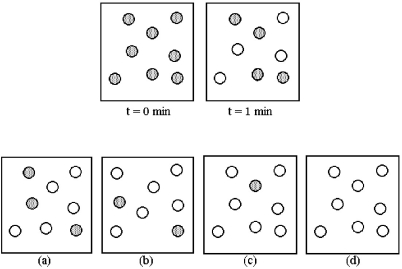 -Which drawing (a)-(d)represents the reaction mixture at t = 3 minutes?
 (Multiple Choice)
4.8/5 (77)
(77) Methanol can be produced by the following reaction:
CO(g)+ 2 H2(g)→ CH3OH(g).
How is the rate of disappearance of hydrogen gas related to the rate of appearance of methanol?  = ?
= ? (Multiple Choice)
4.8/5 (76)
(76) A reaction has the rate law Rate = k[NO]2[H2].If the concentration of NO is reduced by half and the concentration of H2 is quadrupled,the rate of reaction will ________ (increase,decrease,not change).
(Short Answer)
4.8/5 (76)
(76) For the first-order reaction,2 N2O(g)→ 2 N2(g)+ O2(g),what is the concentration of N2O after 3 half-lives if 0.25 mol of N2O is initially placed into a 1.00-L reaction vessel?
(Multiple Choice)
4.8/5 (81)
(81) The following set of data was obtained by the method of initial rates for the reaction:
(H3C)3CBr + OH- → (H3C)3COH + Br-
What is the value of the rate constant,k? 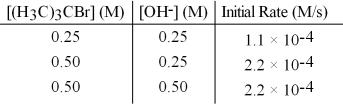
(Multiple Choice)
4.9/5 (88)
(88) The decomposition of ozone in the stratosphere can occur by the following two-step mechanism:
Br + O3 → BrO + O2
BrO + O → Br + O2
Which species is a catalyst in this mechanism?
(Multiple Choice)
4.8/5 (85)
(85) Cerium(IV)ion reacts with thallium(I)ion in a one-step reaction shown below:
2 Ce4+(aq)+ Tl+(aq)→ 2 Ce3+(aq)+ Tl3+(aq).
If the rate law is: Rate = k[Ce4+]2[Tl+],what is the overall order of the reaction?
(Multiple Choice)
4.9/5 (87)
(87) Which statement below regarding the half-life of a second-order reaction is true?
(Multiple Choice)
4.9/5 (76)
(76) A gaseous reaction occurs by a two-step mechanism,shown below.
Step 1: AX +Y2 ⇌ AXY2 fast
Step 2: AXY2 + AX → 2 AXY slow
Including concentration of only reactants and products,what is the rate law for this reaction?
(Multiple Choice)
4.9/5 (64)
(64) The reaction for the decomposition of dinitrogen monoxide gas to form oxygen radicals is:
N2O(g) N2(g)+ O(g).If the rate constant is 3.04 × 10⁻² s-1 and the frequency factor is
8)00 × 1011 s-1,what is the activation energy for the first-order reaction at 700°C?
(Multiple Choice)
4.8/5 (88)
(88) Hydrogen peroxide decomposes to water and oxygen according to the reaction below:
2 H2O2(aq)→ 2 H2O(l)+ O2(g)
In the presence of large excesses of I- ion,the following set of data is obtained.What is the average rate of disappearance of H2O2(aq)in M/s in the first 45.0 seconds of the reaction if 1.00 L of H2O2 reacts at 25°C and 1.00 atm pressure? 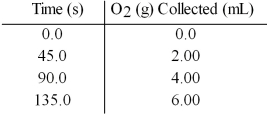
(Multiple Choice)
4.8/5 (77)
(77) A mechanism for a naturally occurring reaction that destroys ozone is:
Step 1: O3(g)+ HO(g)→ HO2(g)+ O2(g)
Step 2: HO2(g)+ O(g)→ HO(g)+ O2(g)
What is the molecularity of the overall reaction?
(Multiple Choice)
4.8/5 (89)
(89) For the zeroth-order reaction: C → products,-Δ[C]/Δt = k,which of the following graphs would be expected to give a straight line?
(Multiple Choice)
4.8/5 (76)
(76) A plot of 1/[BrO-] vs time is linear for the reaction:
3 BrO-(aq)→ BrO3-(aq)+ 2 Br-(aq)
What is the order of the reaction with respect to the hypobromite ion,BrO-?
(Multiple Choice)
4.9/5 (77)
(77) Hydrogen iodide decomposes at 800 K via a second-order process to produce hydrogen and iodine according to the following chemical equation.
2 HI(g)→ H2(g)+ I2(g)
At 800 K it takes 142 seconds for the initial concentration of HI to decrease from 6.75 × 10⁻² M to 3.50 × 10⁻² M.What is the rate constant for the reaction at this temperature?
(Multiple Choice)
5.0/5 (67)
(67) 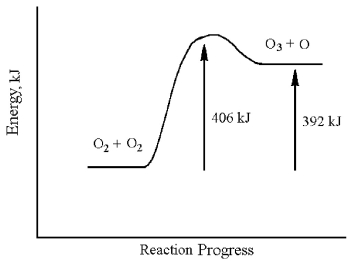 -What is the activation energy for the formation of ozone?
The first-order isomerization reaction: cyclopropane → propene,has a rate constant of
1)10 × 10-4s-1 at 470°C and an activation energy of 264 kJ/mol.What is the temperature of the reaction when the rate constant is equal to 4.36 × 10⁻³s-1?
(Multiple Choice)
4.8/5 (78)
(78) 
Filters
- Essay(0)
- Multiple Choice(0)
- Short Answer(0)
- True False(0)
- Matching(0)