



 Chat with AI
Exam 12: Chemical Kinetics

Exam 1: Chemistry: Matter and Measurement219 Questions
Exam 2: Atoms, molecules, and Ions257 Questions
Exam 3: Formulas, equations, and Moles208 Questions
Exam 4: Reactions in Aqueous Solutions174 Questions
Exam 5: Periodicity and the Atomic Structure of Atoms158 Questions
Exam 6: Ionic Bonds and Some Main-Group Chemistry173 Questions
Exam 7: Covalent Bonds and Molecular Structure232 Questions
Exam 8: Thermochemistry: Chemical Energy163 Questions
Exam 9: Gases: Their Properties and Behavior182 Questions
Exam 10: Liquids,solids,and Phase Changes186 Questions
Exam 11: Solutions and Their Properties192 Questions
Exam 12: Chemical Kinetics206 Questions
Exam 13: Chemical Equilibrium166 Questions
Exam 14: Aqueous Equilibria: Acids and Bases224 Questions
Exam 15: Applications of Aqueous Equilibria190 Questions
Exam 16: Thermodynamics: Entropy, free Energy, and Equilibrium144 Questions
Exam 17: Electrochemistry176 Questions
Exam 18: Hydrogen, oxygen, and Water175 Questions
Exam 19: The Main-Group Elements202 Questions
Exam 20: Transition Elements and Coordination Chemistry185 Questions
Exam 21: Metals and Solid-State Materials149 Questions
Exam 22: Nuclear Chemistry85 Questions
Exam 23: Organic and Biological Chemistry285 Questions
Select questions type


The first-order reaction,2 N2O(g)→ 2 N2(g)+ O2(g),has a rate constant equal to 0.76 s-1 at
1000 K.How long will it take for the concentration of N2O to decrease to 12% of its initial concentration?
(Multiple Choice)
4.7/5  (76)
(76) The reaction shown below has the rate law: Rate = k[BrO3-][Br-][H+]2.
BrO3-(aq)+ 5 Br-(aq)+ 6 H+(aq)→ 3 Br2(aq)+ 3 H2O(l)
What is the overall order of reaction?
(Multiple Choice)
5.0/5 (64)
(64) The following set of data was obtained by the method of initial rates for the reaction:
BrO3-(aq)+ 5 Br-(aq)+ 6 H+(aq)→ 3 Br2(aq)+ 3 H2O(l).
What is the rate law for the reaction? 
(Multiple Choice)
4.8/5 (82)
(82) The decomposition of hydrogen peroxide is given by the following reaction:
2 H2O2(aq)→ 2 H2O(l)+ O2(g)
In the presence of KI the reaction is thought to occur by the following mechanism:
Step 1: H2O2 + I- → H2O + IO-
Step 2: IO- + H2O2 → H2O + O2 + I-
What is the role of I- in this mechanism?
(Multiple Choice)
4.8/5 (90)
(90) The following set of data was obtained by the method of initial rates for the reaction:
BrO3-(aq)+ 5 Br-(aq)+ 6 H+(aq)→ 3 Br2(aq)+ 3 H2O(l).
Calculate the initial rate when BrO3- is 0.30 M,Br- is 0.050 M,and H+ is 0.15 M. 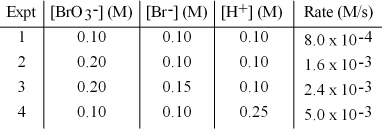
(Multiple Choice)
4.8/5 (80)
(80) A reaction with an activation energy,Ea = 103 kJ/mol has a rate constant,k = 3.5 × 10⁻⁵ s-1 at 25°C.For this reaction the rate constant at 45°C is ________.
(Short Answer)
4.7/5 (81)
(81) Which part of the Arrhenius equation contains a term which measures the number of molecules that have the correct orientation for reaction?
(Multiple Choice)
4.8/5 (85)
(85) Consider a bimolecular reaction in the gas phase.Which one of the following changes in condition will not cause an increase in the rate of the reaction?
(Multiple Choice)
4.9/5 (82)
(82) The following reaction is first order in A and first order in B:
A + B → Products Rate = k[A][B]
What is the initial rate of this reaction in vessel (b)relative to the initial rate of this reaction in vessel (a)? Each vessel has the same volume.Shaded spheres represent A molecules,and unshaded spheres represent B molecules present at the beginning of the reaction. 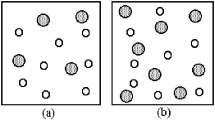
(Multiple Choice)
4.9/5 (80)
(80) The aquation of tris(1,10-phenanthroline)iron(II)in acid solution takes place according to the equation:
Fe(phen)32+ + 3 H3O+ + 3 H2O → Fe(H2O)62+ + 3 phenH+.
If the activation energy,Ea,is 126 kJ/mol and the rate constant at 30°C is 9.8 × 10⁻³ min-1,what is the rate constant at 50°C?
(Multiple Choice)
4.9/5 (89)
(89) What is the rate law for the elementary reaction shown below?
2 HI → H2 + I2
(Multiple Choice)
4.8/5 (74)
(74) What percentage of a radioactive substance remains after 6.00 half-lives have elapsed?
(Multiple Choice)
4.8/5 (83)
(83) Which general rate law below corresponds to an elementary bimolecular reaction?
(Multiple Choice)
4.9/5 (76)
(76) The decomposition of dinitrogen pentoxide is described by the chemical equation
2 N2O5(g)→ 4 NO2(g)+ O2(g)
If the rate of appearance of NO2 is equal to 0.560 mol/min at a particular moment,what is the rate of appearance of O2 at that moment?
(Multiple Choice)
4.8/5 (77)
(77) 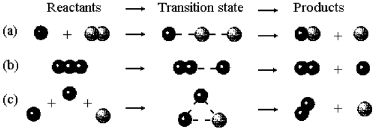 -Which of the elementary reactions shown above has a molecularity of one?
 (Multiple Choice)
4.8/5 (67)
(67)  Decays by alpha emission to give
 )If unshaded spheres represent
 Atoms and shaded spheres represent
 Atoms,how many half-lives have passed in the following example?

Decays by alpha emission to give
)If unshaded spheres represent
Atoms and shaded spheres represent
Atoms,how many half-lives have passed in the following example? (Multiple Choice)
5.0/5 (92)
(92) The decomposition of dinitrogen pentoxide is described by the chemical equation
2 N2O5(g)→ 4 NO2(g)+ O2(g)
If the rate of appearance of O2 is equal to 2.40 mol/min at a particular moment,what is the rate of disappearance of N2O5 at that moment?
(Multiple Choice)
4.8/5 (85)
(85) The following set of data was obtained by the method of initial rates for the reaction:
(H3C)3CBr + OH- → (H3C)3COH + Br-
What is the order of reaction with respect to ion,OH-? 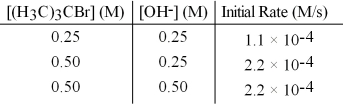
(Multiple Choice)
4.8/5 (80)
(80) The following pictures represent the progress of a reaction in which two A molecules combine to give a more complex molecule A2,2A → A2. 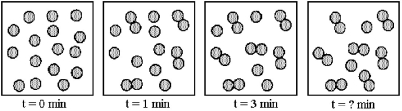 -What is the time required to achieve the molecular mixture in drawing (d)?
 (Multiple Choice)
5.0/5 (74)
(74) 
Filters
- Essay(0)
- Multiple Choice(0)
- Short Answer(0)
- True False(0)
- Matching(0)