



 Chat with AI
Exam 12: Chemical Kinetics

Exam 1: Chemistry: Matter and Measurement219 Questions
Exam 2: Atoms, molecules, and Ions257 Questions
Exam 3: Formulas, equations, and Moles208 Questions
Exam 4: Reactions in Aqueous Solutions174 Questions
Exam 5: Periodicity and the Atomic Structure of Atoms158 Questions
Exam 6: Ionic Bonds and Some Main-Group Chemistry173 Questions
Exam 7: Covalent Bonds and Molecular Structure232 Questions
Exam 8: Thermochemistry: Chemical Energy163 Questions
Exam 9: Gases: Their Properties and Behavior182 Questions
Exam 10: Liquids,solids,and Phase Changes186 Questions
Exam 11: Solutions and Their Properties192 Questions
Exam 12: Chemical Kinetics206 Questions
Exam 13: Chemical Equilibrium166 Questions
Exam 14: Aqueous Equilibria: Acids and Bases224 Questions
Exam 15: Applications of Aqueous Equilibria190 Questions
Exam 16: Thermodynamics: Entropy, free Energy, and Equilibrium144 Questions
Exam 17: Electrochemistry176 Questions
Exam 18: Hydrogen, oxygen, and Water175 Questions
Exam 19: The Main-Group Elements202 Questions
Exam 20: Transition Elements and Coordination Chemistry185 Questions
Exam 21: Metals and Solid-State Materials149 Questions
Exam 22: Nuclear Chemistry85 Questions
Exam 23: Organic and Biological Chemistry285 Questions
Select questions type


The half life of the reaction shown below is found not to depend on the concentration of H2O2(aq).
2 H2O2(aq)→ 2 H2O(l)+ O2(g)
What is the order of this reaction?
(Multiple Choice)
4.9/5  (77)
(77) The reaction below is second order in ClO2 and first order in OH-.When the concentration of ClO2 is 0.020 M and the concentration of OH- is 0.10 M,the initial rate of reaction is 8.00 × 10⁻⁴ M/s.What is the rate constant,k,for this reaction?
2 ClO2(aq)+ 2 OH-(aq)→ ClO3-(aq)+ ClO2-(aq)+ H2O(l)
(Short Answer)
4.8/5 (71)
(71) Hydrogen iodide decomposes at 800 K via a second-order process to produce hydrogen and iodine according to the following chemical equation.
2HI(g)→ H2(g)+ I2(g)
At 800 K it takes 142 seconds for the initial concentration of HI to decrease from 6.75 × 10⁻² M to 3.50 × 10⁻² M.What is the rate constant for the reaction at this temperature?
(Multiple Choice)
4.9/5 (89)
(89) For the reaction shown below,if the rate of formation of Br2 is 1.2 × 10⁻⁶ M/s,over the same time period the rate of consumption of H+ is ________ M/s.
ClO2-(aq)+ 4 Br-(aq)+ 4 H+(aq)→ Cl-(aq)+ 2 Br2(aq)+2 H2O(l)
(Short Answer)
4.7/5 (76)
(76) Consider a reaction that occurs by the following one-step mechanism:
A2 + B2 → 2 AB
The potential energy profile for this reaction is shown below.  -What is the species present at reaction stage 1?
 (Multiple Choice)
4.8/5 (75)
(75) For the reaction shown below,if the rate of formation of O2 is 6.0 × 10⁻⁶ M/s,the rate of decomposition of N2O5 over the same time interval is ________.
2 N2O5(g)→ 4 NO2(g)+ O2(g)
(Short Answer)
4.8/5 (99)
(99) A reaction has the rate law Rate = k[NO]2[H2].If the concentration of NO is reduced by 1/3,the rate of reaction will be ________ (increased,decreased)by ________.
(Short Answer)
4.9/5 (74)
(74) The hydrolysis of tert-butyl chloride is given in the reaction below:
(CH3)3CCl(aq)+ H2O(l)→ (CH3)3COH(aq)+ H+(aq)+ Cl-(aq)
If the rate law is: Rate = k[(CH3)3CCl],what is the order of the reaction with respect to water?
(Multiple Choice)
4.8/5 (78)
(78) The relative initial rates of the reaction A2 + B2 → products in vessels (a)-(d)are 1:1:4:4.Unshaded spheres represent A2 molecules,and shaded spheres represent B2 molecules present at the beginning of the reaction.  -What is the overall order of reaction?
 (Multiple Choice)
5.0/5 (71)
(71) The reaction for the decomposition of dinitrogen monoxide gas to form an oxygen radical is: N2O(g) N2(g)+ O(g).If the activation energy is 250 kJ/mol and the frequency factor is 8.0 × 10¹¹ s-1,what is the rate constant for the first-order reaction at 1000 K?
(Multiple Choice)
4.8/5 (77)
(77) Consider the first-order reaction A → B in which A molecules (unshaded spheres)are converted to B molecules (shaded spheres).Given the following pictures at t = 0 seconds and t = 100 seconds,which picture represents the number of A and B molecules remaining at 200 seconds? 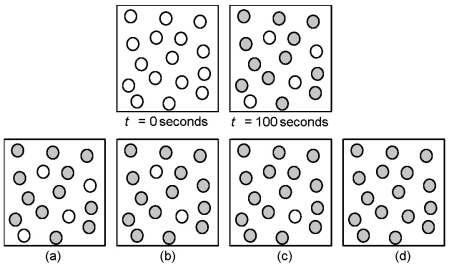
(Multiple Choice)
4.8/5 (74)
(74) The second-order reaction,2 Mn(CO)5 → Mn2(CO)10 has a rate constant equal to 3.0 × 10⁹ M-1s-1 at 25°C.If the initial concentration of Mn(CO)5 is 1.0 × 10⁻⁵ M,how long will it take for 90.% of the reactant to disappear?
(Multiple Choice)
4.9/5 (90)
(90) The isomerization reaction,CH3NC → CH3CN,is first order and the rate constant is equal to
0)46 s-1 at 600 K.What is the concentration of CH3NC after 0.20 minutes if the initial concentration is 0.10 M?
(Multiple Choice)
4.8/5 (77)
(77) The decomposition of cyclopropane,was observed at 500°C and its concentration was monitored as a function of time.The data set is given below.What is the order of the reaction with respect to cyclopropane? 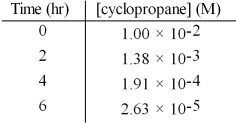
(Multiple Choice)
4.9/5 (85)
(85) The decay curve shown below approximates the decay of cobalt-60.What is the approximate half-life of cobalt-60? 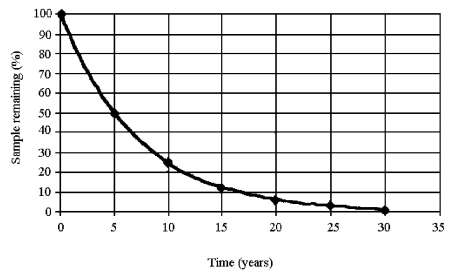
(Multiple Choice)
4.9/5 (79)
(79) Which of the following statements are true about reaction mechanisms?
I.A rate law can be written from the molecularity of the slowest elementary step.
II.The final rate law can include intermediates.
III.The rate of the reaction is dependent on the fastest step in the mechanism.
IV.A mechanism can never be proven to be the correct pathway for a reaction.
(Multiple Choice)
5.0/5 (84)
(84) The following reaction is first order in A and first order in B:
A + B → Products Rate = k[A][B]
What is the rate constant k of this reaction in vessel (b)relative to the rate constant k of this reaction in vessel (a)? Each vessel has the same volume.Shaded spheres represent A molecules,and unshaded spheres represent B molecules. 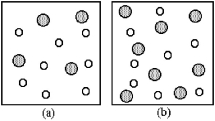
(Multiple Choice)
4.7/5 (74)
(74) Acetaldehyde decomposes at 750 K: CH3CHO → CO + CH4.The reaction is first order in acetaldehyde and the half-life of the reaction is found to be 530 seconds.What is the rate constant for the reaction at this temperature?
(Multiple Choice)
4.9/5 (79)
(79) A concentration-time study of the gas phase reaction 2 A3 → 3 A2 produced the data in the table below.
Time (s)[A3] (M)[A2] (M)
0 4)00 × 10-4 0
10 2.00 × 10⁻⁴ 3.00 × 10⁻⁴
20 1.00 × 10⁻⁴ 4.50 × 10⁻⁴
30 5.00 × 10⁻⁵ ?
What is the average rate of formation of A2 in the time interval 20-30 seconds?
(Multiple Choice)
4.7/5 (66)
(66) The first-order reaction,SO2Cl2 → SO2 + Cl2,has a half-life of 8.75 hours at 593 K.How long will it take for the concentration of SO2Cl2 to fall to 12.5% of its initial value?
(Multiple Choice)
4.8/5 (80)
(80) 
Filters
- Essay(0)
- Multiple Choice(0)
- Short Answer(0)
- True False(0)
- Matching(0)