



 Chat with AI
Exam 8: Thermochemistry: Chemical Energy

Exam 1: Chemistry: Matter and Measurement219 Questions
Exam 2: Atoms, molecules, and Ions257 Questions
Exam 3: Formulas, equations, and Moles208 Questions
Exam 4: Reactions in Aqueous Solutions174 Questions
Exam 5: Periodicity and the Atomic Structure of Atoms158 Questions
Exam 6: Ionic Bonds and Some Main-Group Chemistry173 Questions
Exam 7: Covalent Bonds and Molecular Structure232 Questions
Exam 8: Thermochemistry: Chemical Energy163 Questions
Exam 9: Gases: Their Properties and Behavior182 Questions
Exam 10: Liquids,solids,and Phase Changes186 Questions
Exam 11: Solutions and Their Properties192 Questions
Exam 12: Chemical Kinetics206 Questions
Exam 13: Chemical Equilibrium166 Questions
Exam 14: Aqueous Equilibria: Acids and Bases224 Questions
Exam 15: Applications of Aqueous Equilibria190 Questions
Exam 16: Thermodynamics: Entropy, free Energy, and Equilibrium144 Questions
Exam 17: Electrochemistry176 Questions
Exam 18: Hydrogen, oxygen, and Water175 Questions
Exam 19: The Main-Group Elements202 Questions
Exam 20: Transition Elements and Coordination Chemistry185 Questions
Exam 21: Metals and Solid-State Materials149 Questions
Exam 22: Nuclear Chemistry85 Questions
Exam 23: Organic and Biological Chemistry285 Questions
Select questions type


Given that ΔH°= -311 kJ for the hydrogenation of acetylene,C2H2:
H-C=C-H(g)+ 2 H2(g)→ CH3-CH3(g)
And the following bond dissociation energies,estimate a value for the C-to-C triple bond dissociation energy. 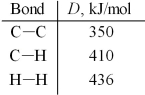

Free
(Multiple Choice)
4.7/5  (66)
(66) Correct Answer: Verified
C
Which is the most exothermic reaction?
Free
(Multiple Choice)
4.9/5 (77)
(77) Correct Answer:Verified
VerifiedB
Find ΔE° for the reaction below if the process is carried out at a constant pressure of 1.00 atm and ΔV (the volume change)= -24.5 L.(1 L ∙ atm = 101 J)
2 CO(g)+ O2 (g)→ 2 CO2(g)ΔH° = -566.kJ
Free
(Multiple Choice)
4.8/5 (78)
(78) Correct Answer:Verified
VerifiedC
When 0.455 g of anthracene,C14H10,is combusted in a bomb calorimeter that has a water jacket containing 500.g of water,the temperature of the water increases by 8.63°C.Assuming that the specific heat of water is 4.18 J/(g ∙ °C),and that the heat absorption by the calorimeter is negligible,estimate the enthalpy of combustion per mole of anthracene.
(Multiple Choice)
4.9/5 (85)
(85) For a particular process that is carried out at constant pressure,q = 145 kJ and w = - 35 kJ.Therefore,
(Multiple Choice)
5.0/5 (78)
(78) Which combination always results in a reaction being spontaneous?
(Multiple Choice)
4.8/5 (86)
(86) It takes 11.2 kJ of energy to raise the temperature of 145 g of benzene from 23.0°C to 68.0°C.What is the specific heat of benzene?
(Multiple Choice)
4.9/5 (85)
(85) When 2.000 moles of H2(g)reacts with 1.000 mol of O2(g)to form 2.000 mol of H2O(l)at 25°C and a constant pressure of 1.00 atm.If 136.6 kJ of heat are released during this reaction,and PΔV is equal to -7.400 kJ,then
(Multiple Choice)
4.8/5 (83)
(83) For a process at constant pressure,49,600 calories of heat are released.This quantity of heat is equivalent to
(Multiple Choice)
4.9/5 (88)
(88) The sign of ΔG for a reaction is if the reaction is spontaneous,________ if the reaction is at equilibrium,and ________ if the reaction is nonspontaneous.
(Short Answer)
4.9/5 (69)
(69) 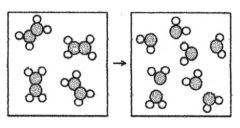 -The reaction represented in the above drawing is likely to be
 (Multiple Choice)
4.8/5 (80)
(80) Is thermal energy a form of kinetic or potential molecular energy?
(Short Answer)
4.8/5 (80)
(80) At constant pressure for which of the reactions shown below should ΔH° be greater than ΔE° ?
I.2 SO2(g)+ O2(g)→ 2 SO3(g)
II.C3H8(g)+ 5 O2(g)→ 3 CO2(g)+ 4 H2O(l)
III.H2(g)+ Cl2(g)→ 2 HCl(g)
IV.N2O4(g)→ 2 NO2(g)
(Multiple Choice)
5.0/5 (78)
(78) For the of freezing liquid ethanol at a given temperature and pressure,
(Multiple Choice)
4.8/5 (88)
(88) Imagine a reaction that results in a change in both volume and temperature,as shown in the diagram below.What is the sign of the work being done and the sign of the enthalpy change involved in this reaction? 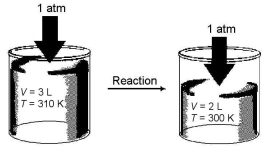
(Multiple Choice)
4.9/5 (72)
(72) What is the thermodynamic criterion for equilibrium for a reaction at constant temperature and pressure (PV work only)?
(Multiple Choice)
4.8/5 (73)
(73) When heated,mercury(II)oxide decomposes into elemental mercury and oxygen:
2 HgO(s)→ 2 Hg(l)+ O2(g)ΔH° = 181.6 kJ ΔS° = 216.4 J/K
Estimate the temperature at which HgO should begin to decompose if the partial pressure of O2(g)is constant at 1.00 atm.
(Multiple Choice)
4.9/5 (78)
(78) A reaction is performed in a 1-L balloon at 25°C and 1 atm pressure.At the end of the reaction the balloon has expanded to 1.5 L and the surface of the balloon has a temperature of 35°C and is at 1 atm pressure.Determine whether the signs of the heat transferred,the work,and the energy change,respectively,are positive or negative.
(Short Answer)
4.8/5 (86)
(86) At 1 atm pressure the heat of sublimation of gallium is 277 kJ/mol and the heat of vaporization is 271 kJ/mol.How much heat is required to melt 1.50 mol of gallium at 1 atm pressure?
(Multiple Choice)
4.8/5 (74)
(74) 
Filters
- Essay(0)
- Multiple Choice(0)
- Short Answer(0)
- True False(0)
- Matching(0)