



 Chat with AI
Exam 8: Thermochemistry: Chemical Energy

Exam 1: Chemistry: Matter and Measurement219 Questions
Exam 2: Atoms, molecules, and Ions257 Questions
Exam 3: Formulas, equations, and Moles208 Questions
Exam 4: Reactions in Aqueous Solutions174 Questions
Exam 5: Periodicity and the Atomic Structure of Atoms158 Questions
Exam 6: Ionic Bonds and Some Main-Group Chemistry173 Questions
Exam 7: Covalent Bonds and Molecular Structure232 Questions
Exam 8: Thermochemistry: Chemical Energy163 Questions
Exam 9: Gases: Their Properties and Behavior182 Questions
Exam 10: Liquids,solids,and Phase Changes186 Questions
Exam 11: Solutions and Their Properties192 Questions
Exam 12: Chemical Kinetics206 Questions
Exam 13: Chemical Equilibrium166 Questions
Exam 14: Aqueous Equilibria: Acids and Bases224 Questions
Exam 15: Applications of Aqueous Equilibria190 Questions
Exam 16: Thermodynamics: Entropy, free Energy, and Equilibrium144 Questions
Exam 17: Electrochemistry176 Questions
Exam 18: Hydrogen, oxygen, and Water175 Questions
Exam 19: The Main-Group Elements202 Questions
Exam 20: Transition Elements and Coordination Chemistry185 Questions
Exam 21: Metals and Solid-State Materials149 Questions
Exam 22: Nuclear Chemistry85 Questions
Exam 23: Organic and Biological Chemistry285 Questions
Select questions type


Which of the following is not a type of energy or energy transfer?
(Multiple Choice)
4.9/5  (76)
(76) Use the given standard enthalpies of formation to calculate ΔH° for the following reaction
3 Fe2O3(s)+ CO(g)→ 2 Fe3O4(s)+ CO2(g). 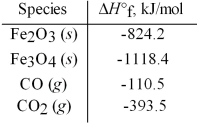
(Multiple Choice)
4.9/5 (88)
(88) A reaction is performed in a water bath initially at 21°C which decreases to 18°C by the end of the reaction.For this reaction the sign of heat transfer is ________,and the reaction is classified as ________.
(Short Answer)
4.9/5 (85)
(85) How much heat is absorbed when 45.00 g of C(s)reacts in the presence of excess SO2(g)to produce CS2(l)and CO(g)according to the following chemical equation?
5 C(s)+ 2 SO2(g)→ CS2(l)+ 4 CO(g)ΔH° = 239.9 kJ
(Multiple Choice)
4.9/5 (67)
(67) Heat transferred in a chemical reaction or physical change is expressed as ΔE when the heat is transferred under constant ________ and is expressed as ΔH when heat is transferred under constant ________ conditions.
(Short Answer)
4.8/5 (74)
(74) What are the signs of ΔH,ΔS,and ΔG for the following spontaneous change? 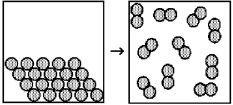
(Multiple Choice)
4.9/5 (86)
(86) Find ΔH for BaCO3 (s)→ BaO (s)+ CO2 (g)
Given 2 Ba (s)+ O2 (g)→ 2 BaO (s)ΔH = -1107.0 kJ
Ba (s)+ CO2 (g)+ 1/2 O2 (g)→ BaCO3 (g)ΔH = -822.5 kJ
(Multiple Choice)
5.0/5 (83)
(83) Which is expected to have the most negative standard enthalpy of formation?
(Multiple Choice)
4.8/5 (80)
(80) A property whose value depends only on the present condition of the system and not how the system arrived at that condition is called a ________ function.
(Short Answer)
4.7/5 (72)
(72) The specific heat of copper is 0.385 J/(g ∙ °C).If 34.2 g of copper,initially at 24.0°C,absorbs
4)689 kJ,what will be the final temperature of the copper?
(Multiple Choice)
4.9/5 (74)
(74) Sodium metal reacts with water to produce hydrogen gas and sodium hydroxide according to the chemical equation shown below.When 0.0 25 mol of Na is added to 100.00 g of water,the temperature of the resulting solution rises from 25.00°C to 35.75°C.If the specific heat of the solution is 4.18 J/(g ∙ °C),calculate ΔH for the reaction,as written.
2 Na(s)+ 2 H2O(l)→ 2 NaOH(aq)+ H2(g)ΔH= ?
(Multiple Choice)
4.9/5 (84)
(84) At 253 K the sign of ΔG for the physical change shown below is ________.
H2O(s)→ H2O(l)
(Short Answer)
4.9/5 (93)
(93) For the reaction: A + 2 B → 3 C,ΔH° = -203 kJ.For the reaction 6 C → 2 A + 4 B,ΔH° = ________ kJ.
(Short Answer)
4.8/5 (73)
(73) Sodium metal reacts with water to produce hydrogen gas and sodium hydroxide according to the chemical equation shown below.When 0.0300 mol of Na is added to 100.00 g of water,the temperature of the resulting solution rises from 25.00°C to 37.90°C.If the specific heat of the solution is
4)18 J/(g ∙ °C),calculate ΔH for the reaction,as written.
2 Na(s)+ 2 H2O(l)→ 2 NaOH(aq)+ H2(g)ΔH = ?
(Multiple Choice)
4.8/5 (96)
(96) Which is expected to have the lowest specific heat capacity at 25°C?
(Multiple Choice)
4.7/5 (79)
(79) The enthalpy of fusion,or heat of fusion (ΔHfusion),of water is positive and corresponds to which physical change?
(Multiple Choice)
4.8/5 (79)
(79) 
Filters
- Essay(0)
- Multiple Choice(0)
- Short Answer(0)
- True False(0)
- Matching(0)