



 Chat with AI
Exam 8: Thermochemistry: Chemical Energy

Exam 1: Chemistry: Matter and Measurement219 Questions
Exam 2: Atoms, molecules, and Ions257 Questions
Exam 3: Formulas, equations, and Moles208 Questions
Exam 4: Reactions in Aqueous Solutions174 Questions
Exam 5: Periodicity and the Atomic Structure of Atoms158 Questions
Exam 6: Ionic Bonds and Some Main-Group Chemistry173 Questions
Exam 7: Covalent Bonds and Molecular Structure232 Questions
Exam 8: Thermochemistry: Chemical Energy163 Questions
Exam 9: Gases: Their Properties and Behavior182 Questions
Exam 10: Liquids,solids,and Phase Changes186 Questions
Exam 11: Solutions and Their Properties192 Questions
Exam 12: Chemical Kinetics206 Questions
Exam 13: Chemical Equilibrium166 Questions
Exam 14: Aqueous Equilibria: Acids and Bases224 Questions
Exam 15: Applications of Aqueous Equilibria190 Questions
Exam 16: Thermodynamics: Entropy, free Energy, and Equilibrium144 Questions
Exam 17: Electrochemistry176 Questions
Exam 18: Hydrogen, oxygen, and Water175 Questions
Exam 19: The Main-Group Elements202 Questions
Exam 20: Transition Elements and Coordination Chemistry185 Questions
Exam 21: Metals and Solid-State Materials149 Questions
Exam 22: Nuclear Chemistry85 Questions
Exam 23: Organic and Biological Chemistry285 Questions
Select questions type


Imagine a reaction that results in a change in both volume and temperature,as shown in the diagram below.What is the sign of the work being done,and what is the sign of the enthalpy change involved in this reaction? 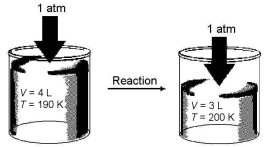
(Multiple Choice)
4.8/5  (87)
(87) When 5.00 mol of benzene is vaporized at a constant pressure of 1.00 atm and at its normal boiling point of 80.1°C,169.5 kJ are absorbed and PΔV for the vaporization process is equal to 14.5 kJ then
(Multiple Choice)
4.8/5 (83)
(83) Is chemical energy a form of kinetic or potential molecular energy?
(Short Answer)
4.8/5 (78)
(78) Find ΔH for C3H8 (g)+ 6 H2O (g)→ 3 CO2 (g)+ 10 H2
Given C3H8 (g)+ 3 H2O (g)→ 3 CO (g)+ 7 H2 (g)ΔH = 499 kJ
CO (g)+ H2O (g)→ CO2 (g)+ H2 (g)ΔH = -41 kJ
(Multiple Choice)
4.9/5 (94)
(94) Coal gasification can be represented by the equation:
2 C(s)+ 2 H2O(g)→ CH4(g)+ CO2(g)ΔH = ?
Use the following information to find ΔH for the reaction above.
CO(g)+ H2(g)→ C(s)+ H2O(g)ΔH = -131 kJ
CO(g)+ H2O(g)→ CO2(g)+ H2(g)ΔH = -41 kJ
CO(g)+ 3 H2(g)→ CH4(g)+ H2O(g)ΔH = -206 kJ
(Multiple Choice)
4.8/5 (79)
(79) If an endothermic reaction is spontaneous at constant temperature and pressure,
(Multiple Choice)
4.7/5 (86)
(86) Determine the sign of ΔS° for each of the following:
I.C6H6(s)→ C6H6(l)
II.2 SO2(g)+ O2(g)→ 2 SO3(g)
(Multiple Choice)
4.9/5 (87)
(87) At a given temperature and pressure,which of the following would be expected to have the greatest molar entropy?
(Multiple Choice)
4.9/5 (77)
(77) Calculate ΔG° for the reaction below and tell whether it is spontaneous or nonspontaneous under standard conditions at 25°C.
2 S (s)+ 3 O2 (g)+ 2 H2O (l)→ 2 H2SO4 (l)ΔH° = -1056 kJ/mol
ΔS° = -505 J/mol
(Multiple Choice)
4.8/5 (85)
(85) For a particular process that is carried out at constant pressure,q = 125 kJ and w = -15 kJ.Therefore,
(Multiple Choice)
4.9/5 (81)
(81) Ethyl alcohol is produced by the fermentation of glucose,C6H12O6.
C6H12O6(s)→ 2 C2H5OH(l)+ 2 CO2(g)ΔH° = -69.1 kJ
Given that the enthalpy of formation is -277.7 kJ/mol for C2H5OH(l)and -393.5 kJ/mol for CO2(g),find the enthalpy of formation for C6H12O6.
(Multiple Choice)
4.9/5 (73)
(73) In the reaction below,is energy released or absorbed by the system? What is the sign of the energy change,E?
432 kJ + A + 2B → 3C
(Short Answer)
5.0/5 (70)
(70) What are the signs of ΔH,ΔS,and ΔG for the following spontaneous change? 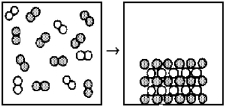
(Multiple Choice)
4.8/5 (86)
(86) 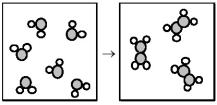 -The reaction represented in the above drawing is likely to be
 (Multiple Choice)
4.8/5 (94)
(94) At a constant pressure of 1.50 atm what is the enthalpy change ΔH for a reaction where the internal energy change ΔE is 58.0 kJ and the volume increase is 12.6 L? (1 L·atm = 101.325 J. )
(Multiple Choice)
4.9/5 (78)
(78) 
Filters
- Essay(0)
- Multiple Choice(0)
- Short Answer(0)
- True False(0)
- Matching(0)