



 Chat with AI
Exam 8: Thermochemistry: Chemical Energy

Exam 1: Chemistry: Matter and Measurement219 Questions
Exam 2: Atoms, molecules, and Ions257 Questions
Exam 3: Formulas, equations, and Moles208 Questions
Exam 4: Reactions in Aqueous Solutions174 Questions
Exam 5: Periodicity and the Atomic Structure of Atoms158 Questions
Exam 6: Ionic Bonds and Some Main-Group Chemistry173 Questions
Exam 7: Covalent Bonds and Molecular Structure232 Questions
Exam 8: Thermochemistry: Chemical Energy163 Questions
Exam 9: Gases: Their Properties and Behavior182 Questions
Exam 10: Liquids,solids,and Phase Changes186 Questions
Exam 11: Solutions and Their Properties192 Questions
Exam 12: Chemical Kinetics206 Questions
Exam 13: Chemical Equilibrium166 Questions
Exam 14: Aqueous Equilibria: Acids and Bases224 Questions
Exam 15: Applications of Aqueous Equilibria190 Questions
Exam 16: Thermodynamics: Entropy, free Energy, and Equilibrium144 Questions
Exam 17: Electrochemistry176 Questions
Exam 18: Hydrogen, oxygen, and Water175 Questions
Exam 19: The Main-Group Elements202 Questions
Exam 20: Transition Elements and Coordination Chemistry185 Questions
Exam 21: Metals and Solid-State Materials149 Questions
Exam 22: Nuclear Chemistry85 Questions
Exam 23: Organic and Biological Chemistry285 Questions
Select questions type


At constant pressure,the combustion of 5.00 g of C2H6(g)releases 259 kJ of heat.What is ΔH for the reaction given below?
2 C2H6(g)+ 7 O2(g)→ 4 CO2(g)+ 6 H2O(l)
(Multiple Choice)
4.8/5  (83)
(83) Which of CH4(g),C2H2(g),and CH3OH(l)provides the most energy per gram upon combustion and which provides the least?
CH4(g)+ 2 O2(g)→ CO2(g)+ 2 H2O(l)ΔH° = -890 kJ
2 C2H2(g)+ 5 O2(g)→ 4 CO2(g)+ 2 H2O(l)ΔH° = -2599 kJ
2 CH3OH(l)+ 3 O2(g)→ 2 CO2(g)+ 4 H2O(l)ΔH° = -1453 kJ
(Multiple Choice)
4.9/5 (80)
(80) When 1.00 mol of benzene is vaporized at a constant pressure of 1.00 atm and at its normal boiling point of 80.1°C,33.9 kJ are absorbed and PΔV for the vaporization process is equal to 2.90 kJ,then
(Multiple Choice)
4.9/5 (75)
(75) Under thermodynamic standard state conditions the element oxygen occurs as
(Multiple Choice)
4.9/5 (89)
(89) Which of the following can be interpreted as a measure of randomness?
(Multiple Choice)
4.8/5 (79)
(79) It takes 11.2 kJ of energy to raise the temperature of 145 g of benzene from 25.0°C to 70.0°C.What is the specific heat of benzene?
(Multiple Choice)
4.8/5 (77)
(77) The following drawing is a representation of the exothermic reaction in which ozone forms dioxygen. 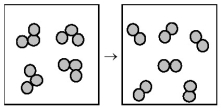 -What are the signs of ΔH and ΔS for this reaction?
 (Multiple Choice)
4.9/5 (84)
(84) The enthalpy of fusion of naphthalene,C10H8,is 19.1 kJ/mol at 78.2°C,its melting point.Calculate the entropy of fusion at the melting point.
(Multiple Choice)
4.9/5 (76)
(76) A process is carried out at constant pressure.Given that 0 > ΔH > ΔE,
(Multiple Choice)
4.8/5 (82)
(82) For the expansion of an ideal gas into a vacuum at constant temperature,ΔH = 0.What can be said about ΔE and ΔS?
(Multiple Choice)
4.9/5 (80)
(80) Calculate the work energy,w,gained or lost by the system when a gas expands from 15 L to 35 L against a constant external pressure of 1.5 atm.[1 L ∙ atm = 101 J]
(Multiple Choice)
4.9/5 (78)
(78) The sign of ΔS° for reaction below is expected to be ________.
2 H2(g)+ O2(g)→ 2 H2O(g)
(Short Answer)
4.7/5 (87)
(87) What is expected when the reaction shown below takes place in a thermally-insulated container outfitted with a movable piston at a constant atmospheric pressure of 1 atm?
2 C2H6(g)+ 7 O2(g)→ 4 CO2(g)+ 6 H2O(g)
(Multiple Choice)
4.9/5 (80)
(80) Heat transfer measured in a coffee-cup calorimeter at constant pressure is a measure of ________,but heat transfer measured in a bomb calorimeter at constant volume is a measure of ________.
(Short Answer)
4.9/5 (82)
(82) The specific heat of copper is 0.385 J/(g ∙°C).If 34.2 g of copper,initially at 25°C,absorbs 4.689 kJ,what will be the final temperature of the copper?
(Multiple Choice)
4.9/5 (82)
(82) Because the number of moles of gas are increasing from 6 to 7 in the reaction shown below,at constant pressure ΔE is predicted to be slightly ________ negative than ΔH.
C3H8(g)+ 5 O2(g)→ 3 CO2(g)+ 4 H2O(g)
(Short Answer)
4.7/5 (66)
(66) When 0.455 g of anthracene,C14H10,is combusted in a bomb calorimeter that has a water jacket containing 500.0 g of water,the temperature of the water increases by 8.63°C.Assuming that the specific heat of water is 4.18 J/(g ∙ °C),and that the heat absorption by the calorimeter is negligible,estimate the enthalpy of combustion per mole of anthracene.
(Multiple Choice)
4.7/5 (59)
(59) Which is expected to have the largest carbon-oxygen bond dissociation energy?
(Multiple Choice)
4.9/5 (64)
(64) Determine the sign of ΔS° for each of the following:
I.The mixing of two gases at a given temperature and pressure
II.C(s)+ 2 H2O(g)→ CO2(g)+ 2 H2(g)
(Multiple Choice)
4.7/5 (78)
(78) At 25°C the heat of fusion of aluminum is 10.6 kJ/mol and the heat of sublimation is 326.4 kJ/mol.What is the heat of vaporization of aluminum at 25°C?
(Multiple Choice)
4.8/5 (71)
(71) 
Filters
- Essay(0)
- Multiple Choice(0)
- Short Answer(0)
- True False(0)
- Matching(0)