



 Chat with AI
Exam 16: Thermodynamics: Entropy, free Energy, and Equilibrium

Exam 1: Chemistry: Matter and Measurement219 Questions
Exam 2: Atoms, molecules, and Ions257 Questions
Exam 3: Formulas, equations, and Moles208 Questions
Exam 4: Reactions in Aqueous Solutions174 Questions
Exam 5: Periodicity and the Atomic Structure of Atoms158 Questions
Exam 6: Ionic Bonds and Some Main-Group Chemistry173 Questions
Exam 7: Covalent Bonds and Molecular Structure232 Questions
Exam 8: Thermochemistry: Chemical Energy163 Questions
Exam 9: Gases: Their Properties and Behavior182 Questions
Exam 10: Liquids,solids,and Phase Changes186 Questions
Exam 11: Solutions and Their Properties192 Questions
Exam 12: Chemical Kinetics206 Questions
Exam 13: Chemical Equilibrium166 Questions
Exam 14: Aqueous Equilibria: Acids and Bases224 Questions
Exam 15: Applications of Aqueous Equilibria190 Questions
Exam 16: Thermodynamics: Entropy, free Energy, and Equilibrium144 Questions
Exam 17: Electrochemistry176 Questions
Exam 18: Hydrogen, oxygen, and Water175 Questions
Exam 19: The Main-Group Elements202 Questions
Exam 20: Transition Elements and Coordination Chemistry185 Questions
Exam 21: Metals and Solid-State Materials149 Questions
Exam 22: Nuclear Chemistry85 Questions
Exam 23: Organic and Biological Chemistry285 Questions
Select questions type


Which one of the following has the lowest standard molar entropy,S°,at 25°C?

Free
(Multiple Choice)
4.9/5  (78)
(78) Correct Answer: Verified
A
The most common white pigment until the 1880s was lead white,sometimes called basic lead carbonate: (PbCO3)2Pb(OH)2.Paintings containing lead white turned black in the presence of moist H2S from natural sources and polluted air due to the formation of PbS.The PbCO3 portion of this reaction is shown below.
PbCO3(s)+ H2S(aq)→ PbS(s)+ H2CO3(aq)
If ΔH° = -60.9 kJ/mol and ΔS° = 26.6 J/K,what are ΔSsurr and ΔStotal for this reaction at 25°C??
Free
(Short Answer)
4.8/5 (79)
(79) Correct Answer:Verified
Verified204 J/K,230 J/K
Predict the sign of ΔS for each of the following systems,which occur at constant temperature
I.The volume of 2.0 moles of O2(g)increases from 44 L to 52 L.
II.The pressure of 2.0 moles of O2(g)increases from 1.0 atm to 1.2 atm.
Free
(Multiple Choice)
4.8/5 (95)
(95) Correct Answer:Verified
VerifiedC
The reaction 2 H2(g)+ O2(g)→ 2 H2O(g)is spontaneous at 25°C.The addition of a catalyst will ________ (decrease,increase,not change)the rate of reaction and ________ (decrease,increase,not change)the spontaneity of the reaction.
(Short Answer)
4.9/5 (71)
(71) For the reaction N2(g)+ 2 O2(g)→ 2 NO2(g),ΔG° = 102.6 kJ.At 25°C the equilibrium constant Kp = ________.
(Short Answer)
4.8/5 (64)
(64) For bromine,ΔH°vap = 30.91 kJ/mol and ΔS°vap = 93.23 JK-1mol-1 at 25°C.What is the normal boiling point for bromine?
(Multiple Choice)
4.9/5 (79)
(79) Solid NaHCO3 is heated to 90°C.At equilibrium the total pressure of the gases produced is 0.545 atm.Calculate ΔG° at 90°C for the reaction
2 NaHCO3(s)⇌ Na2CO3(s)+ H2O(g)+ CO2(g).
(Multiple Choice)
4.8/5 (75)
(75) By what factor does the entropy increase for a collection of 100 molecules from a system of 1 × 10⁵ boxes to 1 × 10⁶ boxes?
(Short Answer)
4.8/5 (64)
(64) At high temperatures,boron carbide vaporizes according to
B4C(s)⇌ 4 B(g)+ C(s)
At 2500 K,the equilibrium pressure of B(g)is 0.0342 mm Hg over a mixture of 0.300 mol B4C(s)and 0.500 mol C(s).Calculate ΔG° for this process.
(Multiple Choice)
4.8/5 (78)
(78) The figure below represents the spontaneous reaction of H2 (shaded spheres)with O2 (unshaded spheres)to produce gaseous H2O. 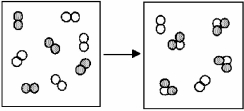 -What are the signs (+,or -)of ΔH,ΔS,and ΔG for this process?
 (Multiple Choice)
4.8/5 (86)
(86) For the reaction 3 C2H2(g)→ C6H6(l)at 25°C,the standard enthalpy change is -631 kJ and the standard entropy change is -430 J/K.Calculate the standard free energy change at 25°C.
(Multiple Choice)
4.8/5 (84)
(84) An ideal gas is expanded at constant temperature.What are the signs (+,-,or 0)of ΔH,ΔS,and ΔG for this system? 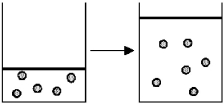
(Multiple Choice)
4.9/5 (66)
(66) Which substance has the highest standard molar entropy at 25°C?
(Multiple Choice)
4.9/5 (75)
(75) The standard free energy for a reaction is ΔG° = -33.0 kJ.At 25°C the equilibrium constant for this reaction,Kp = ________.
(Short Answer)
4.8/5 (71)
(71) 
Filters
- Essay(0)
- Multiple Choice(0)
- Short Answer(0)
- True False(0)
- Matching(0)